Event submissions
Published
This submission belongs to the session B. Nutritional and Functional Foods of the event The 6th International Electronic Conference on Foods
Published date
27 Oct, 2025
Academic Editor
'%3e%3cpath%20d='M12.6657%2010.9104C12.4185%2010.325%2012.0599%209.79327%2011.6097%209.34482C11.1609%208.89508%2010.6293%208.5365%2010.0442%208.28888C10.0389%208.28626%2010.0337%208.28495%2010.0285%208.28233C10.8446%207.69279%2011.3752%206.73249%2011.3752%205.64904C11.3752%203.8542%209.92103%202.39999%208.1262%202.39999C6.33136%202.39999%204.87715%203.8542%204.87715%205.64904C4.87715%206.73249%205.40774%207.69279%206.22393%208.28364C6.21869%208.28626%206.21345%208.28757%206.20821%208.29019C5.62129%208.5378%205.09463%208.89284%204.64265%209.34613C4.1929%209.79493%203.83432%2010.3266%203.58671%2010.9117C3.34345%2011.4845%203.21226%2012.0987%203.20023%2012.7209C3.19988%2012.7349%203.20233%2012.7488%203.20744%2012.7619C3.21255%2012.7749%203.22022%2012.7867%203.22998%2012.7968C3.23975%2012.8068%203.25142%2012.8147%203.26431%2012.8202C3.2772%2012.8256%203.29105%2012.8284%203.30504%2012.8284H4.09109C4.14874%2012.8284%204.19459%2012.7825%204.1959%2012.7262C4.2221%2011.7148%204.62823%2010.7676%205.34617%2010.0497C6.08899%209.30683%207.0755%208.89808%208.1262%208.89808C9.17689%208.89808%2010.1634%209.30683%2010.9062%2010.0497C11.6242%2010.7676%2012.0303%2011.7148%2012.0565%2012.7262C12.0578%2012.7838%2012.1037%2012.8284%2012.1613%2012.8284H12.9474C12.9613%2012.8284%2012.9752%2012.8256%2012.9881%2012.8202C13.001%2012.8147%2013.0126%2012.8068%2013.0224%2012.7968C13.0322%2012.7867%2013.0398%2012.7749%2013.0449%2012.7619C13.0501%2012.7488%2013.0525%2012.7349%2013.0522%2012.7209C13.0391%2012.0947%2012.9094%2011.4855%2012.6657%2010.9104ZM8.1262%207.9024C7.52486%207.9024%206.9589%207.6679%206.53312%207.24211C6.10733%206.81633%205.87283%206.25037%205.87283%205.64904C5.87283%205.0477%206.10733%204.48174%206.53312%204.05596C6.9589%203.63018%207.52486%203.39567%208.1262%203.39567C8.72753%203.39567%209.29349%203.63018%209.71927%204.05596C10.1451%204.48174%2010.3796%205.0477%2010.3796%205.64904C10.3796%206.25037%2010.1451%206.81633%209.71927%207.24211C9.29349%207.6679%208.72753%207.9024%208.1262%207.9024Z'%20fill='%235D1EE1'/%3e%3c/g%3e%3c/svg%3e) Antonello Santini
Antonello SantiniCitation
Jesica Blajman, Pierina Scarafia, María Estela Tarchini, Ariel Risso, Melisa Puntillo, Roxana Paez, Mariana Lingua, Investigating the role of probiotic lactic acid bacteria strains in improving the antioxidant properties of fermented white cabbage., in Proceedings of The 6th International Electronic Conference on Foods, 28 October–30 October 2025, MDPI: Basel, Switzerland
Share
Email
Facebook
Twitter
LinkedIn
Investigating the role of probiotic lactic acid bacteria strains in improving the antioxidant properties of fermented white cabbage.
'%3e%3cpath%20d='M12.6647%2010.9104C12.4176%2010.325%2012.0589%209.7933%2011.6088%209.34485C11.16%208.89511%2010.6283%208.53653%2010.0432%208.28891C10.038%208.28629%2010.0327%208.28498%2010.0275%208.28236C10.8437%207.69282%2011.3743%206.73252%2011.3743%205.64907C11.3743%203.85423%209.92005%202.40002%208.12522%202.40002C6.33038%202.40002%204.87618%203.85423%204.87618%205.64907C4.87618%206.73252%205.40677%207.69282%206.22296%208.28367C6.21772%208.28629%206.21248%208.2876%206.20724%208.29022C5.62031%208.53783%205.09365%208.89287%204.64167%209.34616C4.19192%209.79496%203.83334%2010.3266%203.58573%2010.9117C3.34247%2011.4846%203.21128%2012.0987%203.19925%2012.721C3.1989%2012.735%203.20135%2012.7489%203.20646%2012.7619C3.21157%2012.7749%203.21924%2012.7868%203.22901%2012.7968C3.23877%2012.8068%203.25045%2012.8148%203.26334%2012.8202C3.27623%2012.8256%203.29007%2012.8284%203.30406%2012.8284H4.09012C4.14776%2012.8284%204.19362%2012.7825%204.19493%2012.7262C4.22113%2011.7148%204.62726%2010.7676%205.34519%2010.0497C6.08802%209.30686%207.07452%208.89811%208.12522%208.89811C9.17592%208.89811%2010.1624%209.30686%2010.9052%2010.0497C11.6232%2010.7676%2012.0293%2011.7148%2012.0555%2012.7262C12.0568%2012.7839%2012.1027%2012.8284%2012.1603%2012.8284H12.9464C12.9604%2012.8284%2012.9742%2012.8256%2012.9871%2012.8202C13%2012.8148%2013.0117%2012.8068%2013.0214%2012.7968C13.0312%2012.7868%2013.0389%2012.7749%2013.044%2012.7619C13.0491%2012.7489%2013.0515%2012.735%2013.0512%2012.721C13.0381%2012.0947%2012.9084%2011.4856%2012.6647%2010.9104ZM8.12522%207.90243C7.52388%207.90243%206.95792%207.66793%206.53214%207.24215C6.10636%206.81636%205.87185%206.2504%205.87185%205.64907C5.87185%205.04773%206.10636%204.48177%206.53214%204.05599C6.95792%203.63021%207.52388%203.3957%208.12522%203.3957C8.72655%203.3957%209.29252%203.63021%209.7183%204.05599C10.1441%204.48177%2010.3786%205.04773%2010.3786%205.64907C10.3786%206.2504%2010.1441%206.81636%209.7183%207.24215C9.29252%207.66793%208.72655%207.90243%208.12522%207.90243Z'%20fill='%235D1EE1'/%3e%3c/g%3e%3c/svg%3e)
Jesica Blajman 1,2
Pierina Scarafia 2
María Estela Tarchini 2
Ariel Risso 1
Melisa Puntillo 3
Roxana Paez 1
Mariana Lingua 1
1. Instituto de Investigación de la Cadena Láctea (IdICaL, CONICET-INTA), Ruta 34 Km. 227, CP 2300 Rafaela, Santa Fe, Argentina.
2. Universidad Nacional de Rafaela, Bv. Presidente Julio A. Roca 989, CP 2300 Rafaela, Santa Fe, Argentina.
3. Instituto de Lactología Industrial (INLAIN, CONICET-UNL), Santiago del Estero 2829, CP 3000 Santa Fe, Argentina.
Abstract
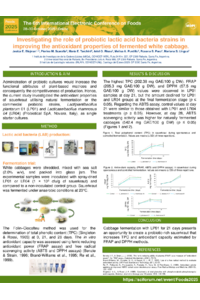
Administration of probiotic cultures would increase the functional attributes of plant-based matrices and consequently the competitiveness of production. Hence, the current study investigated the antioxidant properties of sauerkraut utilising natural fermentation or the commercial probiotic strains, Lactiplantibacillus plantarum 01 (LP01) and Lacticaseibacillus rhamnosus 04 (LR04) (Probiotical SpA, Novara, Italy), as single starter cultures.
White cabbages were shredded, mixed with sea salt (2.0% w/v), and packed into glass jars. The experimental samples were inoculated with spray-dried LP01 or LR04 (1 × 10⁶ cfu/g of sauerkraut) and compared to a non-inoculated control group. Sauerkraut was fermented under anaerobic conditions at 20°C. The Folin–Ciocalteu method was used for the determination of total phenolic content (TPC) at 0, 21, and 28 days. The in vitro antioxidant capacity was assessed using ferric reducing antioxidant power (FRAP assay) and free radical scavenging activity (ABTS and DPPH assays).
The highest TPC (202.38 mg GAE/100 g DW), FRAP (205.3 mg GAE/100 g DW), and DPPH (57.5 mg GAE/100 g DW) values were observed in LP01 samples at day 21, but the amount declined for LP01 and LR04 groups at the final fermentation stage (p ≤ 0.05). In this sense, excessive fermentation time may result in nutrient depletion, which can negatively affect the vitality of fermenting microorganisms and consequently the antioxidant activity. Regarding the ABTS assay, control values at day 21 were similar to those obtained with LP01 and LR04 treatments (p ≥ 0.05). However, at day 28, ABTS scavenging activity was higher for naturally fermented cabbages (542.4 mg GAE/100 g DW) (p ≤ 0.05).
In light of the growing consumer interest in vegetable-based functional foods, cabbage fermentation with LP01 for 21 days presents an opportunity to create a probiotic-rich sauerkraut that increases TPC and antioxidant activity estimated by FRAP and DPPH methods.
Keywords
Lactiplantibacillus plantarum
probiotic
cabbage fermentation
antioxidant properties.
Poster
Poster Foods Conference 2025 - TPC and AC.pdf
Tracing Strawberry Authenticity Using Isotope and Multielement Analysis
A new lease oflife for oat hulls—fermentation-based lifeline for disruptive food innovations