Event submissions
Published
This submission belongs to the session G. Food Biotechnology of the event The 6th International Electronic Conference on Foods
Published date
27 Oct, 2025
Academic Editor
'%3e%3cpath%20d='M12.6657%2010.9104C12.4185%2010.325%2012.0599%209.79327%2011.6097%209.34482C11.1609%208.89508%2010.6293%208.5365%2010.0442%208.28888C10.0389%208.28626%2010.0337%208.28495%2010.0285%208.28233C10.8446%207.69279%2011.3752%206.73249%2011.3752%205.64904C11.3752%203.8542%209.92103%202.39999%208.1262%202.39999C6.33136%202.39999%204.87715%203.8542%204.87715%205.64904C4.87715%206.73249%205.40774%207.69279%206.22393%208.28364C6.21869%208.28626%206.21345%208.28757%206.20821%208.29019C5.62129%208.5378%205.09463%208.89284%204.64265%209.34613C4.1929%209.79493%203.83432%2010.3266%203.58671%2010.9117C3.34345%2011.4845%203.21226%2012.0987%203.20023%2012.7209C3.19988%2012.7349%203.20233%2012.7488%203.20744%2012.7619C3.21255%2012.7749%203.22022%2012.7867%203.22998%2012.7968C3.23975%2012.8068%203.25142%2012.8147%203.26431%2012.8202C3.2772%2012.8256%203.29105%2012.8284%203.30504%2012.8284H4.09109C4.14874%2012.8284%204.19459%2012.7825%204.1959%2012.7262C4.2221%2011.7148%204.62823%2010.7676%205.34617%2010.0497C6.08899%209.30683%207.0755%208.89808%208.1262%208.89808C9.17689%208.89808%2010.1634%209.30683%2010.9062%2010.0497C11.6242%2010.7676%2012.0303%2011.7148%2012.0565%2012.7262C12.0578%2012.7838%2012.1037%2012.8284%2012.1613%2012.8284H12.9474C12.9613%2012.8284%2012.9752%2012.8256%2012.9881%2012.8202C13.001%2012.8147%2013.0126%2012.8068%2013.0224%2012.7968C13.0322%2012.7867%2013.0398%2012.7749%2013.0449%2012.7619C13.0501%2012.7488%2013.0525%2012.7349%2013.0522%2012.7209C13.0391%2012.0947%2012.9094%2011.4855%2012.6657%2010.9104ZM8.1262%207.9024C7.52486%207.9024%206.9589%207.6679%206.53312%207.24211C6.10733%206.81633%205.87283%206.25037%205.87283%205.64904C5.87283%205.0477%206.10733%204.48174%206.53312%204.05596C6.9589%203.63018%207.52486%203.39567%208.1262%203.39567C8.72753%203.39567%209.29349%203.63018%209.71927%204.05596C10.1451%204.48174%2010.3796%205.0477%2010.3796%205.64904C10.3796%206.25037%2010.1451%206.81633%209.71927%207.24211C9.29349%207.6679%208.72753%207.9024%208.1262%207.9024Z'%20fill='%235D1EE1'/%3e%3c/g%3e%3c/svg%3e) Yonghui Li
Yonghui LiCitation
Adriana Rodrigues Machado, Lorrane Soares dos Santos, Fernanda Teixeira de Sousa, Fabiano Guimarães Silva, Letícia Fleury Viana, Technology for obtaining mangaba nectar and its physicochemical characterization, in Proceedings of The 6th International Electronic Conference on Foods, 28 October–30 October 2025, MDPI: Basel, Switzerland
Share
Email
Facebook
Twitter
LinkedIn
Technology for obtaining mangaba nectar and its physicochemical characterization
'%3e%3cpath%20d='M12.6647%2010.9104C12.4176%2010.325%2012.0589%209.7933%2011.6088%209.34485C11.16%208.89511%2010.6283%208.53653%2010.0432%208.28891C10.038%208.28629%2010.0327%208.28498%2010.0275%208.28236C10.8437%207.69282%2011.3743%206.73252%2011.3743%205.64907C11.3743%203.85423%209.92005%202.40002%208.12522%202.40002C6.33038%202.40002%204.87618%203.85423%204.87618%205.64907C4.87618%206.73252%205.40677%207.69282%206.22296%208.28367C6.21772%208.28629%206.21248%208.2876%206.20724%208.29022C5.62031%208.53783%205.09365%208.89287%204.64167%209.34616C4.19192%209.79496%203.83334%2010.3266%203.58573%2010.9117C3.34247%2011.4846%203.21128%2012.0987%203.19925%2012.721C3.1989%2012.735%203.20135%2012.7489%203.20646%2012.7619C3.21157%2012.7749%203.21924%2012.7868%203.22901%2012.7968C3.23877%2012.8068%203.25045%2012.8148%203.26334%2012.8202C3.27623%2012.8256%203.29007%2012.8284%203.30406%2012.8284H4.09012C4.14776%2012.8284%204.19362%2012.7825%204.19493%2012.7262C4.22113%2011.7148%204.62726%2010.7676%205.34519%2010.0497C6.08802%209.30686%207.07452%208.89811%208.12522%208.89811C9.17592%208.89811%2010.1624%209.30686%2010.9052%2010.0497C11.6232%2010.7676%2012.0293%2011.7148%2012.0555%2012.7262C12.0568%2012.7839%2012.1027%2012.8284%2012.1603%2012.8284H12.9464C12.9604%2012.8284%2012.9742%2012.8256%2012.9871%2012.8202C13%2012.8148%2013.0117%2012.8068%2013.0214%2012.7968C13.0312%2012.7868%2013.0389%2012.7749%2013.044%2012.7619C13.0491%2012.7489%2013.0515%2012.735%2013.0512%2012.721C13.0381%2012.0947%2012.9084%2011.4856%2012.6647%2010.9104ZM8.12522%207.90243C7.52388%207.90243%206.95792%207.66793%206.53214%207.24215C6.10636%206.81636%205.87185%206.2504%205.87185%205.64907C5.87185%205.04773%206.10636%204.48177%206.53214%204.05599C6.95792%203.63021%207.52388%203.3957%208.12522%203.3957C8.72655%203.3957%209.29252%203.63021%209.7183%204.05599C10.1441%204.48177%2010.3786%205.04773%2010.3786%205.64907C10.3786%206.2504%2010.1441%206.81636%209.7183%207.24215C9.29252%207.66793%208.72655%207.90243%208.12522%207.90243Z'%20fill='%235D1EE1'/%3e%3c/g%3e%3c/svg%3e)
Adriana Rodrigues Machado 1
Lorrane Soares dos Santos 1
Fernanda Teixeira de Sousa 1
Fabiano Guimarães Silva 1
Letícia Fleury Viana 1
1. Department of Food Science, Goiano Federal Institute of Education, Science and Technology, Campus Rio Verde, Rodovia Sul Goiana, Km 01, Rio Verde 75901-970, GO, Brazil
Abstract
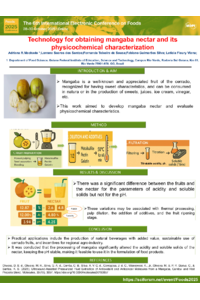
Mangaba is a well-known and appreciated fruit of the cerrado, recognized for having sweet characteristics, and can be consumed in natura or in the production of sweets, juices, ice cream, vinegar, etc. This work aimed to develop mangaba nectar (October 2017 harvest) and evaluate physicochemical characteristics. The mangaba was pulped manually, and its seeds were separated and then taken to the blender for homogenization. The pulp was diluted in water 1:2 (pulp–water), metabisulfite, pectin, and gelatin (50°C for 60 minutes), respectively, immediately after filtering until nectar was obtained. For the fruits and nectar, the following parameters were analyzed in triplicate: titratable acidity, pH, and soluble solids. The pH was determined by direct reading in a potentiometer; titratable acidity was determined by means of titrology with a standardized solution of sodium hydroxide at 0.1N, having, as an indicator, the turning point of phenolphthalein. The values were expressed as percentages of soluble solids (° Brix) through adigital refractometer. The values found for mangaba were 12.87 ± 0.00 ° Brix, 12 ± 0.00%, and 3.94 ± 0.005 for soluble solids, acidity, and pH, respectively. For nectar, the values found were 2.6 ± 0.00 ° Brix, 4.8 ± 0.00 %, and 4.25 ± 0.01 for soluble solids, acidity, and pH, respectively. There was a significant difference between the fruits and the nectar for the parameters of acidity and soluble solids but not for the pH. These variations may be associated with thermal processing, pulp dilution, the addition of additives, and the fruit ripening stage. Additional sensory evaluation data revealed that the nectar was well accepted in terms of flavor, aroma, and appearance, suggesting potential for commercial consumption. Practical applications include the production of natural beverages with added value, sustainable use of cerrado fruits, and incentives for regional agro-industry. It was concluded that the processing of mangaba significantly altered the acidity and soluble solids of the nectar, keeping the pH stable, making it feasible to use it in the formulation of food products.
Keywords
Hancornia speciosa
fruit
analyses.
Poster
Technology for obtaining mangaba n.....FOODS.pdf
Development of a Plant-Based Milk from Local Ancient Oat Varieties: Optimized Processing and Sustainable Formulation
Systematic Review of Food Safety Training outcomes among food handlers across diverse food service settings