Event submissions
Published
This submission belongs to the session H. Foods as Medicine of the event The 6th International Electronic Conference on Foods
Published date
27 Oct, 2025
Academic Editor
'%3e%3cpath%20d='M12.6657%2010.9104C12.4185%2010.325%2012.0599%209.79327%2011.6097%209.34482C11.1609%208.89508%2010.6293%208.5365%2010.0442%208.28888C10.0389%208.28626%2010.0337%208.28495%2010.0285%208.28233C10.8446%207.69279%2011.3752%206.73249%2011.3752%205.64904C11.3752%203.8542%209.92103%202.39999%208.1262%202.39999C6.33136%202.39999%204.87715%203.8542%204.87715%205.64904C4.87715%206.73249%205.40774%207.69279%206.22393%208.28364C6.21869%208.28626%206.21345%208.28757%206.20821%208.29019C5.62129%208.5378%205.09463%208.89284%204.64265%209.34613C4.1929%209.79493%203.83432%2010.3266%203.58671%2010.9117C3.34345%2011.4845%203.21226%2012.0987%203.20023%2012.7209C3.19988%2012.7349%203.20233%2012.7488%203.20744%2012.7619C3.21255%2012.7749%203.22022%2012.7867%203.22998%2012.7968C3.23975%2012.8068%203.25142%2012.8147%203.26431%2012.8202C3.2772%2012.8256%203.29105%2012.8284%203.30504%2012.8284H4.09109C4.14874%2012.8284%204.19459%2012.7825%204.1959%2012.7262C4.2221%2011.7148%204.62823%2010.7676%205.34617%2010.0497C6.08899%209.30683%207.0755%208.89808%208.1262%208.89808C9.17689%208.89808%2010.1634%209.30683%2010.9062%2010.0497C11.6242%2010.7676%2012.0303%2011.7148%2012.0565%2012.7262C12.0578%2012.7838%2012.1037%2012.8284%2012.1613%2012.8284H12.9474C12.9613%2012.8284%2012.9752%2012.8256%2012.9881%2012.8202C13.001%2012.8147%2013.0126%2012.8068%2013.0224%2012.7968C13.0322%2012.7867%2013.0398%2012.7749%2013.0449%2012.7619C13.0501%2012.7488%2013.0525%2012.7349%2013.0522%2012.7209C13.0391%2012.0947%2012.9094%2011.4855%2012.6657%2010.9104ZM8.1262%207.9024C7.52486%207.9024%206.9589%207.6679%206.53312%207.24211C6.10733%206.81633%205.87283%206.25037%205.87283%205.64904C5.87283%205.0477%206.10733%204.48174%206.53312%204.05596C6.9589%203.63018%207.52486%203.39567%208.1262%203.39567C8.72753%203.39567%209.29349%203.63018%209.71927%204.05596C10.1451%204.48174%2010.3796%205.0477%2010.3796%205.64904C10.3796%206.25037%2010.1451%206.81633%209.71927%207.24211C9.29349%207.6679%208.72753%207.9024%208.1262%207.9024Z'%20fill='%235D1EE1'/%3e%3c/g%3e%3c/svg%3e) Antonello Santini
Antonello SantiniCitation
Giorgi Goderdzishvili, Mark Jones, Abhishek Tippa, Krishna Madappa, Srinivasan Vithoba, Harsha Marle Krishna, Petr Kačer, Piezoelectrically Treated Water: Structural Modifications and Implications for Hydration, Nutrition, and Food Quality, in Proceedings of The 6th International Electronic Conference on Foods, 28 October–30 October 2025, MDPI: Basel, Switzerland
Share
Email
Facebook
Twitter
LinkedIn
Piezoelectrically Treated Water: Structural Modifications and Implications for Hydration, Nutrition, and Food Quality

Giorgi Goderdzishvili 1
'%3e%3cpath%20d='M12.6647%2010.9104C12.4176%2010.325%2012.0589%209.7933%2011.6088%209.34485C11.16%208.89511%2010.6283%208.53653%2010.0432%208.28891C10.038%208.28629%2010.0327%208.28498%2010.0275%208.28236C10.8437%207.69282%2011.3743%206.73252%2011.3743%205.64907C11.3743%203.85423%209.92005%202.40002%208.12522%202.40002C6.33038%202.40002%204.87618%203.85423%204.87618%205.64907C4.87618%206.73252%205.40677%207.69282%206.22296%208.28367C6.21772%208.28629%206.21248%208.2876%206.20724%208.29022C5.62031%208.53783%205.09365%208.89287%204.64167%209.34616C4.19192%209.79496%203.83334%2010.3266%203.58573%2010.9117C3.34247%2011.4846%203.21128%2012.0987%203.19925%2012.721C3.1989%2012.735%203.20135%2012.7489%203.20646%2012.7619C3.21157%2012.7749%203.21924%2012.7868%203.22901%2012.7968C3.23877%2012.8068%203.25045%2012.8148%203.26334%2012.8202C3.27623%2012.8256%203.29007%2012.8284%203.30406%2012.8284H4.09012C4.14776%2012.8284%204.19362%2012.7825%204.19493%2012.7262C4.22113%2011.7148%204.62726%2010.7676%205.34519%2010.0497C6.08802%209.30686%207.07452%208.89811%208.12522%208.89811C9.17592%208.89811%2010.1624%209.30686%2010.9052%2010.0497C11.6232%2010.7676%2012.0293%2011.7148%2012.0555%2012.7262C12.0568%2012.7839%2012.1027%2012.8284%2012.1603%2012.8284H12.9464C12.9604%2012.8284%2012.9742%2012.8256%2012.9871%2012.8202C13%2012.8148%2013.0117%2012.8068%2013.0214%2012.7968C13.0312%2012.7868%2013.0389%2012.7749%2013.044%2012.7619C13.0491%2012.7489%2013.0515%2012.735%2013.0512%2012.721C13.0381%2012.0947%2012.9084%2011.4856%2012.6647%2010.9104ZM8.12522%207.90243C7.52388%207.90243%206.95792%207.66793%206.53214%207.24215C6.10636%206.81636%205.87185%206.2504%205.87185%205.64907C5.87185%205.04773%206.10636%204.48177%206.53214%204.05599C6.95792%203.63021%207.52388%203.3957%208.12522%203.3957C8.72655%203.3957%209.29252%203.63021%209.7183%204.05599C10.1441%204.48177%2010.3786%205.04773%2010.3786%205.64907C10.3786%206.2504%2010.1441%206.81636%209.7183%207.24215C9.29252%207.66793%208.72655%207.90243%208.12522%207.90243Z'%20fill='%235D1EE1'/%3e%3c/g%3e%3c/svg%3e)
Mark Jones 1
Abhishek Tippa 2
Krishna Madappa 2
Srinivasan Vithoba 2
Harsha Marle Krishna 2
Petr Kačer 1
1. Czech University of Life Sciences Prague Department Of Chemistry Kamýcká 129 165 00 Praha - Suchdol, Czech Republic
2. 4th Phase Water Technologies Pvt Ltd - Jiva Water, Bengaluru, Karnataka, 560070, India
Abstract
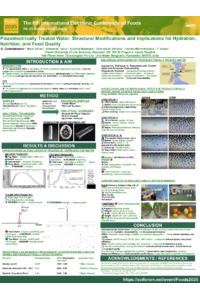
Hydrogen bonding plays a fundamental role in defining the functional behavior of water, particularly in biological, agricultural, and food systems. This study investigates the structural modifications induced in water by piezoelectric treatment, wherein pressurized water passes through piezoelectric materials, generating mechanical stress that alters its hydrogen bonding network. Specifically, this treatment results in shortened hydrogen bond lengths and enhanced molecular organization. A multidisciplinary analytical approach was employed to characterize these changes. Fourier Transform Infrared (FTIR) and Near-Infrared (NIR) spectroscopy revealed redshifts in OH-stretching bands (~20–35 cm⁻¹), indicating restructured hydrogen bonding. ¹H Nuclear Magnetic Resonance (NMR) detected upfield shifts of ~0.03 ppm, suggesting changes in proton environments. Density measurements via pycnometry showed a ~0.4% increase, while surface tension and viscosity decreased by 6.7% and 5.2%, respectively. Molecular dynamics simulations confirmed a ~9% increase in hydrogen bond density, supporting a more compact and ordered molecular structure. These structural changes have tangible implications. In C. elegans, piezoelectrically treated water (PTW) increased hydration efficiency by 17%. In tomato plants, PTW irrigation led to a 23% increase in biomass and enhanced nitrate uptake. In brewing applications, PTW reduced equipment scaling by 41%, intensified aroma through an 18% increase in volatile esters, and altered carbonation dynamics, yielding smoother sensory profiles. Furthermore, the presence of 50–100 ppm dissolved salts further modulated hydrogen bonding, offering a mechanism to tailor PTW properties for specific applications. Collectively, these findings position PTW as a novel functional medium with broad relevance across hydration, nutrition, and food quality domains. This research not only advances our understanding of water’s molecular behaviour under piezoelectric influence, but also reveals new possibilities for its targeted use in biological and industrial systems.
Keywords
Piezoelectric effect
hydrogen bonding
hydration
food processing
brewing
functional water
agricultural efficiency
water structure.
Poster
(MDPI) PIEZO WATER G.G.pdf
Multifunctional Bioactivities of Avocado, Hedge Mustard, and Fireweed Seed Oils: From Inflammation Modulation to Enzyme Inhibition
ANTINFLAMMATORY AND PROTECTIVE PROPERTIES OF BROMELAIN AND PHYTOSTEROLS IN AN EX VIVO PROSTATITIS MODEL