Event submissions
Published
This submission belongs to the session C. Food Quality and Safety of the event The 6th International Electronic Conference on Foods
Published date
27 Oct, 2025
Academic Editor
'%3e%3cpath%20d='M12.6657%2010.9104C12.4185%2010.325%2012.0599%209.79327%2011.6097%209.34482C11.1609%208.89508%2010.6293%208.5365%2010.0442%208.28888C10.0389%208.28626%2010.0337%208.28495%2010.0285%208.28233C10.8446%207.69279%2011.3752%206.73249%2011.3752%205.64904C11.3752%203.8542%209.92103%202.39999%208.1262%202.39999C6.33136%202.39999%204.87715%203.8542%204.87715%205.64904C4.87715%206.73249%205.40774%207.69279%206.22393%208.28364C6.21869%208.28626%206.21345%208.28757%206.20821%208.29019C5.62129%208.5378%205.09463%208.89284%204.64265%209.34613C4.1929%209.79493%203.83432%2010.3266%203.58671%2010.9117C3.34345%2011.4845%203.21226%2012.0987%203.20023%2012.7209C3.19988%2012.7349%203.20233%2012.7488%203.20744%2012.7619C3.21255%2012.7749%203.22022%2012.7867%203.22998%2012.7968C3.23975%2012.8068%203.25142%2012.8147%203.26431%2012.8202C3.2772%2012.8256%203.29105%2012.8284%203.30504%2012.8284H4.09109C4.14874%2012.8284%204.19459%2012.7825%204.1959%2012.7262C4.2221%2011.7148%204.62823%2010.7676%205.34617%2010.0497C6.08899%209.30683%207.0755%208.89808%208.1262%208.89808C9.17689%208.89808%2010.1634%209.30683%2010.9062%2010.0497C11.6242%2010.7676%2012.0303%2011.7148%2012.0565%2012.7262C12.0578%2012.7838%2012.1037%2012.8284%2012.1613%2012.8284H12.9474C12.9613%2012.8284%2012.9752%2012.8256%2012.9881%2012.8202C13.001%2012.8147%2013.0126%2012.8068%2013.0224%2012.7968C13.0322%2012.7867%2013.0398%2012.7749%2013.0449%2012.7619C13.0501%2012.7488%2013.0525%2012.7349%2013.0522%2012.7209C13.0391%2012.0947%2012.9094%2011.4855%2012.6657%2010.9104ZM8.1262%207.9024C7.52486%207.9024%206.9589%207.6679%206.53312%207.24211C6.10733%206.81633%205.87283%206.25037%205.87283%205.64904C5.87283%205.0477%206.10733%204.48174%206.53312%204.05596C6.9589%203.63018%207.52486%203.39567%208.1262%203.39567C8.72753%203.39567%209.29349%203.63018%209.71927%204.05596C10.1451%204.48174%2010.3796%205.0477%2010.3796%205.64904C10.3796%206.25037%2010.1451%206.81633%209.71927%207.24211C9.29349%207.6679%208.72753%207.9024%208.1262%207.9024Z'%20fill='%235D1EE1'/%3e%3c/g%3e%3c/svg%3e) Susana Casal
Susana CasalCitation
Bárbara Kornin Gabardo, Giovana Scuissiatto de Souza, Elisana Julek, Maria Rosa Aparecida Nunes de Oliveira, Julia Unicki Philipp, Guilherme Souza Cavalcanti de Albuquerque, Julia Arantes Galvão, Hygiene and sanitary conditions in an organic layer farm from Piraquara-PR, Brazil, in Proceedings of The 6th International Electronic Conference on Foods, 28 October–30 October 2025, MDPI: Basel, Switzerland
Share
Email
Facebook
Twitter
LinkedIn
Hygiene and sanitary conditions in an organic layer farm from Piraquara-PR, Brazil
'%3e%3cpath%20d='M12.6647%2010.9104C12.4176%2010.325%2012.0589%209.7933%2011.6088%209.34485C11.16%208.89511%2010.6283%208.53653%2010.0432%208.28891C10.038%208.28629%2010.0327%208.28498%2010.0275%208.28236C10.8437%207.69282%2011.3743%206.73252%2011.3743%205.64907C11.3743%203.85423%209.92005%202.40002%208.12522%202.40002C6.33038%202.40002%204.87618%203.85423%204.87618%205.64907C4.87618%206.73252%205.40677%207.69282%206.22296%208.28367C6.21772%208.28629%206.21248%208.2876%206.20724%208.29022C5.62031%208.53783%205.09365%208.89287%204.64167%209.34616C4.19192%209.79496%203.83334%2010.3266%203.58573%2010.9117C3.34247%2011.4846%203.21128%2012.0987%203.19925%2012.721C3.1989%2012.735%203.20135%2012.7489%203.20646%2012.7619C3.21157%2012.7749%203.21924%2012.7868%203.22901%2012.7968C3.23877%2012.8068%203.25045%2012.8148%203.26334%2012.8202C3.27623%2012.8256%203.29007%2012.8284%203.30406%2012.8284H4.09012C4.14776%2012.8284%204.19362%2012.7825%204.19493%2012.7262C4.22113%2011.7148%204.62726%2010.7676%205.34519%2010.0497C6.08802%209.30686%207.07452%208.89811%208.12522%208.89811C9.17592%208.89811%2010.1624%209.30686%2010.9052%2010.0497C11.6232%2010.7676%2012.0293%2011.7148%2012.0555%2012.7262C12.0568%2012.7839%2012.1027%2012.8284%2012.1603%2012.8284H12.9464C12.9604%2012.8284%2012.9742%2012.8256%2012.9871%2012.8202C13%2012.8148%2013.0117%2012.8068%2013.0214%2012.7968C13.0312%2012.7868%2013.0389%2012.7749%2013.044%2012.7619C13.0491%2012.7489%2013.0515%2012.735%2013.0512%2012.721C13.0381%2012.0947%2012.9084%2011.4856%2012.6647%2010.9104ZM8.12522%207.90243C7.52388%207.90243%206.95792%207.66793%206.53214%207.24215C6.10636%206.81636%205.87185%206.2504%205.87185%205.64907C5.87185%205.04773%206.10636%204.48177%206.53214%204.05599C6.95792%203.63021%207.52388%203.3957%208.12522%203.3957C8.72655%203.3957%209.29252%203.63021%209.7183%204.05599C10.1441%204.48177%2010.3786%205.04773%2010.3786%205.64907C10.3786%206.2504%2010.1441%206.81636%209.7183%207.24215C9.29252%207.66793%208.72655%207.90243%208.12522%207.90243Z'%20fill='%235D1EE1'/%3e%3c/g%3e%3c/svg%3e)
Bárbara Kornin Gabardo 1
Giovana Scuissiatto de Souza 1,2
Elisana Julek 1,2
Maria Rosa Aparecida Nunes de Oliveira 1,2
Julia Unicki Philipp 1
Guilherme Souza Cavalcanti de Albuquerque 3

Julia Arantes Galvão 1,4
1. Department of Veterinary Medicine, Agrarian Sciences Sector, Universidade Federal do Paraná (UFPR), Curitiba, 82520-690, Brazil
2. Post-Graduation Program in Veterinary Sciences, Veterinary Department, Campus Cabral, Federal University of Parana, Curitiba 80035-050, PR, Brazil
3. Federal University of Parana, Curitiba/Paraná, 80035-050, PR, Brazil
4. Department of Veterinary Medicine, Federal University of Paraná (UFPR), Curitiba, 82520-690, Brazil
Abstract
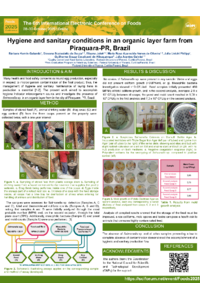
Many health and food safety concerns surround egg production, especially in respect to microorganism contamination of the final product; thus, the management of hygiene and sanitary maintenance of laying hens in production is essential. The present work aimed to accomplish hygiene indicator microorganism counts and investigate the presence of Salmonella sp. in an organic layer farm in the city of Piraquara, PR, Brazil. Samples of stored feed (A), animal drinking water (B), drag swab (C) and egg content (D) from the three coops present on the property were collected twice, with a one-year interval. The samples were assessed for Salmonella sp. detection (Samples A, C and D), total and thermotolerant coliform counts (Samples A, B and D), noting that samples A and D were initially analyzed through the most probable number (MPN) and, on the second occasion, through the total plate count (TPC). Additionally, mesophilic bacteria (Sample B) and yeast and mold counts (Sample A) were also performed. No strains of Salmonella sp. were present in any sample. Water and eggs did not present coliform growth (<3MPN/ml or g). Mesophilic bacteria investigation showed <10 CFU/ml. Feed samples initially presented 460 MPN/g of total coliform growth, and in the second analysis, averaged 2,8 x 10³ CFU/g between all coops; the yeast and mold count resulted in 9,00 x 10⁴ CFU/g in the first analysis and 7,0 x 10⁴ CFU/g on the second analysis. Analysis of compiled results showed that the storage of the feed must be improved, since coliforms, mold spores and toxins can pose a health risk to animals that consume highly contaminated feed. The absence of Salmonella sp. and all other samples presenting a low to complete absence of contamination demonstrated the accomplishment of a hygienic and sanitary production flow.
Keywords
Organic Eggs
Aviculture
Contamination
Poster
Foods Poster revision.pdf
Development of NanoBoost Bar: A Moringa-Powered Calcium-Rich nutribar for Enhanced Nutritional Supplementation
Isopropyl cinnamate prolongs the lifespan of C. elegans, promising functional foods