Event submissions
Published
This submission belongs to the session B. Nutritional and Functional Foods of the event The 6th International Electronic Conference on Foods
Published date
27 Oct, 2025
Academic Editor
'%3e%3cpath%20d='M12.6657%2010.9104C12.4185%2010.325%2012.0599%209.79327%2011.6097%209.34482C11.1609%208.89508%2010.6293%208.5365%2010.0442%208.28888C10.0389%208.28626%2010.0337%208.28495%2010.0285%208.28233C10.8446%207.69279%2011.3752%206.73249%2011.3752%205.64904C11.3752%203.8542%209.92103%202.39999%208.1262%202.39999C6.33136%202.39999%204.87715%203.8542%204.87715%205.64904C4.87715%206.73249%205.40774%207.69279%206.22393%208.28364C6.21869%208.28626%206.21345%208.28757%206.20821%208.29019C5.62129%208.5378%205.09463%208.89284%204.64265%209.34613C4.1929%209.79493%203.83432%2010.3266%203.58671%2010.9117C3.34345%2011.4845%203.21226%2012.0987%203.20023%2012.7209C3.19988%2012.7349%203.20233%2012.7488%203.20744%2012.7619C3.21255%2012.7749%203.22022%2012.7867%203.22998%2012.7968C3.23975%2012.8068%203.25142%2012.8147%203.26431%2012.8202C3.2772%2012.8256%203.29105%2012.8284%203.30504%2012.8284H4.09109C4.14874%2012.8284%204.19459%2012.7825%204.1959%2012.7262C4.2221%2011.7148%204.62823%2010.7676%205.34617%2010.0497C6.08899%209.30683%207.0755%208.89808%208.1262%208.89808C9.17689%208.89808%2010.1634%209.30683%2010.9062%2010.0497C11.6242%2010.7676%2012.0303%2011.7148%2012.0565%2012.7262C12.0578%2012.7838%2012.1037%2012.8284%2012.1613%2012.8284H12.9474C12.9613%2012.8284%2012.9752%2012.8256%2012.9881%2012.8202C13.001%2012.8147%2013.0126%2012.8068%2013.0224%2012.7968C13.0322%2012.7867%2013.0398%2012.7749%2013.0449%2012.7619C13.0501%2012.7488%2013.0525%2012.7349%2013.0522%2012.7209C13.0391%2012.0947%2012.9094%2011.4855%2012.6657%2010.9104ZM8.1262%207.9024C7.52486%207.9024%206.9589%207.6679%206.53312%207.24211C6.10733%206.81633%205.87283%206.25037%205.87283%205.64904C5.87283%205.0477%206.10733%204.48174%206.53312%204.05596C6.9589%203.63018%207.52486%203.39567%208.1262%203.39567C8.72753%203.39567%209.29349%203.63018%209.71927%204.05596C10.1451%204.48174%2010.3796%205.0477%2010.3796%205.64904C10.3796%206.25037%2010.1451%206.81633%209.71927%207.24211C9.29349%207.6679%208.72753%207.9024%208.1262%207.9024Z'%20fill='%235D1EE1'/%3e%3c/g%3e%3c/svg%3e) Manuel Viuda-Martos
Manuel Viuda-MartosCitation
Lara Borim, Olga Luisa Tavano, Antioxidant Peptides Released by the Simulated Digestion of a Novel Chickpea Genotype (GB Cappuccino): A First Insight, in Proceedings of The 6th International Electronic Conference on Foods, 28 October–30 October 2025, MDPI: Basel, Switzerland
Share
Email
Facebook
Twitter
LinkedIn
Antioxidant Peptides Released by the Simulated Digestion of a Novel Chickpea Genotype (GB Cappuccino): A First Insight

Lara Borim 1

Olga Luisa Tavano 1
1. Federal University of Alfenas, Alfenas, 37130-001, Brazil
Abstract
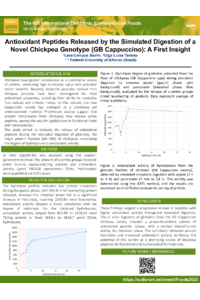
Chickpeas have gained prominence as a sustainable source of protein, combining high nutritional value with potential health benefits. Recently, bioactive peptides derived from chickpea proteins have been investigated for their antioxidant properties, including their ability to neutralize free radicals and chelate metals. In this context, the new Cappuccino variety has emerged as a promising yet underexplored material. Preliminary studies suggest that protein hydrolysates from chickpeas may release active peptides, paving the way for applications in functional foods and nutraceuticals.
This study aimed to evaluate the release of antioxidant peptides during the simulated digestion of globulins, the major protein fraction (60–70%) of chickpeas, correlating the degree of hydrolysis with antioxidant activity. In vitro digestibility was assessed using the pepsin–pancreatin method. The amount of α-amino groups released (nmol leucine equivalents/mg protein) and antioxidant activity (µmol TROLOX equivalents—TE/mL hydrolysate) were quantified via ABTS assay.
The hydrolysis profiles indicated low protein breakdown during the gastric phase (point A), with 596.8 nmol leucine/mg protein released, whereas the intestinal phase (point C) led to a significant increase in hydrolysis, reaching 1650.83 nmol leucine/mg. Antioxidant activity showed a direct correlation with the degree of hydrolysis. For the obtained hydrolysates, antioxidant activity ranged from 854.99 to 1378.35 nmol TE/mg protein or from 2858.4 to 4838.7 µmol TE/mL hydrolysate.
These findings suggest a progressive release of peptides with higher antioxidant activity throughout simulated digestion. The in vitro digestion of globulins from the GB Cappuccino chickpea variety revealed a phase-dependent pattern of antioxidant peptide release, with a marked intensification during the intestinal phase. The correlation between protein hydrolysis and increased antioxidant activity reinforces the potential of this variety as a promising source of bioactive peptides for functional and nutraceutical formulations.
Keywords
Chickpea protein hydrolysates
Bioactive peptides
Antioxidant activity
Simulated digestion
Functional foods
Poster
Poster Lara Borim.pdf
Capsaicin enhances hypothermia tolerance and accelerates recovery from hypothermic shock
Grape Antioxidant Dietary Fibre Induces Anti-Proliferative Response in Healthy Colon via Cell Cycle Arrest