Event submissions
Published
This submission belongs to the session B. Nutritional and Functional Foods of the event The 6th International Electronic Conference on Foods
Published date
27 Oct, 2025
Academic Editor
'%3e%3cpath%20d='M12.6657%2010.9104C12.4185%2010.325%2012.0599%209.79327%2011.6097%209.34482C11.1609%208.89508%2010.6293%208.5365%2010.0442%208.28888C10.0389%208.28626%2010.0337%208.28495%2010.0285%208.28233C10.8446%207.69279%2011.3752%206.73249%2011.3752%205.64904C11.3752%203.8542%209.92103%202.39999%208.1262%202.39999C6.33136%202.39999%204.87715%203.8542%204.87715%205.64904C4.87715%206.73249%205.40774%207.69279%206.22393%208.28364C6.21869%208.28626%206.21345%208.28757%206.20821%208.29019C5.62129%208.5378%205.09463%208.89284%204.64265%209.34613C4.1929%209.79493%203.83432%2010.3266%203.58671%2010.9117C3.34345%2011.4845%203.21226%2012.0987%203.20023%2012.7209C3.19988%2012.7349%203.20233%2012.7488%203.20744%2012.7619C3.21255%2012.7749%203.22022%2012.7867%203.22998%2012.7968C3.23975%2012.8068%203.25142%2012.8147%203.26431%2012.8202C3.2772%2012.8256%203.29105%2012.8284%203.30504%2012.8284H4.09109C4.14874%2012.8284%204.19459%2012.7825%204.1959%2012.7262C4.2221%2011.7148%204.62823%2010.7676%205.34617%2010.0497C6.08899%209.30683%207.0755%208.89808%208.1262%208.89808C9.17689%208.89808%2010.1634%209.30683%2010.9062%2010.0497C11.6242%2010.7676%2012.0303%2011.7148%2012.0565%2012.7262C12.0578%2012.7838%2012.1037%2012.8284%2012.1613%2012.8284H12.9474C12.9613%2012.8284%2012.9752%2012.8256%2012.9881%2012.8202C13.001%2012.8147%2013.0126%2012.8068%2013.0224%2012.7968C13.0322%2012.7867%2013.0398%2012.7749%2013.0449%2012.7619C13.0501%2012.7488%2013.0525%2012.7349%2013.0522%2012.7209C13.0391%2012.0947%2012.9094%2011.4855%2012.6657%2010.9104ZM8.1262%207.9024C7.52486%207.9024%206.9589%207.6679%206.53312%207.24211C6.10733%206.81633%205.87283%206.25037%205.87283%205.64904C5.87283%205.0477%206.10733%204.48174%206.53312%204.05596C6.9589%203.63018%207.52486%203.39567%208.1262%203.39567C8.72753%203.39567%209.29349%203.63018%209.71927%204.05596C10.1451%204.48174%2010.3796%205.0477%2010.3796%205.64904C10.3796%206.25037%2010.1451%206.81633%209.71927%207.24211C9.29349%207.6679%208.72753%207.9024%208.1262%207.9024Z'%20fill='%235D1EE1'/%3e%3c/g%3e%3c/svg%3e) Manuel Viuda-Martos
Manuel Viuda-MartosCitation
Beata Stasiewicz, The profile of metabolites of ellagitannins in the context of insomnia occurrence in peri- and postmenopausal women: A preliminary cross-sectional study, in Proceedings of The 6th International Electronic Conference on Foods, 28 October–30 October 2025, MDPI: Basel, Switzerland
Share
Email
Facebook
Twitter
LinkedIn
The profile of metabolites of ellagitannins in the context of insomnia occurrence in peri- and postmenopausal women: A preliminary cross-sectional study

Beata Stasiewicz 1
1. Department of Human Nutrition, The Faculty of Food Science, University of Warmia and Mazury in Olsztyn, Sloneczna 45f, 10-718 Olsztyn, Poland
Abstract
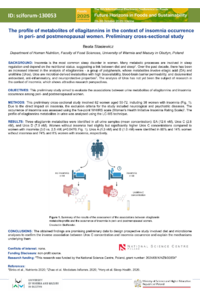
Introduction: Insomnia is the most common sleep disorder in women. Many metabolic processes are involved in sleep regulation and depend on nutritional status, suggesting a link between diet and sleep1. Over the past decade, there has been increased interest in the analysis of ellagitannins—a group of polyphenols whose metabolites involve ellagic acid (EA) and urolithins (Uros). Uros are microbial-derived metabolites with high bioavailability, blood–brain barrier permeability, and documented antioxidant, anti-inflammatory, and neuroprotective properties2. However, Uros have not yet been analysed in the context of insomnia. This preliminary study will aim to evaluate the associations between urine metabolites of ellagitannins and insomnia occurrence among peri- and postmenopausal women.
Methods: This preliminary cross-sectional study involved 80 women aged 50–70, including 38 women with insomnia. Due to the direct impact on insomnia, the exclusion criteria for the study included neurological and psychiatric diseases. The occurrence of insomnia was assessed using the five-point WHIIRS scale (Women's Health Initiative Insomnia Rating Scale)3. The profile of ellagitannins metabolites in urine was analysed using the LC-MS technique.
Results: Three ellagitannin metabolites were identified in all urine samples (mean concentration): EA (12.6 nM), Uros C (2.8 nM), and Uros D (7.9 nM). Women without insomnia had slightly but significantly higher Uros C concentrations compared to women with insomnia (3.0 vs. 2.5 nM; p=0.0470). Uros A (1.3 nM) and B (1.0 nM) were identified in 80% and 14% women without insomnia and 74% and 8% women with insomnia, respectively.
Conclusions: The obtained findings provide promising preliminary data to design prospective studies involving diet and microbiome analyses to confirm the inverse association between Uros C concentration and insomnia occurrence and explain the mechanisms underlying them.
Research funding: This research was funded by the National Science Centre, Poland, grant number: 2024/08/X/NZ9/00854.
References: 1Binks et al., Nutrients 2020; 2Zhao et al. Mediators Inflamm. 2020; 3Hery et al. Sleep Health. 2020.
Keywords
ellagitannins
metabolites
urolithins
insomnia
sleep quality
women
menopause
Poster
StasiewiczB_FOODS conference online_10_2025_poster_sciforum ID-130053.pdf
Identification of Key Targets and Pathways Modulated by Dietary Isothiocyanate Erucin in Gastric Cancer: A Bioinformatics Approach with Experimental Validation
Immunomodulatory potential of probiotic bacteria: implications for human and animal health