Event submissions
Published
This submission belongs to the session B. Nutritional and Functional Foods of the event The 6th International Electronic Conference on Foods
Published date
27 Oct, 2025
Academic Editor
'%3e%3cpath%20d='M12.6657%2010.9104C12.4185%2010.325%2012.0599%209.79327%2011.6097%209.34482C11.1609%208.89508%2010.6293%208.5365%2010.0442%208.28888C10.0389%208.28626%2010.0337%208.28495%2010.0285%208.28233C10.8446%207.69279%2011.3752%206.73249%2011.3752%205.64904C11.3752%203.8542%209.92103%202.39999%208.1262%202.39999C6.33136%202.39999%204.87715%203.8542%204.87715%205.64904C4.87715%206.73249%205.40774%207.69279%206.22393%208.28364C6.21869%208.28626%206.21345%208.28757%206.20821%208.29019C5.62129%208.5378%205.09463%208.89284%204.64265%209.34613C4.1929%209.79493%203.83432%2010.3266%203.58671%2010.9117C3.34345%2011.4845%203.21226%2012.0987%203.20023%2012.7209C3.19988%2012.7349%203.20233%2012.7488%203.20744%2012.7619C3.21255%2012.7749%203.22022%2012.7867%203.22998%2012.7968C3.23975%2012.8068%203.25142%2012.8147%203.26431%2012.8202C3.2772%2012.8256%203.29105%2012.8284%203.30504%2012.8284H4.09109C4.14874%2012.8284%204.19459%2012.7825%204.1959%2012.7262C4.2221%2011.7148%204.62823%2010.7676%205.34617%2010.0497C6.08899%209.30683%207.0755%208.89808%208.1262%208.89808C9.17689%208.89808%2010.1634%209.30683%2010.9062%2010.0497C11.6242%2010.7676%2012.0303%2011.7148%2012.0565%2012.7262C12.0578%2012.7838%2012.1037%2012.8284%2012.1613%2012.8284H12.9474C12.9613%2012.8284%2012.9752%2012.8256%2012.9881%2012.8202C13.001%2012.8147%2013.0126%2012.8068%2013.0224%2012.7968C13.0322%2012.7867%2013.0398%2012.7749%2013.0449%2012.7619C13.0501%2012.7488%2013.0525%2012.7349%2013.0522%2012.7209C13.0391%2012.0947%2012.9094%2011.4855%2012.6657%2010.9104ZM8.1262%207.9024C7.52486%207.9024%206.9589%207.6679%206.53312%207.24211C6.10733%206.81633%205.87283%206.25037%205.87283%205.64904C5.87283%205.0477%206.10733%204.48174%206.53312%204.05596C6.9589%203.63018%207.52486%203.39567%208.1262%203.39567C8.72753%203.39567%209.29349%203.63018%209.71927%204.05596C10.1451%204.48174%2010.3796%205.0477%2010.3796%205.64904C10.3796%206.25037%2010.1451%206.81633%209.71927%207.24211C9.29349%207.6679%208.72753%207.9024%208.1262%207.9024Z'%20fill='%235D1EE1'/%3e%3c/g%3e%3c/svg%3e) Antonello Santini
Antonello SantiniCitation
Franklin Chamorro, Rafael Nogueira-Marques, Maria Carpena, A. Perez-Vasquez, Ezgi Nur Yuksek, Javier Echave, M.A. Prieto, Sustainable Antioxidant Recovery: Optimizing the Extraction of Bioactive Compounds from the Peels and Bagasse of Actinidia deliciosa and Actinidia chinenesis, in Proceedings of The 6th International Electronic Conference on Foods, 28 October–30 October 2025, MDPI: Basel, Switzerland
Share
Email
Facebook
Twitter
LinkedIn
Sustainable Antioxidant Recovery: Optimizing the Extraction of Bioactive Compounds from the Peels and Bagasse of Actinidia deliciosa and Actinidia chinenesis

Franklin Chamorro 1
'%3e%3cpath%20d='M12.6647%2010.9104C12.4176%2010.325%2012.0589%209.7933%2011.6088%209.34485C11.16%208.89511%2010.6283%208.53653%2010.0432%208.28891C10.038%208.28629%2010.0327%208.28498%2010.0275%208.28236C10.8437%207.69282%2011.3743%206.73252%2011.3743%205.64907C11.3743%203.85423%209.92005%202.40002%208.12522%202.40002C6.33038%202.40002%204.87618%203.85423%204.87618%205.64907C4.87618%206.73252%205.40677%207.69282%206.22296%208.28367C6.21772%208.28629%206.21248%208.2876%206.20724%208.29022C5.62031%208.53783%205.09365%208.89287%204.64167%209.34616C4.19192%209.79496%203.83334%2010.3266%203.58573%2010.9117C3.34247%2011.4846%203.21128%2012.0987%203.19925%2012.721C3.1989%2012.735%203.20135%2012.7489%203.20646%2012.7619C3.21157%2012.7749%203.21924%2012.7868%203.22901%2012.7968C3.23877%2012.8068%203.25045%2012.8148%203.26334%2012.8202C3.27623%2012.8256%203.29007%2012.8284%203.30406%2012.8284H4.09012C4.14776%2012.8284%204.19362%2012.7825%204.19493%2012.7262C4.22113%2011.7148%204.62726%2010.7676%205.34519%2010.0497C6.08802%209.30686%207.07452%208.89811%208.12522%208.89811C9.17592%208.89811%2010.1624%209.30686%2010.9052%2010.0497C11.6232%2010.7676%2012.0293%2011.7148%2012.0555%2012.7262C12.0568%2012.7839%2012.1027%2012.8284%2012.1603%2012.8284H12.9464C12.9604%2012.8284%2012.9742%2012.8256%2012.9871%2012.8202C13%2012.8148%2013.0117%2012.8068%2013.0214%2012.7968C13.0312%2012.7868%2013.0389%2012.7749%2013.044%2012.7619C13.0491%2012.7489%2013.0515%2012.735%2013.0512%2012.721C13.0381%2012.0947%2012.9084%2011.4856%2012.6647%2010.9104ZM8.12522%207.90243C7.52388%207.90243%206.95792%207.66793%206.53214%207.24215C6.10636%206.81636%205.87185%206.2504%205.87185%205.64907C5.87185%205.04773%206.10636%204.48177%206.53214%204.05599C6.95792%203.63021%207.52388%203.3957%208.12522%203.3957C8.72655%203.3957%209.29252%203.63021%209.7183%204.05599C10.1441%204.48177%2010.3786%205.04773%2010.3786%205.64907C10.3786%206.2504%2010.1441%206.81636%209.7183%207.24215C9.29252%207.66793%208.72655%207.90243%208.12522%207.90243Z'%20fill='%235D1EE1'/%3e%3c/g%3e%3c/svg%3e)
Rafael Nogueira-Marques 1

Maria Carpena 1
A. Perez-Vasquez 1

Ezgi Nur Yuksek 1

Javier Echave 1

M.A. Prieto 1
1. Instituto de Agroecoloxía e Alimentación (IAA), Universidade de Vigo, Nutrition and Food Group (NuFoG), Campus Auga, 32004 Ourense, Spain
Abstract
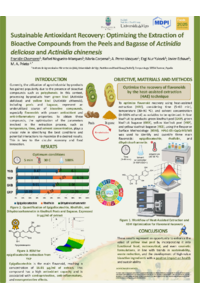
Currently, the utilization of agro-industrial by-products has gained popularity due to the presence of bioactive compounds such as polyphenols. In this context, processing residues from green kiwi (Actinidia deliciosa) and yellow kiwi (Actinidia chinensis), including peels and bagasse, represent an underutilized source of bioactive compounds, especially flavonoids with proven antioxidant and anti-inflammatory properties. To obtain these compounds, the optimization of the parameters involved in the extraction process, such as temperature, time, and solvent concentration, plays a crucial role in identifying the best conditions and potential interactions to maximize the desired results. This is key to the circular economy and food innovation. The main objective of this work was to optimize the recovery of flavonoids using the heat-assisted extraction (HAE) technique, considering time (5–60 min), temperature (30–90 ºC), and solvent concentration (0–100% ethanol) as variables to be optimized, in four kiwifruit by-products—green kiwifruit peel (GKP), green kiwifruit bagasse (GKB), yellow kiwifruit peel (YKP) and yellow kiwifruit bagasse (YKB)—using Response Surface Methodology (RSM). HPLC-ESI-QqQ-MS/MS was used to identify and quantify three main flavonoids: epigallocatechin, rhoifolin, and dihydroisorhamnetin. The data show that YKP concentrates the highest amount of total flavonoids (33.2 µg/ml of extract) among the matrices evaluated, with epigallocatechin being the main flavonoid, reaching a concentration of 16.01 µg/ml of extract, being of importance since this compound has high antioxidant capacity and is associated with cardioprotective, anti-inflammatory, and neuroprotective effects. The experimental conditions that allowed the highest recovery of flavonoids were 5 minutes, 30 °C, and 100% ethanol as solvent. These results represent an opportunity to enhance the value of yellow kiwifruit peel by incorporating it into functional food, nutraceuticals, and even cosmetic formulations, aligning with trends in sustainability, waste reduction, and the development of high-value bioactive ingredients with a positive impact on health and sustainability.
Keywords
RSM
flavonoids
epigallocatechin
heat-assisted extraction
kiwifruit by-broducts
Poster
FOODS_Franklin.pdf
The Cholesterol content and fatty acid composition of sheep butter oil in comparison to cow butter oil
Intra-species variation in regiospecific distribution of fatty acids in triacylglycerol (TAG), and nutritional indices of cow (Bos indicus), buffalo (Bubalus bubalis) milk fat