Event submissions
Published
This submission belongs to the session B. Nutritional and Functional Foods of the event The 6th International Electronic Conference on Foods
Published date
27 Oct, 2025
Academic Editor
'%3e%3cpath%20d='M12.6657%2010.9104C12.4185%2010.325%2012.0599%209.79327%2011.6097%209.34482C11.1609%208.89508%2010.6293%208.5365%2010.0442%208.28888C10.0389%208.28626%2010.0337%208.28495%2010.0285%208.28233C10.8446%207.69279%2011.3752%206.73249%2011.3752%205.64904C11.3752%203.8542%209.92103%202.39999%208.1262%202.39999C6.33136%202.39999%204.87715%203.8542%204.87715%205.64904C4.87715%206.73249%205.40774%207.69279%206.22393%208.28364C6.21869%208.28626%206.21345%208.28757%206.20821%208.29019C5.62129%208.5378%205.09463%208.89284%204.64265%209.34613C4.1929%209.79493%203.83432%2010.3266%203.58671%2010.9117C3.34345%2011.4845%203.21226%2012.0987%203.20023%2012.7209C3.19988%2012.7349%203.20233%2012.7488%203.20744%2012.7619C3.21255%2012.7749%203.22022%2012.7867%203.22998%2012.7968C3.23975%2012.8068%203.25142%2012.8147%203.26431%2012.8202C3.2772%2012.8256%203.29105%2012.8284%203.30504%2012.8284H4.09109C4.14874%2012.8284%204.19459%2012.7825%204.1959%2012.7262C4.2221%2011.7148%204.62823%2010.7676%205.34617%2010.0497C6.08899%209.30683%207.0755%208.89808%208.1262%208.89808C9.17689%208.89808%2010.1634%209.30683%2010.9062%2010.0497C11.6242%2010.7676%2012.0303%2011.7148%2012.0565%2012.7262C12.0578%2012.7838%2012.1037%2012.8284%2012.1613%2012.8284H12.9474C12.9613%2012.8284%2012.9752%2012.8256%2012.9881%2012.8202C13.001%2012.8147%2013.0126%2012.8068%2013.0224%2012.7968C13.0322%2012.7867%2013.0398%2012.7749%2013.0449%2012.7619C13.0501%2012.7488%2013.0525%2012.7349%2013.0522%2012.7209C13.0391%2012.0947%2012.9094%2011.4855%2012.6657%2010.9104ZM8.1262%207.9024C7.52486%207.9024%206.9589%207.6679%206.53312%207.24211C6.10733%206.81633%205.87283%206.25037%205.87283%205.64904C5.87283%205.0477%206.10733%204.48174%206.53312%204.05596C6.9589%203.63018%207.52486%203.39567%208.1262%203.39567C8.72753%203.39567%209.29349%203.63018%209.71927%204.05596C10.1451%204.48174%2010.3796%205.0477%2010.3796%205.64904C10.3796%206.25037%2010.1451%206.81633%209.71927%207.24211C9.29349%207.6679%208.72753%207.9024%208.1262%207.9024Z'%20fill='%235D1EE1'/%3e%3c/g%3e%3c/svg%3e) Antonello Santini
Antonello SantiniCitation
PAULINE DONN, Antia Gonzalez Pereira, María Carpena Rodríguez, Sepidar Seyyedi-Mansour, Paula Barciela, Ana Olívia Serra Jorge, Miguel Angel Prieto Lage, Toward efficient recovery of the alkaloid plantagonine from Verbascum sinuatum flowers: Optimization of microwave-assisted and pressurized liquid extraction methods, in Proceedings of The 6th International Electronic Conference on Foods, 28 October–30 October 2025, MDPI: Basel, Switzerland
Share
Email
Facebook
Twitter
LinkedIn
Toward efficient recovery of the alkaloid plantagonine from Verbascum sinuatum flowers: Optimization of microwave-assisted and pressurized liquid extraction methods
'%3e%3cpath%20d='M12.6647%2010.9104C12.4176%2010.325%2012.0589%209.7933%2011.6088%209.34485C11.16%208.89511%2010.6283%208.53653%2010.0432%208.28891C10.038%208.28629%2010.0327%208.28498%2010.0275%208.28236C10.8437%207.69282%2011.3743%206.73252%2011.3743%205.64907C11.3743%203.85423%209.92005%202.40002%208.12522%202.40002C6.33038%202.40002%204.87618%203.85423%204.87618%205.64907C4.87618%206.73252%205.40677%207.69282%206.22296%208.28367C6.21772%208.28629%206.21248%208.2876%206.20724%208.29022C5.62031%208.53783%205.09365%208.89287%204.64167%209.34616C4.19192%209.79496%203.83334%2010.3266%203.58573%2010.9117C3.34247%2011.4846%203.21128%2012.0987%203.19925%2012.721C3.1989%2012.735%203.20135%2012.7489%203.20646%2012.7619C3.21157%2012.7749%203.21924%2012.7868%203.22901%2012.7968C3.23877%2012.8068%203.25045%2012.8148%203.26334%2012.8202C3.27623%2012.8256%203.29007%2012.8284%203.30406%2012.8284H4.09012C4.14776%2012.8284%204.19362%2012.7825%204.19493%2012.7262C4.22113%2011.7148%204.62726%2010.7676%205.34519%2010.0497C6.08802%209.30686%207.07452%208.89811%208.12522%208.89811C9.17592%208.89811%2010.1624%209.30686%2010.9052%2010.0497C11.6232%2010.7676%2012.0293%2011.7148%2012.0555%2012.7262C12.0568%2012.7839%2012.1027%2012.8284%2012.1603%2012.8284H12.9464C12.9604%2012.8284%2012.9742%2012.8256%2012.9871%2012.8202C13%2012.8148%2013.0117%2012.8068%2013.0214%2012.7968C13.0312%2012.7868%2013.0389%2012.7749%2013.044%2012.7619C13.0491%2012.7489%2013.0515%2012.735%2013.0512%2012.721C13.0381%2012.0947%2012.9084%2011.4856%2012.6647%2010.9104ZM8.12522%207.90243C7.52388%207.90243%206.95792%207.66793%206.53214%207.24215C6.10636%206.81636%205.87185%206.2504%205.87185%205.64907C5.87185%205.04773%206.10636%204.48177%206.53214%204.05599C6.95792%203.63021%207.52388%203.3957%208.12522%203.3957C8.72655%203.3957%209.29252%203.63021%209.7183%204.05599C10.1441%204.48177%2010.3786%205.04773%2010.3786%205.64907C10.3786%206.2504%2010.1441%206.81636%209.7183%207.24215C9.29252%207.66793%208.72655%207.90243%208.12522%207.90243Z'%20fill='%235D1EE1'/%3e%3c/g%3e%3c/svg%3e)
PAULINE DONN 1

Antia Gonzalez Pereira 1,2

María Carpena Rodríguez 1
Sepidar Seyyedi-Mansour 1

Paula Barciela 1
Ana Olívia Serra Jorge 1,3

Miguel Angel Prieto Lage 1
1. Instituto de Agroecoloxía e Alimentación (IAA), Universidade de Vigo, Nutrition and Food Group (NuFoG), Campus Auga, 32004 Ourense, Spain.
2. Investigaciones Agroalimentarias Research Group, Galicia Sur Health Research Institute (IIS Galicia Sur). SERGAS-UVIGO, Vigo, Spain.
3. REQUIMTE/LAQV, Department of Chemical Sciences, Faculty of Pharmacy, University of Porto, R. Jorge Viterbo Ferreira 228, 4050-313 Porto, Portugal.
Abstract
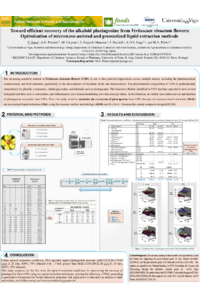
The increasing scientific interest in Verbascum sinuatum L. flowers (VSFs) is due to their potential applications across multiple sectors, including the pharmaceutical, cosmeceutical, and food industries, particularly in the development of functional foods and nutraceuticals. The phytochemical composition of VSFs is predominantly characterized by phenolic compounds, iridoid glycosides, and alkaloids such as plantagonine. This bioactive alkaloid identified in VSFs has been reported to have anticancer, antioxidant, and antimicrobial activities. In the literature, no studies have addressed the optimization of plantagonine extraction from VSFs. Thus, this study aimed to maximize the extraction of plantagonine from VSFs through microwave-assisted extraction (MAE) and pressurized liquid extraction (PLE). For MAE, 2g of dried VSF powder was placed in a closed vessel and dissolved in 40 mL of a solvent at various concentrations (S) and temperatures (T) and for various periods of time (t). Regarding PLE, the procedure involved placing 1g of dried VSFs in a 66 mL extraction cell containing diatomaceous earth under 10 bar pressure and applying various S, T and t conditions. Efficient recovery, meaning the maximization of the yield using the lowest possible inputs, was determined using the Response Surface Methodology (RSM) with three independent variables (t/X1, T/X2, and the proportion of ethanol in the hydroethanolic solution, S/X3), employing a five-level circumscribed central composite design (CCCD) comprising 28 experimental runs. The plantagonine content in the VSF extracts obtained under the operational conditions for each point of the experimental design was evaluated through HPLC-ESI-QqQ-MS/MS. The results revealed that under the optimal extraction conditions, the yield obtained using PLE (2312.86 ± 39.69 µg/g extract; 25 min, 200°C, 59% ethanol) was 1.7-fold higher than that obtained using MAE (1356.20±32.10 µg/g extract; 25 min, 180°C, 55% ethanol). Therefore, this study proposes, for the first time, the optimal extraction conditions for maximizing the recovery of plantagonine from VSFs using two green extraction techniques, demonstrates the superiority of PLE, and provides a quantitative framework for further industrial extraction and application in the food, cosmeceutical, and pharmaceutical industries.
Keywords
Verbascum sinuatum flowers
optimization
alkaloid
plantagonine
microwave-assisted extraction
pressurized-liquid extraction.
Poster
6th IECF 2025_Pauline.pdf
Optimization of Fatty Acid Extraction and Derivatization for GC-MS: An Application on Chicken Liver Tissue
Unravelling Corn Silk's Bioactive Potential for Health Enhancement: Advancing the Legacy of Traditional Medicine via Innovative Research