Event submissions
Published
This submission belongs to the session H. Foods as Medicine of the event The 6th International Electronic Conference on Foods
Published date
27 Oct, 2025
Academic Editor
'%3e%3cpath%20d='M12.6657%2010.9104C12.4185%2010.325%2012.0599%209.79327%2011.6097%209.34482C11.1609%208.89508%2010.6293%208.5365%2010.0442%208.28888C10.0389%208.28626%2010.0337%208.28495%2010.0285%208.28233C10.8446%207.69279%2011.3752%206.73249%2011.3752%205.64904C11.3752%203.8542%209.92103%202.39999%208.1262%202.39999C6.33136%202.39999%204.87715%203.8542%204.87715%205.64904C4.87715%206.73249%205.40774%207.69279%206.22393%208.28364C6.21869%208.28626%206.21345%208.28757%206.20821%208.29019C5.62129%208.5378%205.09463%208.89284%204.64265%209.34613C4.1929%209.79493%203.83432%2010.3266%203.58671%2010.9117C3.34345%2011.4845%203.21226%2012.0987%203.20023%2012.7209C3.19988%2012.7349%203.20233%2012.7488%203.20744%2012.7619C3.21255%2012.7749%203.22022%2012.7867%203.22998%2012.7968C3.23975%2012.8068%203.25142%2012.8147%203.26431%2012.8202C3.2772%2012.8256%203.29105%2012.8284%203.30504%2012.8284H4.09109C4.14874%2012.8284%204.19459%2012.7825%204.1959%2012.7262C4.2221%2011.7148%204.62823%2010.7676%205.34617%2010.0497C6.08899%209.30683%207.0755%208.89808%208.1262%208.89808C9.17689%208.89808%2010.1634%209.30683%2010.9062%2010.0497C11.6242%2010.7676%2012.0303%2011.7148%2012.0565%2012.7262C12.0578%2012.7838%2012.1037%2012.8284%2012.1613%2012.8284H12.9474C12.9613%2012.8284%2012.9752%2012.8256%2012.9881%2012.8202C13.001%2012.8147%2013.0126%2012.8068%2013.0224%2012.7968C13.0322%2012.7867%2013.0398%2012.7749%2013.0449%2012.7619C13.0501%2012.7488%2013.0525%2012.7349%2013.0522%2012.7209C13.0391%2012.0947%2012.9094%2011.4855%2012.6657%2010.9104ZM8.1262%207.9024C7.52486%207.9024%206.9589%207.6679%206.53312%207.24211C6.10733%206.81633%205.87283%206.25037%205.87283%205.64904C5.87283%205.0477%206.10733%204.48174%206.53312%204.05596C6.9589%203.63018%207.52486%203.39567%208.1262%203.39567C8.72753%203.39567%209.29349%203.63018%209.71927%204.05596C10.1451%204.48174%2010.3796%205.0477%2010.3796%205.64904C10.3796%206.25037%2010.1451%206.81633%209.71927%207.24211C9.29349%207.6679%208.72753%207.9024%208.1262%207.9024Z'%20fill='%235D1EE1'/%3e%3c/g%3e%3c/svg%3e) Antonello Santini
Antonello SantiniCitation
Toshihiro Ona, Junko Johzuka, Cellular activation through contact and orally ingested honey with high polarization (wave) achieved by blending monofloral nectar, in Proceedings of The 6th International Electronic Conference on Foods, 28 October–30 October 2025, MDPI: Basel, Switzerland
Share
Email
Facebook
Twitter
LinkedIn
Cellular activation through contact and orally ingested honey with high polarization (wave) achieved by blending monofloral nectar
'%3e%3cpath%20d='M12.6647%2010.9104C12.4176%2010.325%2012.0589%209.7933%2011.6088%209.34485C11.16%208.89511%2010.6283%208.53653%2010.0432%208.28891C10.038%208.28629%2010.0327%208.28498%2010.0275%208.28236C10.8437%207.69282%2011.3743%206.73252%2011.3743%205.64907C11.3743%203.85423%209.92005%202.40002%208.12522%202.40002C6.33038%202.40002%204.87618%203.85423%204.87618%205.64907C4.87618%206.73252%205.40677%207.69282%206.22296%208.28367C6.21772%208.28629%206.21248%208.2876%206.20724%208.29022C5.62031%208.53783%205.09365%208.89287%204.64167%209.34616C4.19192%209.79496%203.83334%2010.3266%203.58573%2010.9117C3.34247%2011.4846%203.21128%2012.0987%203.19925%2012.721C3.1989%2012.735%203.20135%2012.7489%203.20646%2012.7619C3.21157%2012.7749%203.21924%2012.7868%203.22901%2012.7968C3.23877%2012.8068%203.25045%2012.8148%203.26334%2012.8202C3.27623%2012.8256%203.29007%2012.8284%203.30406%2012.8284H4.09012C4.14776%2012.8284%204.19362%2012.7825%204.19493%2012.7262C4.22113%2011.7148%204.62726%2010.7676%205.34519%2010.0497C6.08802%209.30686%207.07452%208.89811%208.12522%208.89811C9.17592%208.89811%2010.1624%209.30686%2010.9052%2010.0497C11.6232%2010.7676%2012.0293%2011.7148%2012.0555%2012.7262C12.0568%2012.7839%2012.1027%2012.8284%2012.1603%2012.8284H12.9464C12.9604%2012.8284%2012.9742%2012.8256%2012.9871%2012.8202C13%2012.8148%2013.0117%2012.8068%2013.0214%2012.7968C13.0312%2012.7868%2013.0389%2012.7749%2013.044%2012.7619C13.0491%2012.7489%2013.0515%2012.735%2013.0512%2012.721C13.0381%2012.0947%2012.9084%2011.4856%2012.6647%2010.9104ZM8.12522%207.90243C7.52388%207.90243%206.95792%207.66793%206.53214%207.24215C6.10636%206.81636%205.87185%206.2504%205.87185%205.64907C5.87185%205.04773%206.10636%204.48177%206.53214%204.05599C6.95792%203.63021%207.52388%203.3957%208.12522%203.3957C8.72655%203.3957%209.29252%203.63021%209.7183%204.05599C10.1441%204.48177%2010.3786%205.04773%2010.3786%205.64907C10.3786%206.2504%2010.1441%206.81636%209.7183%207.24215C9.29252%207.66793%208.72655%207.90243%208.12522%207.90243Z'%20fill='%235D1EE1'/%3e%3c/g%3e%3c/svg%3e)
Toshihiro Ona 1,2
Junko Johzuka 1,2
1. Graduate School of Bioresource and Bioenvironmental Sciences, Kyushu University, Kasuga 816-8580, Japan
2. Head Office, O’Atari Inc., Onojo 816-0942, Japan
Abstract
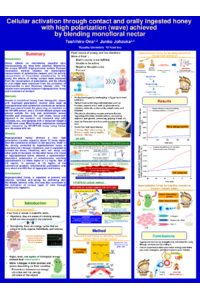
[Introduction] Honey's effects on maintaining beautiful skin, hematopoiesis, etc. have been reported. Meanwhile, the unique HP-SPR (high-precision surface Plasmon resonance) method enables the transcription measurement of polarization (waves) and the activity measurement of intracellular mitochondria. In this study, the effects of honey contact were examined from the transcription of polarization, and the effects of oral intake were examined from the activation of mitochondria in skin fibroblast (dermis) cells. The results were compared between hyperpolarized honey and a commercial product.
[Methods] Blends of monofloral honey from Yamaguchi, Japan, with maximum polarization transfer were used as hyperpolarized samples, and commercial products served as controls. PBS was placed inside the glass ring, an insulator on the HP-SPR sensor, and a 120-fold diluted sample was placed outside the ring and polarization (wave) transfer was measured. For oral intake, honey was digested in the stomach and via a duodenal step with enzymes, and samples with a molecular weight ≤ 10,000 were used. Mitochondrial polarization changes were measured by the HP-SPR-3D assay using the human skin fibroblast HFb16d.
[Results] Hyperpolarized honey showed a very high polarization transfer capacity, about 13 times higher than the commercial product at 400 seconds. Water in the vicinity contacted by hyperpolarized honey is polarized through insulators, and is expected to activate the throat, intestines, skin, hair, scalp, and other parts of the body. On the other hand, oral intake of hyperpolarized honey showed a concentration-dependent polarization of mitochondria, reaching approximately 3.5 times higher at 1.0 mg/mL than at 0.5 mg/mL. In contrast, at 1.0 mg/mL of the commercial product, mitochondrial polarization was only about one-fifth that of hyperpolarized honey.
[Conclusions] Hyperpolarized honey is expected to prevent and improve wrinkles (anti-aging) by activating skin fibroblasts (dermis) cells, and may also contribute to the activation of various types of cells through contact and ingestion.
Keywords
honey
cell
activation
polarization
wave
transfer
contact
oral
Poster
Foods2025Poster(Ona).pdf
Exploring the effect of dairy milk and plant-based dairy milk alternatives on physicochemical properties of strawberry smoothies
Effect of Flour Fractionation on Functional Properties, Antioxidant Capacity, and Phenolic Acids in Wheat Flour