Event submissions
Published
This submission belongs to the session H. Foods as Medicine of the event The 6th International Electronic Conference on Foods
Published date
27 Oct, 2025
Academic Editor
'%3e%3cpath%20d='M12.6657%2010.9104C12.4185%2010.325%2012.0599%209.79327%2011.6097%209.34482C11.1609%208.89508%2010.6293%208.5365%2010.0442%208.28888C10.0389%208.28626%2010.0337%208.28495%2010.0285%208.28233C10.8446%207.69279%2011.3752%206.73249%2011.3752%205.64904C11.3752%203.8542%209.92103%202.39999%208.1262%202.39999C6.33136%202.39999%204.87715%203.8542%204.87715%205.64904C4.87715%206.73249%205.40774%207.69279%206.22393%208.28364C6.21869%208.28626%206.21345%208.28757%206.20821%208.29019C5.62129%208.5378%205.09463%208.89284%204.64265%209.34613C4.1929%209.79493%203.83432%2010.3266%203.58671%2010.9117C3.34345%2011.4845%203.21226%2012.0987%203.20023%2012.7209C3.19988%2012.7349%203.20233%2012.7488%203.20744%2012.7619C3.21255%2012.7749%203.22022%2012.7867%203.22998%2012.7968C3.23975%2012.8068%203.25142%2012.8147%203.26431%2012.8202C3.2772%2012.8256%203.29105%2012.8284%203.30504%2012.8284H4.09109C4.14874%2012.8284%204.19459%2012.7825%204.1959%2012.7262C4.2221%2011.7148%204.62823%2010.7676%205.34617%2010.0497C6.08899%209.30683%207.0755%208.89808%208.1262%208.89808C9.17689%208.89808%2010.1634%209.30683%2010.9062%2010.0497C11.6242%2010.7676%2012.0303%2011.7148%2012.0565%2012.7262C12.0578%2012.7838%2012.1037%2012.8284%2012.1613%2012.8284H12.9474C12.9613%2012.8284%2012.9752%2012.8256%2012.9881%2012.8202C13.001%2012.8147%2013.0126%2012.8068%2013.0224%2012.7968C13.0322%2012.7867%2013.0398%2012.7749%2013.0449%2012.7619C13.0501%2012.7488%2013.0525%2012.7349%2013.0522%2012.7209C13.0391%2012.0947%2012.9094%2011.4855%2012.6657%2010.9104ZM8.1262%207.9024C7.52486%207.9024%206.9589%207.6679%206.53312%207.24211C6.10733%206.81633%205.87283%206.25037%205.87283%205.64904C5.87283%205.0477%206.10733%204.48174%206.53312%204.05596C6.9589%203.63018%207.52486%203.39567%208.1262%203.39567C8.72753%203.39567%209.29349%203.63018%209.71927%204.05596C10.1451%204.48174%2010.3796%205.0477%2010.3796%205.64904C10.3796%206.25037%2010.1451%206.81633%209.71927%207.24211C9.29349%207.6679%208.72753%207.9024%208.1262%207.9024Z'%20fill='%235D1EE1'/%3e%3c/g%3e%3c/svg%3e) Antonello Santini
Antonello SantiniCitation
Cinzia Zolfanelli, Vincenzo Lauciello, Alessio Di Ciancia, Alessio Vagliasindi, Theodoros Varzakas, Teresa D'Amore, Short-Chain Fatty Acids as Postbiotics in Colorectal Cancer Management: A Meta-Analysis of Preclinical Evidence, in Proceedings of The 6th International Electronic Conference on Foods, 28 October–30 October 2025, MDPI: Basel, Switzerland
Share
Email
Facebook
Twitter
LinkedIn
Short-Chain Fatty Acids as Postbiotics in Colorectal Cancer Management: A Meta-Analysis of Preclinical Evidence
'%3e%3cpath%20d='M12.6647%2010.9104C12.4176%2010.325%2012.0589%209.7933%2011.6088%209.34485C11.16%208.89511%2010.6283%208.53653%2010.0432%208.28891C10.038%208.28629%2010.0327%208.28498%2010.0275%208.28236C10.8437%207.69282%2011.3743%206.73252%2011.3743%205.64907C11.3743%203.85423%209.92005%202.40002%208.12522%202.40002C6.33038%202.40002%204.87618%203.85423%204.87618%205.64907C4.87618%206.73252%205.40677%207.69282%206.22296%208.28367C6.21772%208.28629%206.21248%208.2876%206.20724%208.29022C5.62031%208.53783%205.09365%208.89287%204.64167%209.34616C4.19192%209.79496%203.83334%2010.3266%203.58573%2010.9117C3.34247%2011.4846%203.21128%2012.0987%203.19925%2012.721C3.1989%2012.735%203.20135%2012.7489%203.20646%2012.7619C3.21157%2012.7749%203.21924%2012.7868%203.22901%2012.7968C3.23877%2012.8068%203.25045%2012.8148%203.26334%2012.8202C3.27623%2012.8256%203.29007%2012.8284%203.30406%2012.8284H4.09012C4.14776%2012.8284%204.19362%2012.7825%204.19493%2012.7262C4.22113%2011.7148%204.62726%2010.7676%205.34519%2010.0497C6.08802%209.30686%207.07452%208.89811%208.12522%208.89811C9.17592%208.89811%2010.1624%209.30686%2010.9052%2010.0497C11.6232%2010.7676%2012.0293%2011.7148%2012.0555%2012.7262C12.0568%2012.7839%2012.1027%2012.8284%2012.1603%2012.8284H12.9464C12.9604%2012.8284%2012.9742%2012.8256%2012.9871%2012.8202C13%2012.8148%2013.0117%2012.8068%2013.0214%2012.7968C13.0312%2012.7868%2013.0389%2012.7749%2013.044%2012.7619C13.0491%2012.7489%2013.0515%2012.735%2013.0512%2012.721C13.0381%2012.0947%2012.9084%2011.4856%2012.6647%2010.9104ZM8.12522%207.90243C7.52388%207.90243%206.95792%207.66793%206.53214%207.24215C6.10636%206.81636%205.87185%206.2504%205.87185%205.64907C5.87185%205.04773%206.10636%204.48177%206.53214%204.05599C6.95792%203.63021%207.52388%203.3957%208.12522%203.3957C8.72655%203.3957%209.29252%203.63021%209.7183%204.05599C10.1441%204.48177%2010.3786%205.04773%2010.3786%205.64907C10.3786%206.2504%2010.1441%206.81636%209.7183%207.24215C9.29252%207.66793%208.72655%207.90243%208.12522%207.90243Z'%20fill='%235D1EE1'/%3e%3c/g%3e%3c/svg%3e)
Cinzia Zolfanelli 1
Vincenzo Lauciello 1
Alessio Di Ciancia 1
Alessio Vagliasindi 1

Theodoros Varzakas 2

Teresa D'Amore 1
1. IRCCS CROB, Centro di Riferimento Oncologico della Basilicata, Rionero in Vulture, 85028, Italy
2. Department of Food Science and Technology, University of the Peloponnese, Antikalamos, 24100, Greece
Abstract
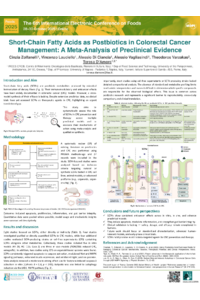
Background and Aims: Short-chain fatty acids (SCFAs), including butyrate, acetate, and propionate, are postbiotics produced by the microbial fermentation of dietary fibers. Their immunomodulatory and anticancer effects have been widely documented in colorectal cancer (CRC). However, a cross-model synthesis of their efficacy is lacking. This study aimed to assess the role of SCFAs in CRC across preclinical models and evaluate their mechanisms using meta-analytic synthesis.
Methods: A systematic review of the existing literature on postbiotics and CRC was performed using PRISMA methodology, and 27 records were included. SCFA-focused studies were analyzed based on inclusion criteria targeting natural or synthetic SCFAs tested in CRC cell lines, animal models, or advanced platforms. Outcomes included apoptosis, proliferation, inflammation, and barrier integrity. Quantitative data were pooled where possible; model usage and mechanistic insights were summarized.
Results and Discussion: Eight studies addressed SCFAs either directly (n=4) or indirectly using SCFA-containing supernatants (n=4). Collectively, they included five in vitro (HT-29, HCT-116, and Caco-2), three in vivo models (AOM/DSS-induced CRC and xenografts), and two organoid-based systems. SCFAs triggered apoptosis via caspase activation, modulated NF-κB and MAPK signaling pathways, enhanced mucin expression, and reinforced tight junction proteins. Meta-analysis revealed a moderate-to-strong effect size for butyrate-induced caspase-3 activation. Butyrate was also linked to the induction of autophagy via the LKB1–AMPK pathway. Four indirect studies supported these findings, though attribution to SCFAs remains limited due to the presence of multiple biomolecules. They also lacked detailed compositional analysis, which is an issue common across postbiotic research that represents a barrier to reproducibility, cross-study comparisons, and clinical translation.
Conclusions:
SCFAs represent a biologically active class of postbiotics with consistent anticancer effects across in vitro, in vivo, and organoid CRC models. Despite robust preclinical evidence, clinical validation remains absent, underlining the need for translational studies and early-phase trials.
Keywords
short-chain fatty acids
butyrate
colorectal cancer
postbiotics
apoptosis
inflammation
in vitro
in vivo
organoids
Poster
FOODS2025_D'Amore.pdf
Identification of Key Targets and Pathways Modulated by Dietary Flavonoid Morin in Gastric Cancer: A Bioinformatics-Guided Experimental Study
Development and Assessment of Ixora coccinea-Based Probiotic Carbonated Beverage