Event submissions
Published
This submission belongs to the session C. Food Quality and Safety of the event The 6th International Electronic Conference on Foods
Published date
27 Oct, 2025
Academic Editor
'%3e%3cpath%20d='M12.6657%2010.9104C12.4185%2010.325%2012.0599%209.79327%2011.6097%209.34482C11.1609%208.89508%2010.6293%208.5365%2010.0442%208.28888C10.0389%208.28626%2010.0337%208.28495%2010.0285%208.28233C10.8446%207.69279%2011.3752%206.73249%2011.3752%205.64904C11.3752%203.8542%209.92103%202.39999%208.1262%202.39999C6.33136%202.39999%204.87715%203.8542%204.87715%205.64904C4.87715%206.73249%205.40774%207.69279%206.22393%208.28364C6.21869%208.28626%206.21345%208.28757%206.20821%208.29019C5.62129%208.5378%205.09463%208.89284%204.64265%209.34613C4.1929%209.79493%203.83432%2010.3266%203.58671%2010.9117C3.34345%2011.4845%203.21226%2012.0987%203.20023%2012.7209C3.19988%2012.7349%203.20233%2012.7488%203.20744%2012.7619C3.21255%2012.7749%203.22022%2012.7867%203.22998%2012.7968C3.23975%2012.8068%203.25142%2012.8147%203.26431%2012.8202C3.2772%2012.8256%203.29105%2012.8284%203.30504%2012.8284H4.09109C4.14874%2012.8284%204.19459%2012.7825%204.1959%2012.7262C4.2221%2011.7148%204.62823%2010.7676%205.34617%2010.0497C6.08899%209.30683%207.0755%208.89808%208.1262%208.89808C9.17689%208.89808%2010.1634%209.30683%2010.9062%2010.0497C11.6242%2010.7676%2012.0303%2011.7148%2012.0565%2012.7262C12.0578%2012.7838%2012.1037%2012.8284%2012.1613%2012.8284H12.9474C12.9613%2012.8284%2012.9752%2012.8256%2012.9881%2012.8202C13.001%2012.8147%2013.0126%2012.8068%2013.0224%2012.7968C13.0322%2012.7867%2013.0398%2012.7749%2013.0449%2012.7619C13.0501%2012.7488%2013.0525%2012.7349%2013.0522%2012.7209C13.0391%2012.0947%2012.9094%2011.4855%2012.6657%2010.9104ZM8.1262%207.9024C7.52486%207.9024%206.9589%207.6679%206.53312%207.24211C6.10733%206.81633%205.87283%206.25037%205.87283%205.64904C5.87283%205.0477%206.10733%204.48174%206.53312%204.05596C6.9589%203.63018%207.52486%203.39567%208.1262%203.39567C8.72753%203.39567%209.29349%203.63018%209.71927%204.05596C10.1451%204.48174%2010.3796%205.0477%2010.3796%205.64904C10.3796%206.25037%2010.1451%206.81633%209.71927%207.24211C9.29349%207.6679%208.72753%207.9024%208.1262%207.9024Z'%20fill='%235D1EE1'/%3e%3c/g%3e%3c/svg%3e) Susana Casal
Susana CasalCitation
Vlatka Mikulec, Želimira Cvetković, Petra Adamović, Martina Ivešić, A study on microplastic contamination in medicinal plants, in Proceedings of The 6th International Electronic Conference on Foods, 28 October–30 October 2025, MDPI: Basel, Switzerland
Share
Email
Facebook
Twitter
LinkedIn
A study on microplastic contamination in medicinal plants
'%3e%3cpath%20d='M12.6647%2010.9104C12.4176%2010.325%2012.0589%209.7933%2011.6088%209.34485C11.16%208.89511%2010.6283%208.53653%2010.0432%208.28891C10.038%208.28629%2010.0327%208.28498%2010.0275%208.28236C10.8437%207.69282%2011.3743%206.73252%2011.3743%205.64907C11.3743%203.85423%209.92005%202.40002%208.12522%202.40002C6.33038%202.40002%204.87618%203.85423%204.87618%205.64907C4.87618%206.73252%205.40677%207.69282%206.22296%208.28367C6.21772%208.28629%206.21248%208.2876%206.20724%208.29022C5.62031%208.53783%205.09365%208.89287%204.64167%209.34616C4.19192%209.79496%203.83334%2010.3266%203.58573%2010.9117C3.34247%2011.4846%203.21128%2012.0987%203.19925%2012.721C3.1989%2012.735%203.20135%2012.7489%203.20646%2012.7619C3.21157%2012.7749%203.21924%2012.7868%203.22901%2012.7968C3.23877%2012.8068%203.25045%2012.8148%203.26334%2012.8202C3.27623%2012.8256%203.29007%2012.8284%203.30406%2012.8284H4.09012C4.14776%2012.8284%204.19362%2012.7825%204.19493%2012.7262C4.22113%2011.7148%204.62726%2010.7676%205.34519%2010.0497C6.08802%209.30686%207.07452%208.89811%208.12522%208.89811C9.17592%208.89811%2010.1624%209.30686%2010.9052%2010.0497C11.6232%2010.7676%2012.0293%2011.7148%2012.0555%2012.7262C12.0568%2012.7839%2012.1027%2012.8284%2012.1603%2012.8284H12.9464C12.9604%2012.8284%2012.9742%2012.8256%2012.9871%2012.8202C13%2012.8148%2013.0117%2012.8068%2013.0214%2012.7968C13.0312%2012.7868%2013.0389%2012.7749%2013.044%2012.7619C13.0491%2012.7489%2013.0515%2012.735%2013.0512%2012.721C13.0381%2012.0947%2012.9084%2011.4856%2012.6647%2010.9104ZM8.12522%207.90243C7.52388%207.90243%206.95792%207.66793%206.53214%207.24215C6.10636%206.81636%205.87185%206.2504%205.87185%205.64907C5.87185%205.04773%206.10636%204.48177%206.53214%204.05599C6.95792%203.63021%207.52388%203.3957%208.12522%203.3957C8.72655%203.3957%209.29252%203.63021%209.7183%204.05599C10.1441%204.48177%2010.3786%205.04773%2010.3786%205.64907C10.3786%206.2504%2010.1441%206.81636%209.7183%207.24215C9.29252%207.66793%208.72655%207.90243%208.12522%207.90243Z'%20fill='%235D1EE1'/%3e%3c/g%3e%3c/svg%3e)
Vlatka Mikulec 1
Želimira Cvetković 1

Petra Adamović 2
Martina Ivešić 1
1. Andrija Stampar Teaching Institut of Public Health, Zagreb, 10 000, Croatia
2. Faculty of Mechanical Engineering and Naval Architecture, University of Zagreb, 10000 Zagreb, Croatia
Abstract
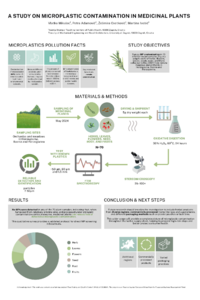
The microplastic (MP) contamination of food plants is increasingly being recognised as an environmental and public health concern, yet raw medicinal botanicals remain understudied. We surveyed 70 wild‐harvested samples (5 g dry weight each) of herbs, flowers, leaves, seeds, roots, and fruits collected in May 2024 from remote meadows and orchards in Herzegovina, Bosnia and Herzegovina. All sample handling—including drying, oxidative digestion (30 % H₂O₂, 60 °C, 24 h), and vacuum filtration (0.45 µm)—was performed under clean‐air conditions with procedural blanks (n = 3), which showed no background particles. Retained particles were first inspected by stereomicroscopy (25–100×) and then identified via FTIR spectroscopy. To validate detection capability down to micrometre scales, two positive controls were used, (1) certified traceable polystyrene spheres and (2) in‐house ground polystyrene 678E resin, yielding size fractions of ~50 µm, 80 µm and 1.5 mm (MSDS provided). Polymer identity in both controls was confirmed by ATR‐FTIR, demonstrating that our qualitative workflow reliably detects and identifies particles ≥ 50 µm. No MPs were detected in any of the 70 plant samples, indicating that, when harvested from relatively pristine sites and processed under stringent contamination‐control measures, medicinal plants can remain free of detectable microplastic contamination. This qualitative survey provides a validated protocol for direct MP screening in botanicals. Future work should extend to additional regions, commercially processed products, and varied packaging practices to fully assess microplastic exposure across the herbal supply chain.
Acknowledgement: This work was carried out within the project "Food Safety and Quality Center" (KK.01.1.1.02.0004). The project is co-financed by the European Union from the European Regional Development Fund.
Keywords
microplastics
medical plants
herbal teas
environmental contamination
Herzegovina
Poster
Poster - Medicinal Herbs - final_131480.pdf
Comparative Evaluation of Maceration and Ultrasound-Assisted Extraction Methods on Phytochemical Profile, Total Phenolic and Flavonoid Contents, and Antioxidant Activity of Ethanolic Extracts from Selected Locally Available Philippine Citrus Fruit Peels
Characterization of Volatile Phenol-Producing Microorganisms in Wine and Investigation of Biocontrol Strategies