Event submissions
Published
This submission belongs to the session C. Food Quality and Safety of the event The 6th International Electronic Conference on Foods
Published date
27 Oct, 2025
Academic Editor
'%3e%3cpath%20d='M12.6657%2010.9104C12.4185%2010.325%2012.0599%209.79327%2011.6097%209.34482C11.1609%208.89508%2010.6293%208.5365%2010.0442%208.28888C10.0389%208.28626%2010.0337%208.28495%2010.0285%208.28233C10.8446%207.69279%2011.3752%206.73249%2011.3752%205.64904C11.3752%203.8542%209.92103%202.39999%208.1262%202.39999C6.33136%202.39999%204.87715%203.8542%204.87715%205.64904C4.87715%206.73249%205.40774%207.69279%206.22393%208.28364C6.21869%208.28626%206.21345%208.28757%206.20821%208.29019C5.62129%208.5378%205.09463%208.89284%204.64265%209.34613C4.1929%209.79493%203.83432%2010.3266%203.58671%2010.9117C3.34345%2011.4845%203.21226%2012.0987%203.20023%2012.7209C3.19988%2012.7349%203.20233%2012.7488%203.20744%2012.7619C3.21255%2012.7749%203.22022%2012.7867%203.22998%2012.7968C3.23975%2012.8068%203.25142%2012.8147%203.26431%2012.8202C3.2772%2012.8256%203.29105%2012.8284%203.30504%2012.8284H4.09109C4.14874%2012.8284%204.19459%2012.7825%204.1959%2012.7262C4.2221%2011.7148%204.62823%2010.7676%205.34617%2010.0497C6.08899%209.30683%207.0755%208.89808%208.1262%208.89808C9.17689%208.89808%2010.1634%209.30683%2010.9062%2010.0497C11.6242%2010.7676%2012.0303%2011.7148%2012.0565%2012.7262C12.0578%2012.7838%2012.1037%2012.8284%2012.1613%2012.8284H12.9474C12.9613%2012.8284%2012.9752%2012.8256%2012.9881%2012.8202C13.001%2012.8147%2013.0126%2012.8068%2013.0224%2012.7968C13.0322%2012.7867%2013.0398%2012.7749%2013.0449%2012.7619C13.0501%2012.7488%2013.0525%2012.7349%2013.0522%2012.7209C13.0391%2012.0947%2012.9094%2011.4855%2012.6657%2010.9104ZM8.1262%207.9024C7.52486%207.9024%206.9589%207.6679%206.53312%207.24211C6.10733%206.81633%205.87283%206.25037%205.87283%205.64904C5.87283%205.0477%206.10733%204.48174%206.53312%204.05596C6.9589%203.63018%207.52486%203.39567%208.1262%203.39567C8.72753%203.39567%209.29349%203.63018%209.71927%204.05596C10.1451%204.48174%2010.3796%205.0477%2010.3796%205.64904C10.3796%206.25037%2010.1451%206.81633%209.71927%207.24211C9.29349%207.6679%208.72753%207.9024%208.1262%207.9024Z'%20fill='%235D1EE1'/%3e%3c/g%3e%3c/svg%3e) Susana Casal
Susana CasalCitation
Joaquina Pinheiro, Cíntia Silva, Margarida Silva, Rui Ganhão, Traditional vs. innovative rice cakes: the contribution of Alcobaça apple and Spirulina, in Proceedings of The 6th International Electronic Conference on Foods, 28 October–30 October 2025, MDPI: Basel, Switzerland
Share
Email
Facebook
Twitter
LinkedIn
Traditional vs. innovative rice cakes: the contribution of Alcobaça apple and Spirulina

Joaquina Pinheiro 1
'%3e%3cpath%20d='M12.6647%2010.9104C12.4176%2010.325%2012.0589%209.7933%2011.6088%209.34485C11.16%208.89511%2010.6283%208.53653%2010.0432%208.28891C10.038%208.28629%2010.0327%208.28498%2010.0275%208.28236C10.8437%207.69282%2011.3743%206.73252%2011.3743%205.64907C11.3743%203.85423%209.92005%202.40002%208.12522%202.40002C6.33038%202.40002%204.87618%203.85423%204.87618%205.64907C4.87618%206.73252%205.40677%207.69282%206.22296%208.28367C6.21772%208.28629%206.21248%208.2876%206.20724%208.29022C5.62031%208.53783%205.09365%208.89287%204.64167%209.34616C4.19192%209.79496%203.83334%2010.3266%203.58573%2010.9117C3.34247%2011.4846%203.21128%2012.0987%203.19925%2012.721C3.1989%2012.735%203.20135%2012.7489%203.20646%2012.7619C3.21157%2012.7749%203.21924%2012.7868%203.22901%2012.7968C3.23877%2012.8068%203.25045%2012.8148%203.26334%2012.8202C3.27623%2012.8256%203.29007%2012.8284%203.30406%2012.8284H4.09012C4.14776%2012.8284%204.19362%2012.7825%204.19493%2012.7262C4.22113%2011.7148%204.62726%2010.7676%205.34519%2010.0497C6.08802%209.30686%207.07452%208.89811%208.12522%208.89811C9.17592%208.89811%2010.1624%209.30686%2010.9052%2010.0497C11.6232%2010.7676%2012.0293%2011.7148%2012.0555%2012.7262C12.0568%2012.7839%2012.1027%2012.8284%2012.1603%2012.8284H12.9464C12.9604%2012.8284%2012.9742%2012.8256%2012.9871%2012.8202C13%2012.8148%2013.0117%2012.8068%2013.0214%2012.7968C13.0312%2012.7868%2013.0389%2012.7749%2013.044%2012.7619C13.0491%2012.7489%2013.0515%2012.735%2013.0512%2012.721C13.0381%2012.0947%2012.9084%2011.4856%2012.6647%2010.9104ZM8.12522%207.90243C7.52388%207.90243%206.95792%207.66793%206.53214%207.24215C6.10636%206.81636%205.87185%206.2504%205.87185%205.64907C5.87185%205.04773%206.10636%204.48177%206.53214%204.05599C6.95792%203.63021%207.52388%203.3957%208.12522%203.3957C8.72655%203.3957%209.29252%203.63021%209.7183%204.05599C10.1441%204.48177%2010.3786%205.04773%2010.3786%205.64907C10.3786%206.2504%2010.1441%206.81636%209.7183%207.24215C9.29252%207.66793%208.72655%207.90243%208.12522%207.90243Z'%20fill='%235D1EE1'/%3e%3c/g%3e%3c/svg%3e)
Cíntia Silva 2
Margarida Silva 2
Rui Ganhão 1
1. MARE – Marine and Environmental Sciences Centre / ARNET – Aquatic Research Network, ESTM - School of Tourism and Maritime Technology, Polytechnic of Leiria, 2520-614 Peniche, Portugal
2. ESTM - School of Tourism and Maritime Technology, Polytechnic of Leiria, 2520-614 Peniche, Portugal
Abstract
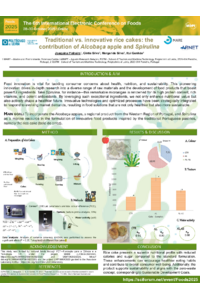
Food innovation is essential to address consumers’ growing concerns about health, nutrition, and sustainability. This innovation encourages the research of diverse raw materials and the development of food products featuring powerful ingredients, such as the microalgae Spirulina, known for its high protein content, vitamins, and antioxidants. Advanced technologies and streamlined processes have been adapted to meet market demand, resulting in healthier and more sustainable food solutions. Our commitment is to enhance nutritional and functional quality while prioritizing environmental stewardship, aiming to address today's dietary needs and ensure the preservation of essential resources for future generations.
The main goal of this study was to develop innovative food products inspired by traditional Portuguese pastries, namely the rice cake (bolo de arroz). To achieve this, the formulation was modified through the incorporation of the following regional ingredients: Alcobaça apples, representing fruit from the Western Region of Portugal, and Spirulina as a marine resource. Three cake formulations (CTR: wheat and rice flour, AL: rice and almond flour, AL.AS: rice and almond flour with apple and microalgae) were tested in triplicate for comparative analysis. The colour (CIE Lab parameters and TCD), texture (texture profile analysis), and water activity (aW) of traditional and innovative rice cake samples were determined. The enriched rice cake samples (AL.AS) exhibited a significantly greener and darker colour (P < 0.05, Tukey's test) compared to the CTR and AL samples. In terms of texture, the AL.AS samples showed a 40% increase in hardness and less water activity (0.88) than that observed in the CTR samples (0.91).
The enriched rice cake features an improved nutritional profile, particularly with lower calorie and sugar content compared to the standard formulation. This enhancement may encourage healthier dietary choices and promote the consumer's well-being. Additionally, the product aligns with two Sustainable Development Goals: promoting sustainability and supporting the zero-waste concept.
Keywords
Spirulina
Alcobaça apple
cake
quality
Poster
sciforum-131516.pdf
Bioavailability and Metabolic Fate of Montmorency Tart Cherry Polyphenols in Human Plasma, Urine, and Stool Using Triple Quadrupole LC-MS/MS
COMPUTATIONAL SCREENING OF ENZYME VARIANTS OF 2-OXOISOVALERATE DEHYDROGENASE SUBUNIT ALPHA