Event submissions
Published
This submission belongs to the session C. Food Quality and Safety of the event The 6th International Electronic Conference on Foods
Published date
27 Oct, 2025
Academic Editor
'%3e%3cpath%20d='M12.6657%2010.9104C12.4185%2010.325%2012.0599%209.79327%2011.6097%209.34482C11.1609%208.89508%2010.6293%208.5365%2010.0442%208.28888C10.0389%208.28626%2010.0337%208.28495%2010.0285%208.28233C10.8446%207.69279%2011.3752%206.73249%2011.3752%205.64904C11.3752%203.8542%209.92103%202.39999%208.1262%202.39999C6.33136%202.39999%204.87715%203.8542%204.87715%205.64904C4.87715%206.73249%205.40774%207.69279%206.22393%208.28364C6.21869%208.28626%206.21345%208.28757%206.20821%208.29019C5.62129%208.5378%205.09463%208.89284%204.64265%209.34613C4.1929%209.79493%203.83432%2010.3266%203.58671%2010.9117C3.34345%2011.4845%203.21226%2012.0987%203.20023%2012.7209C3.19988%2012.7349%203.20233%2012.7488%203.20744%2012.7619C3.21255%2012.7749%203.22022%2012.7867%203.22998%2012.7968C3.23975%2012.8068%203.25142%2012.8147%203.26431%2012.8202C3.2772%2012.8256%203.29105%2012.8284%203.30504%2012.8284H4.09109C4.14874%2012.8284%204.19459%2012.7825%204.1959%2012.7262C4.2221%2011.7148%204.62823%2010.7676%205.34617%2010.0497C6.08899%209.30683%207.0755%208.89808%208.1262%208.89808C9.17689%208.89808%2010.1634%209.30683%2010.9062%2010.0497C11.6242%2010.7676%2012.0303%2011.7148%2012.0565%2012.7262C12.0578%2012.7838%2012.1037%2012.8284%2012.1613%2012.8284H12.9474C12.9613%2012.8284%2012.9752%2012.8256%2012.9881%2012.8202C13.001%2012.8147%2013.0126%2012.8068%2013.0224%2012.7968C13.0322%2012.7867%2013.0398%2012.7749%2013.0449%2012.7619C13.0501%2012.7488%2013.0525%2012.7349%2013.0522%2012.7209C13.0391%2012.0947%2012.9094%2011.4855%2012.6657%2010.9104ZM8.1262%207.9024C7.52486%207.9024%206.9589%207.6679%206.53312%207.24211C6.10733%206.81633%205.87283%206.25037%205.87283%205.64904C5.87283%205.0477%206.10733%204.48174%206.53312%204.05596C6.9589%203.63018%207.52486%203.39567%208.1262%203.39567C8.72753%203.39567%209.29349%203.63018%209.71927%204.05596C10.1451%204.48174%2010.3796%205.0477%2010.3796%205.64904C10.3796%206.25037%2010.1451%206.81633%209.71927%207.24211C9.29349%207.6679%208.72753%207.9024%208.1262%207.9024Z'%20fill='%235D1EE1'/%3e%3c/g%3e%3c/svg%3e) Susana Casal
Susana CasalCitation
Newton Valerio Verbisck, Larissa Bortoli de Souza, Marita Vedovelli Cardozo, Nilton Gabriel Paiva Guimarães, Gelson Luis Dias Feijó, Meat Species Identification and Classification by MALDI-TOF Mass Spectrometry, in Proceedings of The 6th International Electronic Conference on Foods, 28 October–30 October 2025, MDPI: Basel, Switzerland
Share
Email
Facebook
Twitter
LinkedIn
Meat Species Identification and Classification by MALDI-TOF Mass Spectrometry

Newton Valerio Verbisck 1
'%3e%3cpath%20d='M12.6647%2010.9104C12.4176%2010.325%2012.0589%209.7933%2011.6088%209.34485C11.16%208.89511%2010.6283%208.53653%2010.0432%208.28891C10.038%208.28629%2010.0327%208.28498%2010.0275%208.28236C10.8437%207.69282%2011.3743%206.73252%2011.3743%205.64907C11.3743%203.85423%209.92005%202.40002%208.12522%202.40002C6.33038%202.40002%204.87618%203.85423%204.87618%205.64907C4.87618%206.73252%205.40677%207.69282%206.22296%208.28367C6.21772%208.28629%206.21248%208.2876%206.20724%208.29022C5.62031%208.53783%205.09365%208.89287%204.64167%209.34616C4.19192%209.79496%203.83334%2010.3266%203.58573%2010.9117C3.34247%2011.4846%203.21128%2012.0987%203.19925%2012.721C3.1989%2012.735%203.20135%2012.7489%203.20646%2012.7619C3.21157%2012.7749%203.21924%2012.7868%203.22901%2012.7968C3.23877%2012.8068%203.25045%2012.8148%203.26334%2012.8202C3.27623%2012.8256%203.29007%2012.8284%203.30406%2012.8284H4.09012C4.14776%2012.8284%204.19362%2012.7825%204.19493%2012.7262C4.22113%2011.7148%204.62726%2010.7676%205.34519%2010.0497C6.08802%209.30686%207.07452%208.89811%208.12522%208.89811C9.17592%208.89811%2010.1624%209.30686%2010.9052%2010.0497C11.6232%2010.7676%2012.0293%2011.7148%2012.0555%2012.7262C12.0568%2012.7839%2012.1027%2012.8284%2012.1603%2012.8284H12.9464C12.9604%2012.8284%2012.9742%2012.8256%2012.9871%2012.8202C13%2012.8148%2013.0117%2012.8068%2013.0214%2012.7968C13.0312%2012.7868%2013.0389%2012.7749%2013.044%2012.7619C13.0491%2012.7489%2013.0515%2012.735%2013.0512%2012.721C13.0381%2012.0947%2012.9084%2011.4856%2012.6647%2010.9104ZM8.12522%207.90243C7.52388%207.90243%206.95792%207.66793%206.53214%207.24215C6.10636%206.81636%205.87185%206.2504%205.87185%205.64907C5.87185%205.04773%206.10636%204.48177%206.53214%204.05599C6.95792%203.63021%207.52388%203.3957%208.12522%203.3957C8.72655%203.3957%209.29252%203.63021%209.7183%204.05599C10.1441%204.48177%2010.3786%205.04773%2010.3786%205.64907C10.3786%206.2504%2010.1441%206.81636%209.7183%207.24215C9.29252%207.66793%208.72655%207.90243%208.12522%207.90243Z'%20fill='%235D1EE1'/%3e%3c/g%3e%3c/svg%3e)
Larissa Bortoli de Souza 2

Marita Vedovelli Cardozo 3
Nilton Gabriel Paiva Guimarães 1
Gelson Luis Dias Feijó 1
1. EMBRAPA Beef Cattle, Campo Grande, 79106-550, Brazil
2. Institute of Biosciences, Federal University of Mato Grosso do Sul (UFMS), Campo Grande, 79070-900, Brazil
3. Department of Pathology, Reproduction and One Health, School of Agricultural and Veterinarian Sciences, São Paulo State University (UNESP), Jaboticabal, 14884-900, Brazil
Abstract
Introduction
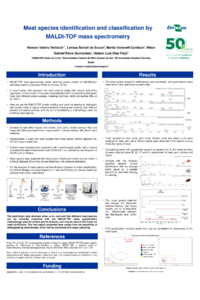
MALDI-TOF protein profiling and machine learning were developed to distinguish and classify meat from different species of livestock animals, with the aim of establishing a methodology useful for certifying meat species.
Methods
The samples were beef (filet mignon and sirloin), pork (loin), chicken (breast fillet) and tilapia fish (fillet). Approximately 3 cubic mm were excised, without apparent fat. After maceration with a sterile plastic pestle, proteins were extracted with a mixture of acetonitrile/water/trifluoroacetic acid, 50:49.9:0.1 v/v, followed by centrifugation at 13,000 g for 2 minutes. Supernatants were mixed with alpha-cyano-4-hydroxycinnamic acid, and mass spectra were acquired in a MALDI Biotyper Sirius One (Bruker Daltonics), with external calibration. Peak identification and meat classification were carried out with MALDI Biotyper Compass Explorer 4.1 and ClinProTools 3.0 (Bruker Daltonics) software.
Results
Meat protein extraction methodology successfully produced nice spectra for fresh and frozen/cooked meat. Fresh samples of beef (n=6), pork (n=6), chicken (n=4) and tilapia (n=2) were analyzed, and clearly distinct peaks were observed for all types of meat. Considering peaks with signal/noise equal to or greater than 5, the mean numbers of peaks obtained were 30, 26, 17 and 41, respectively, for beef, pork, chicken and tilapia. Analysis with the Biotyper algorithm allowed correct identification with an average score equal to or greater than 2,000 for beef after freezing or cooking. The mass spectra obtained also allowed the distinction between Nelore and Angus breeds, but so far they have not differentiated between the filet mignon and sirloin cuts. PCA classification revealed possible biomarkers for meat types.
Conclusions
Different meat species can be correctly classified with the MALDI-TOF mass spectrometry and may be used in the future for meat certification. The new aspect presented here comes from the possibility of distinguishing cattle breeds.
Keywords
Beef
Protein profiling
MALDI-TOF
Machine learning
Certification
Poster
VerbisckNV_Foods_2025.pdf
The Application of Unconventional Raw Materials in the Production of Gluten-Free Bread
Metal--Antibiotic Combinations as a One Health Strategy Against Multidrug-resistant Pathogens: In Vitro and Milk Matrix Evaluation