Event submissions
Published
This submission belongs to the session C. Food Quality and Safety of the event The 6th International Electronic Conference on Foods
Published date
27 Oct, 2025
Academic Editor
'%3e%3cpath%20d='M12.6657%2010.9104C12.4185%2010.325%2012.0599%209.79327%2011.6097%209.34482C11.1609%208.89508%2010.6293%208.5365%2010.0442%208.28888C10.0389%208.28626%2010.0337%208.28495%2010.0285%208.28233C10.8446%207.69279%2011.3752%206.73249%2011.3752%205.64904C11.3752%203.8542%209.92103%202.39999%208.1262%202.39999C6.33136%202.39999%204.87715%203.8542%204.87715%205.64904C4.87715%206.73249%205.40774%207.69279%206.22393%208.28364C6.21869%208.28626%206.21345%208.28757%206.20821%208.29019C5.62129%208.5378%205.09463%208.89284%204.64265%209.34613C4.1929%209.79493%203.83432%2010.3266%203.58671%2010.9117C3.34345%2011.4845%203.21226%2012.0987%203.20023%2012.7209C3.19988%2012.7349%203.20233%2012.7488%203.20744%2012.7619C3.21255%2012.7749%203.22022%2012.7867%203.22998%2012.7968C3.23975%2012.8068%203.25142%2012.8147%203.26431%2012.8202C3.2772%2012.8256%203.29105%2012.8284%203.30504%2012.8284H4.09109C4.14874%2012.8284%204.19459%2012.7825%204.1959%2012.7262C4.2221%2011.7148%204.62823%2010.7676%205.34617%2010.0497C6.08899%209.30683%207.0755%208.89808%208.1262%208.89808C9.17689%208.89808%2010.1634%209.30683%2010.9062%2010.0497C11.6242%2010.7676%2012.0303%2011.7148%2012.0565%2012.7262C12.0578%2012.7838%2012.1037%2012.8284%2012.1613%2012.8284H12.9474C12.9613%2012.8284%2012.9752%2012.8256%2012.9881%2012.8202C13.001%2012.8147%2013.0126%2012.8068%2013.0224%2012.7968C13.0322%2012.7867%2013.0398%2012.7749%2013.0449%2012.7619C13.0501%2012.7488%2013.0525%2012.7349%2013.0522%2012.7209C13.0391%2012.0947%2012.9094%2011.4855%2012.6657%2010.9104ZM8.1262%207.9024C7.52486%207.9024%206.9589%207.6679%206.53312%207.24211C6.10733%206.81633%205.87283%206.25037%205.87283%205.64904C5.87283%205.0477%206.10733%204.48174%206.53312%204.05596C6.9589%203.63018%207.52486%203.39567%208.1262%203.39567C8.72753%203.39567%209.29349%203.63018%209.71927%204.05596C10.1451%204.48174%2010.3796%205.0477%2010.3796%205.64904C10.3796%206.25037%2010.1451%206.81633%209.71927%207.24211C9.29349%207.6679%208.72753%207.9024%208.1262%207.9024Z'%20fill='%235D1EE1'/%3e%3c/g%3e%3c/svg%3e) Susana Casal
Susana CasalCitation
Nadia Ciotola, Ivana Mango, Giovanni D'Auria, Chiara Nitride, Salvatore Velotto, Pasquale Ferranti, Developement of an analytical approach to assess the persistence of Alternaria mycotoxins in tomato-based products and under simulated gastrointestinal digestion, in Proceedings of The 6th International Electronic Conference on Foods, 28 October–30 October 2025, MDPI: Basel, Switzerland
Share
Email
Facebook
Twitter
LinkedIn
Developement of an analytical approach to assess the persistence of Alternaria mycotoxins in tomato-based products and under simulated gastrointestinal digestion
'%3e%3cpath%20d='M12.6647%2010.9104C12.4176%2010.325%2012.0589%209.7933%2011.6088%209.34485C11.16%208.89511%2010.6283%208.53653%2010.0432%208.28891C10.038%208.28629%2010.0327%208.28498%2010.0275%208.28236C10.8437%207.69282%2011.3743%206.73252%2011.3743%205.64907C11.3743%203.85423%209.92005%202.40002%208.12522%202.40002C6.33038%202.40002%204.87618%203.85423%204.87618%205.64907C4.87618%206.73252%205.40677%207.69282%206.22296%208.28367C6.21772%208.28629%206.21248%208.2876%206.20724%208.29022C5.62031%208.53783%205.09365%208.89287%204.64167%209.34616C4.19192%209.79496%203.83334%2010.3266%203.58573%2010.9117C3.34247%2011.4846%203.21128%2012.0987%203.19925%2012.721C3.1989%2012.735%203.20135%2012.7489%203.20646%2012.7619C3.21157%2012.7749%203.21924%2012.7868%203.22901%2012.7968C3.23877%2012.8068%203.25045%2012.8148%203.26334%2012.8202C3.27623%2012.8256%203.29007%2012.8284%203.30406%2012.8284H4.09012C4.14776%2012.8284%204.19362%2012.7825%204.19493%2012.7262C4.22113%2011.7148%204.62726%2010.7676%205.34519%2010.0497C6.08802%209.30686%207.07452%208.89811%208.12522%208.89811C9.17592%208.89811%2010.1624%209.30686%2010.9052%2010.0497C11.6232%2010.7676%2012.0293%2011.7148%2012.0555%2012.7262C12.0568%2012.7839%2012.1027%2012.8284%2012.1603%2012.8284H12.9464C12.9604%2012.8284%2012.9742%2012.8256%2012.9871%2012.8202C13%2012.8148%2013.0117%2012.8068%2013.0214%2012.7968C13.0312%2012.7868%2013.0389%2012.7749%2013.044%2012.7619C13.0491%2012.7489%2013.0515%2012.735%2013.0512%2012.721C13.0381%2012.0947%2012.9084%2011.4856%2012.6647%2010.9104ZM8.12522%207.90243C7.52388%207.90243%206.95792%207.66793%206.53214%207.24215C6.10636%206.81636%205.87185%206.2504%205.87185%205.64907C5.87185%205.04773%206.10636%204.48177%206.53214%204.05599C6.95792%203.63021%207.52388%203.3957%208.12522%203.3957C8.72655%203.3957%209.29252%203.63021%209.7183%204.05599C10.1441%204.48177%2010.3786%205.04773%2010.3786%205.64907C10.3786%206.2504%2010.1441%206.81636%209.7183%207.24215C9.29252%207.66793%208.72655%207.90243%208.12522%207.90243Z'%20fill='%235D1EE1'/%3e%3c/g%3e%3c/svg%3e)
Nadia Ciotola 1
Ivana Mango 1
Giovanni D'Auria 1
Chiara Nitride 1
Salvatore Velotto 2
Pasquale Ferranti 1
1. Department of Agricultural Sciences, University of Naples Federico II, 80138 Portici, Italy
2. Department of Promotion of Human Sciences and the Quality of Life, University of Study of Roma "San Raffaele", Via di Val Cannuta, 247, 00166 Roma, Italy.
Abstract
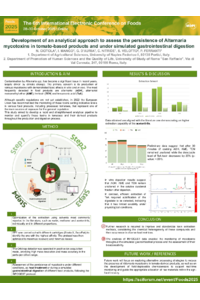
Contamination by Alternaria spp. has become a significant issue driven by climate change, primarily due to its production of mycotoxins with demonstrated toxic effects, demonstrated in vitro and in vivo. The most frequently detected mycotoxins in food are alternariol (AOH), alternariol monomethyl ether (AME), tentoxin (TEN), and tenuazonic acid (TeA). This study aimed to develop a rapid and straightforward analytical pipeline for quantifying these toxins in tomatoes and their derived products, both before and after simulated gastrointestinal digestion.
A blank tomato purée was prepared from locally sourced tomatoes following Italian regulatory standards for this product. Samples were subjected to in vitro digestion, using the standardized INFOGEST protocol, an internationally recognized static model that simulates the human oral, gastric, and duodenal phases. At the end of the digestion process, samples were centrifuged to separate the soluble supernatant from the insoluble pellet. The supernatant represents the potentially bioavailable fraction, whereas the pellet represents the non-absorbed fraction destined for transit through the lower gut. Both fractions were then freeze-dried to preserve them for analysis, extracted with acetonitrile:H2O:methanol (45:45:10, v/v/v) solution, and purified using an SPE-cartridge.
Preliminary data suggest that AOH, AME, and TEN remain unaltered in the soluble duodenal fraction post-digestion. In contrast, the efficient extraction of TeA required acidification (pH = 4.5–4.7), indicating that it has limited solubility under physiological conditions (pH = 7). Furthermore, analysis by means of HPLC-MS demonstrated the capability to detect these Alternaria toxins in both the original food matrix and the final digested fluids, at the parts-per-billion (ppb) level.
By analysing the samples before and after the INFOGEST process, it was possible to monitor mycotoxins throughout the simulated gastrointestinal process and measure their bioaccessibility. The chemical heterogeneity of these compounds and their occurrence in diverse food matrices necessitates further research to improve and standardize toxin extraction methods.
Keywords
Alternaria spp.
Mycotoxins
tomato-based products
Poster
134729.pdf
Untargeted Lipidomics Profiling for Halal Authentication of Meatball Products from Mixed Meat Sources
Preparation and Characterization of Vegan Biscuits made with Vegetable Flours from Agro-Industrial Waste