Event submissions
Published
This submission belongs to the session E. Chemistry and Physicochemical Properties of the event The 6th International Electronic Conference on Foods
Published date
27 Oct, 2025
Academic Editor
'%3e%3cpath%20d='M12.6657%2010.9104C12.4185%2010.325%2012.0599%209.79327%2011.6097%209.34482C11.1609%208.89508%2010.6293%208.5365%2010.0442%208.28888C10.0389%208.28626%2010.0337%208.28495%2010.0285%208.28233C10.8446%207.69279%2011.3752%206.73249%2011.3752%205.64904C11.3752%203.8542%209.92103%202.39999%208.1262%202.39999C6.33136%202.39999%204.87715%203.8542%204.87715%205.64904C4.87715%206.73249%205.40774%207.69279%206.22393%208.28364C6.21869%208.28626%206.21345%208.28757%206.20821%208.29019C5.62129%208.5378%205.09463%208.89284%204.64265%209.34613C4.1929%209.79493%203.83432%2010.3266%203.58671%2010.9117C3.34345%2011.4845%203.21226%2012.0987%203.20023%2012.7209C3.19988%2012.7349%203.20233%2012.7488%203.20744%2012.7619C3.21255%2012.7749%203.22022%2012.7867%203.22998%2012.7968C3.23975%2012.8068%203.25142%2012.8147%203.26431%2012.8202C3.2772%2012.8256%203.29105%2012.8284%203.30504%2012.8284H4.09109C4.14874%2012.8284%204.19459%2012.7825%204.1959%2012.7262C4.2221%2011.7148%204.62823%2010.7676%205.34617%2010.0497C6.08899%209.30683%207.0755%208.89808%208.1262%208.89808C9.17689%208.89808%2010.1634%209.30683%2010.9062%2010.0497C11.6242%2010.7676%2012.0303%2011.7148%2012.0565%2012.7262C12.0578%2012.7838%2012.1037%2012.8284%2012.1613%2012.8284H12.9474C12.9613%2012.8284%2012.9752%2012.8256%2012.9881%2012.8202C13.001%2012.8147%2013.0126%2012.8068%2013.0224%2012.7968C13.0322%2012.7867%2013.0398%2012.7749%2013.0449%2012.7619C13.0501%2012.7488%2013.0525%2012.7349%2013.0522%2012.7209C13.0391%2012.0947%2012.9094%2011.4855%2012.6657%2010.9104ZM8.1262%207.9024C7.52486%207.9024%206.9589%207.6679%206.53312%207.24211C6.10733%206.81633%205.87283%206.25037%205.87283%205.64904C5.87283%205.0477%206.10733%204.48174%206.53312%204.05596C6.9589%203.63018%207.52486%203.39567%208.1262%203.39567C8.72753%203.39567%209.29349%203.63018%209.71927%204.05596C10.1451%204.48174%2010.3796%205.0477%2010.3796%205.64904C10.3796%206.25037%2010.1451%206.81633%209.71927%207.24211C9.29349%207.6679%208.72753%207.9024%208.1262%207.9024Z'%20fill='%235D1EE1'/%3e%3c/g%3e%3c/svg%3e) Joana Amaral
Joana AmaralCitation
Sandra Rodrigues, Ana Leite, Lia Vasconcelos, Alfredo Teixeira, Influence of Raising Method and Dietary Olive Cake Supplementation on the Physicochemical Composition of Bísaro Pork Loins: A Comparative Analysis, in Proceedings of The 6th International Electronic Conference on Foods, 28 October–30 October 2025, MDPI: Basel, Switzerland
Share
Email
Facebook
Twitter
LinkedIn
Influence of Raising Method and Dietary Olive Cake Supplementation on the Physicochemical Composition of Bísaro Pork Loins: A Comparative Analysis

Sandra Rodrigues 1

Ana Leite 1

Lia Vasconcelos 1

Alfredo Teixeira 1
1. Centro de Investigação de Montanha, LA SusTEC, Instituto Politécnico de Bragança, Campus de Santa Apolónia, 5300-253 Bragança, Portugal
Abstract
The present study was designed with two primary objectives: (1) to investigate and compare the effects of different rearing systems—specifically intensive versus extensive production—on the quality characteristics of loins obtained from Bísaro pigs, a traditional Portuguese breed, and (2) to assess the potential influence of dietary supplementation with olive cake, a by-product of olive oil production, on the physicochemical composition of pork loins derived from these animals. To achieve these aims, muscle samples from the Longissimus thoracis et lumborum region were collected from Bísaro pigs reared on farms located in the Trás-os-Montes region of northern Portugal. The slaughter and carcass cutting procedures were standardized and conducted at the Bragança municipal slaughterhouse, ensuring consistency in sample handling and preparation for laboratory analyses. Comprehensive evaluation of physicochemical parameters revealed that, among the various components analyzed, only the ash content showed a statistically significant difference (p = 0.007) between the two rearing systems, suggesting that farming conditions may influence mineral content in the meat. However, no statistically significant differences (p > 0.05) were observed between rearing systems concerning other key quality indicators, including moisture content, protein concentration, total fat, collagen content, and pigment levels. Furthermore, the inclusion of olive cake in the animals’ diet, regardless of the rearing system employed, did not result in any significant alterations in the levels of these physicochemical traits. The same lack of statistical significance (p > 0.05) was observed in the analysis of the meat's fatty acid composition, including the proportions of saturated fatty acids (SFAs), monounsaturated fatty acids (MUFAs), and polyunsaturated fatty acids (PUFAs).
Keywords
Longissimus thoracis et lumborum
rearing systems
Bísaro pork
physicochemical composition
Poster
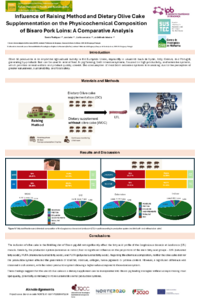
Poster sciforum-131251.pdf
Green Food Wrap—An innovative packaging material for confectionery products
Changes in Antioxidant Capacity of Apples Stored Under Controlled Atmosphere