Event submissions
Published
This submission belongs to the session C. Food Quality and Safety of the event The 6th International Electronic Conference on Foods
Published date
27 Oct, 2025
Academic Editor
'%3e%3cpath%20d='M12.6657%2010.9104C12.4185%2010.325%2012.0599%209.79327%2011.6097%209.34482C11.1609%208.89508%2010.6293%208.5365%2010.0442%208.28888C10.0389%208.28626%2010.0337%208.28495%2010.0285%208.28233C10.8446%207.69279%2011.3752%206.73249%2011.3752%205.64904C11.3752%203.8542%209.92103%202.39999%208.1262%202.39999C6.33136%202.39999%204.87715%203.8542%204.87715%205.64904C4.87715%206.73249%205.40774%207.69279%206.22393%208.28364C6.21869%208.28626%206.21345%208.28757%206.20821%208.29019C5.62129%208.5378%205.09463%208.89284%204.64265%209.34613C4.1929%209.79493%203.83432%2010.3266%203.58671%2010.9117C3.34345%2011.4845%203.21226%2012.0987%203.20023%2012.7209C3.19988%2012.7349%203.20233%2012.7488%203.20744%2012.7619C3.21255%2012.7749%203.22022%2012.7867%203.22998%2012.7968C3.23975%2012.8068%203.25142%2012.8147%203.26431%2012.8202C3.2772%2012.8256%203.29105%2012.8284%203.30504%2012.8284H4.09109C4.14874%2012.8284%204.19459%2012.7825%204.1959%2012.7262C4.2221%2011.7148%204.62823%2010.7676%205.34617%2010.0497C6.08899%209.30683%207.0755%208.89808%208.1262%208.89808C9.17689%208.89808%2010.1634%209.30683%2010.9062%2010.0497C11.6242%2010.7676%2012.0303%2011.7148%2012.0565%2012.7262C12.0578%2012.7838%2012.1037%2012.8284%2012.1613%2012.8284H12.9474C12.9613%2012.8284%2012.9752%2012.8256%2012.9881%2012.8202C13.001%2012.8147%2013.0126%2012.8068%2013.0224%2012.7968C13.0322%2012.7867%2013.0398%2012.7749%2013.0449%2012.7619C13.0501%2012.7488%2013.0525%2012.7349%2013.0522%2012.7209C13.0391%2012.0947%2012.9094%2011.4855%2012.6657%2010.9104ZM8.1262%207.9024C7.52486%207.9024%206.9589%207.6679%206.53312%207.24211C6.10733%206.81633%205.87283%206.25037%205.87283%205.64904C5.87283%205.0477%206.10733%204.48174%206.53312%204.05596C6.9589%203.63018%207.52486%203.39567%208.1262%203.39567C8.72753%203.39567%209.29349%203.63018%209.71927%204.05596C10.1451%204.48174%2010.3796%205.0477%2010.3796%205.64904C10.3796%206.25037%2010.1451%206.81633%209.71927%207.24211C9.29349%207.6679%208.72753%207.9024%208.1262%207.9024Z'%20fill='%235D1EE1'/%3e%3c/g%3e%3c/svg%3e) Susana Casal
Susana CasalCitation
Cátia Morgado, Fabíola Ayres Cacciatore, Patrícia Da Silva Malheiros, Eduardo Tondo, Carlos Brandão, Bactericidal Efficacy of Carvacrol Nanocapsules in Chia Mucilage for the Reduction of Salmonella in Spaghetti alla Carbonara, in Proceedings of The 6th International Electronic Conference on Foods, 28 October–30 October 2025, MDPI: Basel, Switzerland
Share
Email
Facebook
Twitter
LinkedIn
Bactericidal Efficacy of Carvacrol Nanocapsules in Chia Mucilage for the Reduction of Salmonella in Spaghetti alla Carbonara
'%3e%3cpath%20d='M12.6647%2010.9104C12.4176%2010.325%2012.0589%209.7933%2011.6088%209.34485C11.16%208.89511%2010.6283%208.53653%2010.0432%208.28891C10.038%208.28629%2010.0327%208.28498%2010.0275%208.28236C10.8437%207.69282%2011.3743%206.73252%2011.3743%205.64907C11.3743%203.85423%209.92005%202.40002%208.12522%202.40002C6.33038%202.40002%204.87618%203.85423%204.87618%205.64907C4.87618%206.73252%205.40677%207.69282%206.22296%208.28367C6.21772%208.28629%206.21248%208.2876%206.20724%208.29022C5.62031%208.53783%205.09365%208.89287%204.64167%209.34616C4.19192%209.79496%203.83334%2010.3266%203.58573%2010.9117C3.34247%2011.4846%203.21128%2012.0987%203.19925%2012.721C3.1989%2012.735%203.20135%2012.7489%203.20646%2012.7619C3.21157%2012.7749%203.21924%2012.7868%203.22901%2012.7968C3.23877%2012.8068%203.25045%2012.8148%203.26334%2012.8202C3.27623%2012.8256%203.29007%2012.8284%203.30406%2012.8284H4.09012C4.14776%2012.8284%204.19362%2012.7825%204.19493%2012.7262C4.22113%2011.7148%204.62726%2010.7676%205.34519%2010.0497C6.08802%209.30686%207.07452%208.89811%208.12522%208.89811C9.17592%208.89811%2010.1624%209.30686%2010.9052%2010.0497C11.6232%2010.7676%2012.0293%2011.7148%2012.0555%2012.7262C12.0568%2012.7839%2012.1027%2012.8284%2012.1603%2012.8284H12.9464C12.9604%2012.8284%2012.9742%2012.8256%2012.9871%2012.8202C13%2012.8148%2013.0117%2012.8068%2013.0214%2012.7968C13.0312%2012.7868%2013.0389%2012.7749%2013.044%2012.7619C13.0491%2012.7489%2013.0515%2012.735%2013.0512%2012.721C13.0381%2012.0947%2012.9084%2011.4856%2012.6647%2010.9104ZM8.12522%207.90243C7.52388%207.90243%206.95792%207.66793%206.53214%207.24215C6.10636%206.81636%205.87185%206.2504%205.87185%205.64907C5.87185%205.04773%206.10636%204.48177%206.53214%204.05599C6.95792%203.63021%207.52388%203.3957%208.12522%203.3957C8.72655%203.3957%209.29252%203.63021%209.7183%204.05599C10.1441%204.48177%2010.3786%205.04773%2010.3786%205.64907C10.3786%206.2504%2010.1441%206.81636%209.7183%207.24215C9.29252%207.66793%208.72655%207.90243%208.12522%207.90243Z'%20fill='%235D1EE1'/%3e%3c/g%3e%3c/svg%3e)
Cátia Morgado 1,2,3
Fabíola Ayres Cacciatore 4
Patrícia Da Silva Malheiros 4
Eduardo Tondo 4
Carlos Brandão 1,2
1. Estoril Higher Institute for Tourism and Hotel Studies, Estoril, 2769-510 Estoril, Portugal
2. Centre for Tourism Research, Development and Innovation (CiTUR) Estoril, Estoril, 2769-510 Estoril, Portugal
3. Doctorate Program in Food Science, University of Extremadura, 06071 Badajoz, Spain
4. Instituto de Ciências e Tecnologia dos Alimentos (ICTA/UFRGS), Universidade Federal do Rio Grande do Sul Campus do Vale-Agronomia (ICTA/UFRGS), Av. Bento Gonçalves 9500, Porto Alegre 91501-970, RS CEP, Brazil
Abstract
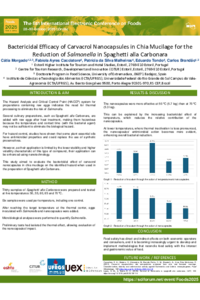
Introduction: The Hazard Analysis and Critical Control Point (HACCP) system for preparations containing raw eggs indicates the need for thermal processing to eliminate the risk of Salmonella. Several culinary preparations, such as Spaghetti alla Carbonara, are added with raw eggs after heat treatment, making them hazardous because the temperature and contact time (with the bacterial agent) may not be sufficient to eliminate the biological hazard. For hazard control, studies have shown that some plant essential oils have antimicrobial properties and could replace the use of synthetic preservatives. However, as their application is limited by the lower stability and higher volatility characteristic of this type of compound, their application can be enhanced using nanotechnology.
Objectives: This study aimed to evaluate the bactericidal effect of carvacrol nanocapsules in chia mucilage on the identified hazard when used in the preparation of Spaghetti alla Carbonara.
Methodology: Thirty samples of Spaghetti alla Carbonara were prepared and tested at five temperatures: 50, 55, 60, 65 and 70 °C. Six samples were used per temperature, including one control. After reaching the target temperature at the thermal center, eggs inoculated with Salmonella and nanocapsules were added. Microbiological analyses were performed to quantify Salmonella. Preliminary tests had isolated the thermal effect, allowing evaluation of the nanocapsules' impact.
Results: The nanocapsules were more effective at 50 °C (5.7 log) than at 70 °C (5.3 log). This can be explained by the increasing bactericidal effect of temperature, which reduces the relative contribution of the nanocapsules. At lower temperatures, where thermal inactivation is less pronounced, the nanocapsules' antimicrobial action becomes more evident, enhancing overall bacterial reduction.
Conclusion: Food safety has direct and indirect effects on both economic operators and consumers, and it is becoming increasingly urgent to develop and implement methodologies that reconcile food safety with the interest and gastronomic value of food.
Keywords
Carbonara
Eggs
Salmonella
Nanocapsules
Carvacrol
Poster
Foods2025_sciforum-134843.pdf
Profiling of reference and commercial Echinacea extracts via liquid and gas chromatography, in vivo and planar assays
Optimized Ultrasonic-Assisted Deep Eutectic Solvent Extraction of Polyphenols from Pleurotus eryngii: Enhanced Yield, Stability, and Antioxidant Activity