Event submissions
Published
This submission belongs to the session B. Nutritional and Functional Foods of the event The 6th International Electronic Conference on Foods
Published date
27 Oct, 2025
Academic Editor
'%3e%3cpath%20d='M12.6657%2010.9104C12.4185%2010.325%2012.0599%209.79327%2011.6097%209.34482C11.1609%208.89508%2010.6293%208.5365%2010.0442%208.28888C10.0389%208.28626%2010.0337%208.28495%2010.0285%208.28233C10.8446%207.69279%2011.3752%206.73249%2011.3752%205.64904C11.3752%203.8542%209.92103%202.39999%208.1262%202.39999C6.33136%202.39999%204.87715%203.8542%204.87715%205.64904C4.87715%206.73249%205.40774%207.69279%206.22393%208.28364C6.21869%208.28626%206.21345%208.28757%206.20821%208.29019C5.62129%208.5378%205.09463%208.89284%204.64265%209.34613C4.1929%209.79493%203.83432%2010.3266%203.58671%2010.9117C3.34345%2011.4845%203.21226%2012.0987%203.20023%2012.7209C3.19988%2012.7349%203.20233%2012.7488%203.20744%2012.7619C3.21255%2012.7749%203.22022%2012.7867%203.22998%2012.7968C3.23975%2012.8068%203.25142%2012.8147%203.26431%2012.8202C3.2772%2012.8256%203.29105%2012.8284%203.30504%2012.8284H4.09109C4.14874%2012.8284%204.19459%2012.7825%204.1959%2012.7262C4.2221%2011.7148%204.62823%2010.7676%205.34617%2010.0497C6.08899%209.30683%207.0755%208.89808%208.1262%208.89808C9.17689%208.89808%2010.1634%209.30683%2010.9062%2010.0497C11.6242%2010.7676%2012.0303%2011.7148%2012.0565%2012.7262C12.0578%2012.7838%2012.1037%2012.8284%2012.1613%2012.8284H12.9474C12.9613%2012.8284%2012.9752%2012.8256%2012.9881%2012.8202C13.001%2012.8147%2013.0126%2012.8068%2013.0224%2012.7968C13.0322%2012.7867%2013.0398%2012.7749%2013.0449%2012.7619C13.0501%2012.7488%2013.0525%2012.7349%2013.0522%2012.7209C13.0391%2012.0947%2012.9094%2011.4855%2012.6657%2010.9104ZM8.1262%207.9024C7.52486%207.9024%206.9589%207.6679%206.53312%207.24211C6.10733%206.81633%205.87283%206.25037%205.87283%205.64904C5.87283%205.0477%206.10733%204.48174%206.53312%204.05596C6.9589%203.63018%207.52486%203.39567%208.1262%203.39567C8.72753%203.39567%209.29349%203.63018%209.71927%204.05596C10.1451%204.48174%2010.3796%205.0477%2010.3796%205.64904C10.3796%206.25037%2010.1451%206.81633%209.71927%207.24211C9.29349%207.6679%208.72753%207.9024%208.1262%207.9024Z'%20fill='%235D1EE1'/%3e%3c/g%3e%3c/svg%3e) Antonello Santini
Antonello SantiniCitation
Matilde Rodrigues, Cátia Magalhães, José Pinela, Green Pea Microgreens as Novel Foods: A Study on Nutritional Composition and Antioxidant Properties, in Proceedings of The 6th International Electronic Conference on Foods, 28 October–30 October 2025, MDPI: Basel, Switzerland
Share
Email
Facebook
Twitter
LinkedIn
Green Pea Microgreens as Novel Foods: A Study on Nutritional Composition and Antioxidant Properties

Matilde Rodrigues 1
'%3e%3cpath%20d='M12.6647%2010.9104C12.4176%2010.325%2012.0589%209.7933%2011.6088%209.34485C11.16%208.89511%2010.6283%208.53653%2010.0432%208.28891C10.038%208.28629%2010.0327%208.28498%2010.0275%208.28236C10.8437%207.69282%2011.3743%206.73252%2011.3743%205.64907C11.3743%203.85423%209.92005%202.40002%208.12522%202.40002C6.33038%202.40002%204.87618%203.85423%204.87618%205.64907C4.87618%206.73252%205.40677%207.69282%206.22296%208.28367C6.21772%208.28629%206.21248%208.2876%206.20724%208.29022C5.62031%208.53783%205.09365%208.89287%204.64167%209.34616C4.19192%209.79496%203.83334%2010.3266%203.58573%2010.9117C3.34247%2011.4846%203.21128%2012.0987%203.19925%2012.721C3.1989%2012.735%203.20135%2012.7489%203.20646%2012.7619C3.21157%2012.7749%203.21924%2012.7868%203.22901%2012.7968C3.23877%2012.8068%203.25045%2012.8148%203.26334%2012.8202C3.27623%2012.8256%203.29007%2012.8284%203.30406%2012.8284H4.09012C4.14776%2012.8284%204.19362%2012.7825%204.19493%2012.7262C4.22113%2011.7148%204.62726%2010.7676%205.34519%2010.0497C6.08802%209.30686%207.07452%208.89811%208.12522%208.89811C9.17592%208.89811%2010.1624%209.30686%2010.9052%2010.0497C11.6232%2010.7676%2012.0293%2011.7148%2012.0555%2012.7262C12.0568%2012.7839%2012.1027%2012.8284%2012.1603%2012.8284H12.9464C12.9604%2012.8284%2012.9742%2012.8256%2012.9871%2012.8202C13%2012.8148%2013.0117%2012.8068%2013.0214%2012.7968C13.0312%2012.7868%2013.0389%2012.7749%2013.044%2012.7619C13.0491%2012.7489%2013.0515%2012.735%2013.0512%2012.721C13.0381%2012.0947%2012.9084%2011.4856%2012.6647%2010.9104ZM8.12522%207.90243C7.52388%207.90243%206.95792%207.66793%206.53214%207.24215C6.10636%206.81636%205.87185%206.2504%205.87185%205.64907C5.87185%205.04773%206.10636%204.48177%206.53214%204.05599C6.95792%203.63021%207.52388%203.3957%208.12522%203.3957C8.72655%203.3957%209.29252%203.63021%209.7183%204.05599C10.1441%204.48177%2010.3786%205.04773%2010.3786%205.64907C10.3786%206.2504%2010.1441%206.81636%209.7183%207.24215C9.29252%207.66793%208.72655%207.90243%208.12522%207.90243Z'%20fill='%235D1EE1'/%3e%3c/g%3e%3c/svg%3e)
Cátia Magalhães 1,2

José Pinela 1,3
1. Centro de Investigação de Montanha (CIMO), Instituto Politécnico de Bragança, Campus Santa Apolónia, 5300-253 Bragança, Portugal
2. Escola Superior Agrária, Instituto Politécnico de Bragança, Campus de Santa Apolónia, 5300-253 Bragança, Portugal
3. National Institute for Agricultural and Veterinary Research (INIAV), I.P., Rua dos Lágidos, Lugar da Madalena, 4485-655 Vairão, Vila do Conde, Portugal
Abstract
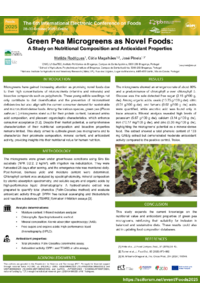
Microgreens have gained attention as promising functional foods due to their high concentrations of essential nutrients and bioactive compounds, which can contribute to diet diversification and the prevention of malnutrition. Among them, green pea (Pisum sativum L.) microgreens stand out for their nutritional value and appealing organoleptic properties. However, a comprehensive characterization of their nutritional composition and bioactive properties is still limited. This study aimed to cultivate green pea microgreens and evaluate their nutritional profile and antioxidant activity. The microgreens were grown under greenhouse conditions using Siro Bio substrate (NPK 9:2:2, 2 kg/m³), with irrigation via nebulization. They were harvested 25 days after sowing, and the emergence rate was monitored daily. Post-harvest, biomass yield and moisture content were determined. Chlorophyll content was analyzed via spectrophotometry, mineral composition was analyzed using atomic absorption spectrometry, and soluble sugars and organic acids were analzyed by means of high-performance liquid chromatography. A hydroethanolic extract was prepared to quantify total phenolics (Folin–Ciocalteu method) and evaluate antioxidant activity through DPPH free radical scavenging and TBARS formation inhibition assays [3]. The microgreens showed an emergence rate of approximately 80% and a predominance of chlorophyll a over chlorophyll b. Glucose was the sole detected soluble sugar (2.18 g/100 g dw). Among organic acids, oxalic (13.75 g/100 g dw), citric (0.51 g/100 g dw), and fumaric (0.02 g/100 g dw) acids were quantified, while ascorbic acid was found only in trace amounts. Mineral analysis revealed high levels of potassium (5.67 g/100 g dw), calcium (3.14 g/100 g dw), iron (10.17 mg/100 g dw), and zinc (6.38 mg/100 g dw), highlighting the microgreens’ potential as a mineral-dense food. The hydroethanolic extract showed a total phenolic content of 133 mg GAE/g but demonstrated moderate antioxidant activity compared to the positive control, Trolox. This study expands the current knowledge on the nutritional value and antioxidant properties of green pea microgreens, reinforcing their suitability for inclusion in balanced and sustainable diets.
Keywords
Microgreens
Nutritional quality
Functional foods
Poster
Poster_MR-JP.pdf
Optimized Ultrasonic-Assisted Deep Eutectic Solvent Extraction of Polyphenols from Pleurotus eryngii: Enhanced Yield, Stability, and Antioxidant Activity
Implications of surface topography, substrate composition, and microbial symbiosis on Listeria monocytogenes biofilm on food contact substances