Event submissions
Published
This submission belongs to the session C. Food Quality and Safety of the event The 6th International Electronic Conference on Foods
Published date
27 Oct, 2025
Academic Editor
'%3e%3cpath%20d='M12.6657%2010.9104C12.4185%2010.325%2012.0599%209.79327%2011.6097%209.34482C11.1609%208.89508%2010.6293%208.5365%2010.0442%208.28888C10.0389%208.28626%2010.0337%208.28495%2010.0285%208.28233C10.8446%207.69279%2011.3752%206.73249%2011.3752%205.64904C11.3752%203.8542%209.92103%202.39999%208.1262%202.39999C6.33136%202.39999%204.87715%203.8542%204.87715%205.64904C4.87715%206.73249%205.40774%207.69279%206.22393%208.28364C6.21869%208.28626%206.21345%208.28757%206.20821%208.29019C5.62129%208.5378%205.09463%208.89284%204.64265%209.34613C4.1929%209.79493%203.83432%2010.3266%203.58671%2010.9117C3.34345%2011.4845%203.21226%2012.0987%203.20023%2012.7209C3.19988%2012.7349%203.20233%2012.7488%203.20744%2012.7619C3.21255%2012.7749%203.22022%2012.7867%203.22998%2012.7968C3.23975%2012.8068%203.25142%2012.8147%203.26431%2012.8202C3.2772%2012.8256%203.29105%2012.8284%203.30504%2012.8284H4.09109C4.14874%2012.8284%204.19459%2012.7825%204.1959%2012.7262C4.2221%2011.7148%204.62823%2010.7676%205.34617%2010.0497C6.08899%209.30683%207.0755%208.89808%208.1262%208.89808C9.17689%208.89808%2010.1634%209.30683%2010.9062%2010.0497C11.6242%2010.7676%2012.0303%2011.7148%2012.0565%2012.7262C12.0578%2012.7838%2012.1037%2012.8284%2012.1613%2012.8284H12.9474C12.9613%2012.8284%2012.9752%2012.8256%2012.9881%2012.8202C13.001%2012.8147%2013.0126%2012.8068%2013.0224%2012.7968C13.0322%2012.7867%2013.0398%2012.7749%2013.0449%2012.7619C13.0501%2012.7488%2013.0525%2012.7349%2013.0522%2012.7209C13.0391%2012.0947%2012.9094%2011.4855%2012.6657%2010.9104ZM8.1262%207.9024C7.52486%207.9024%206.9589%207.6679%206.53312%207.24211C6.10733%206.81633%205.87283%206.25037%205.87283%205.64904C5.87283%205.0477%206.10733%204.48174%206.53312%204.05596C6.9589%203.63018%207.52486%203.39567%208.1262%203.39567C8.72753%203.39567%209.29349%203.63018%209.71927%204.05596C10.1451%204.48174%2010.3796%205.0477%2010.3796%205.64904C10.3796%206.25037%2010.1451%206.81633%209.71927%207.24211C9.29349%207.6679%208.72753%207.9024%208.1262%207.9024Z'%20fill='%235D1EE1'/%3e%3c/g%3e%3c/svg%3e) Susana Casal
Susana CasalCitation
Tingting Gu, Boce Zhang, Implications of surface topography, substrate composition, and microbial symbiosis on Listeria monocytogenes biofilm on food contact substances, in Proceedings of The 6th International Electronic Conference on Foods, 28 October–30 October 2025, MDPI: Basel, Switzerland
Share
Email
Facebook
Twitter
LinkedIn
Implications of surface topography, substrate composition, and microbial symbiosis on Listeria monocytogenes biofilm on food contact substances
'%3e%3cpath%20d='M12.6647%2010.9104C12.4176%2010.325%2012.0589%209.7933%2011.6088%209.34485C11.16%208.89511%2010.6283%208.53653%2010.0432%208.28891C10.038%208.28629%2010.0327%208.28498%2010.0275%208.28236C10.8437%207.69282%2011.3743%206.73252%2011.3743%205.64907C11.3743%203.85423%209.92005%202.40002%208.12522%202.40002C6.33038%202.40002%204.87618%203.85423%204.87618%205.64907C4.87618%206.73252%205.40677%207.69282%206.22296%208.28367C6.21772%208.28629%206.21248%208.2876%206.20724%208.29022C5.62031%208.53783%205.09365%208.89287%204.64167%209.34616C4.19192%209.79496%203.83334%2010.3266%203.58573%2010.9117C3.34247%2011.4846%203.21128%2012.0987%203.19925%2012.721C3.1989%2012.735%203.20135%2012.7489%203.20646%2012.7619C3.21157%2012.7749%203.21924%2012.7868%203.22901%2012.7968C3.23877%2012.8068%203.25045%2012.8148%203.26334%2012.8202C3.27623%2012.8256%203.29007%2012.8284%203.30406%2012.8284H4.09012C4.14776%2012.8284%204.19362%2012.7825%204.19493%2012.7262C4.22113%2011.7148%204.62726%2010.7676%205.34519%2010.0497C6.08802%209.30686%207.07452%208.89811%208.12522%208.89811C9.17592%208.89811%2010.1624%209.30686%2010.9052%2010.0497C11.6232%2010.7676%2012.0293%2011.7148%2012.0555%2012.7262C12.0568%2012.7839%2012.1027%2012.8284%2012.1603%2012.8284H12.9464C12.9604%2012.8284%2012.9742%2012.8256%2012.9871%2012.8202C13%2012.8148%2013.0117%2012.8068%2013.0214%2012.7968C13.0312%2012.7868%2013.0389%2012.7749%2013.044%2012.7619C13.0491%2012.7489%2013.0515%2012.735%2013.0512%2012.721C13.0381%2012.0947%2012.9084%2011.4856%2012.6647%2010.9104ZM8.12522%207.90243C7.52388%207.90243%206.95792%207.66793%206.53214%207.24215C6.10636%206.81636%205.87185%206.2504%205.87185%205.64907C5.87185%205.04773%206.10636%204.48177%206.53214%204.05599C6.95792%203.63021%207.52388%203.3957%208.12522%203.3957C8.72655%203.3957%209.29252%203.63021%209.7183%204.05599C10.1441%204.48177%2010.3786%205.04773%2010.3786%205.64907C10.3786%206.2504%2010.1441%206.81636%209.7183%207.24215C9.29252%207.66793%208.72655%207.90243%208.12522%207.90243Z'%20fill='%235D1EE1'/%3e%3c/g%3e%3c/svg%3e)
Tingting Gu 1

Boce Zhang 1
1. Food Science and Human Nutrition Department, Institute of Food and Agricultural Sciences, University of Florida, Gainesville, Florida, 32611, USA
Abstract
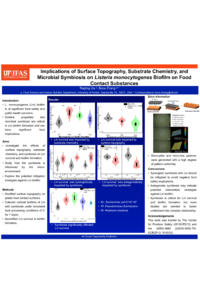
Introduction: L. monocytogenes forms persistent biofilms on food contact substances, posing significant food safety risks. We aimed to investigate how L. monocytogenes persistence in biofilms is affected by surface topography, substrate composition, and symbiotic species in produce processing facilities and how the symbiosis is impacted.
Methods: Cocktail biofilms were cultivated on plastic coupons (polyethylene, polyoxymethylene, polypropylene, and polyvinyl chloride), each with three types of surface topographies of native, microdots, and microlines. Cocktail biofilms included monospecies biofilm (L. monocytogenes), dual-species cocktail biofilm (L. monocytogenes + Escherichia coli O157:H7; L. monocytogenes + Pseudomonas fluorescence; L. monocytogenes + Ralstonia insidiosa), and four-species cocktail biofilm (L. monocytogenes + E. coli O157:H7 + P. fluorescence + R. insidiosa). L. monocytogenes cocktail biofilms were grown for 7 days at 4 °C in lettuce juice extract to simulate the produce processing conditions.
Results: Monospecies L. monocytogenes biofilm formation decreased on surfaces with microdots (0.4 Log CFU/cm2 reduction) and microlines (0.7 Log CFU/cm2 reduction). In dual-species biofilms, P. fluorescence consistently enhanced L. monocytogenes biofilm formation (P < 0.01) while E. coli O157:H7 and R. insidiosa showed surface-dependent synergistic (P < 0.05) or antagonistic effects (P < 0.05). Four-species cocktail biofilms exhibited synergistic symbiosis with L. monocytogenes under all conditions. The results suggest that surface topography, substrate composition, and symbiotic species significantly influence biofilm dynamics, and symbiosis can be affected by surface properties.
Contribution: Symbiosis plays a critical role in L. monocytogenes biofilm formation with implications for food safety. Mitigating synergistic interactions and leveraging antagonistic symbiosis could indicate potential intervention strategies against L. monocytogenes biofilms.
Keywords
Listeria monocytogenes
plastic
food contact substance
surface topography
substrate composition
cocktail biofilm
symbiosis
Poster
2025 Foods_Poster_ Tingting Gu.pdf
Green Pea Microgreens as Novel Foods: A Study on Nutritional Composition and Antioxidant Properties
Comparative Study of Natural Vinegars and Sodium Hypochlorite on Microbial Load Reduction, Antioxidant Activity, and Phenolic Content in Fresh Spinach