Event submissions
Published
This submission belongs to the session C. Food Quality and Safety of the event The 6th International Electronic Conference on Foods
Published date
27 Oct, 2025
Academic Editor
'%3e%3cpath%20d='M12.6657%2010.9104C12.4185%2010.325%2012.0599%209.79327%2011.6097%209.34482C11.1609%208.89508%2010.6293%208.5365%2010.0442%208.28888C10.0389%208.28626%2010.0337%208.28495%2010.0285%208.28233C10.8446%207.69279%2011.3752%206.73249%2011.3752%205.64904C11.3752%203.8542%209.92103%202.39999%208.1262%202.39999C6.33136%202.39999%204.87715%203.8542%204.87715%205.64904C4.87715%206.73249%205.40774%207.69279%206.22393%208.28364C6.21869%208.28626%206.21345%208.28757%206.20821%208.29019C5.62129%208.5378%205.09463%208.89284%204.64265%209.34613C4.1929%209.79493%203.83432%2010.3266%203.58671%2010.9117C3.34345%2011.4845%203.21226%2012.0987%203.20023%2012.7209C3.19988%2012.7349%203.20233%2012.7488%203.20744%2012.7619C3.21255%2012.7749%203.22022%2012.7867%203.22998%2012.7968C3.23975%2012.8068%203.25142%2012.8147%203.26431%2012.8202C3.2772%2012.8256%203.29105%2012.8284%203.30504%2012.8284H4.09109C4.14874%2012.8284%204.19459%2012.7825%204.1959%2012.7262C4.2221%2011.7148%204.62823%2010.7676%205.34617%2010.0497C6.08899%209.30683%207.0755%208.89808%208.1262%208.89808C9.17689%208.89808%2010.1634%209.30683%2010.9062%2010.0497C11.6242%2010.7676%2012.0303%2011.7148%2012.0565%2012.7262C12.0578%2012.7838%2012.1037%2012.8284%2012.1613%2012.8284H12.9474C12.9613%2012.8284%2012.9752%2012.8256%2012.9881%2012.8202C13.001%2012.8147%2013.0126%2012.8068%2013.0224%2012.7968C13.0322%2012.7867%2013.0398%2012.7749%2013.0449%2012.7619C13.0501%2012.7488%2013.0525%2012.7349%2013.0522%2012.7209C13.0391%2012.0947%2012.9094%2011.4855%2012.6657%2010.9104ZM8.1262%207.9024C7.52486%207.9024%206.9589%207.6679%206.53312%207.24211C6.10733%206.81633%205.87283%206.25037%205.87283%205.64904C5.87283%205.0477%206.10733%204.48174%206.53312%204.05596C6.9589%203.63018%207.52486%203.39567%208.1262%203.39567C8.72753%203.39567%209.29349%203.63018%209.71927%204.05596C10.1451%204.48174%2010.3796%205.0477%2010.3796%205.64904C10.3796%206.25037%2010.1451%206.81633%209.71927%207.24211C9.29349%207.6679%208.72753%207.9024%208.1262%207.9024Z'%20fill='%235D1EE1'/%3e%3c/g%3e%3c/svg%3e) Susana Casal
Susana CasalCitation
Sherry Bansal, Xin Liu, Mamadou Aliou Balde, Yu Wang, Katherine A. Thompson-Witrick, Amarat Simonne, Boce Zhang, Implications of Nanoscale Agrochemicals in Microbiome Evolution in Agri-Food Systems, in Proceedings of The 6th International Electronic Conference on Foods, 28 October–30 October 2025, MDPI: Basel, Switzerland
Share
Email
Facebook
Twitter
LinkedIn
Implications of Nanoscale Agrochemicals in Microbiome Evolution in Agri-Food Systems
'%3e%3cpath%20d='M12.6647%2010.9104C12.4176%2010.325%2012.0589%209.7933%2011.6088%209.34485C11.16%208.89511%2010.6283%208.53653%2010.0432%208.28891C10.038%208.28629%2010.0327%208.28498%2010.0275%208.28236C10.8437%207.69282%2011.3743%206.73252%2011.3743%205.64907C11.3743%203.85423%209.92005%202.40002%208.12522%202.40002C6.33038%202.40002%204.87618%203.85423%204.87618%205.64907C4.87618%206.73252%205.40677%207.69282%206.22296%208.28367C6.21772%208.28629%206.21248%208.2876%206.20724%208.29022C5.62031%208.53783%205.09365%208.89287%204.64167%209.34616C4.19192%209.79496%203.83334%2010.3266%203.58573%2010.9117C3.34247%2011.4846%203.21128%2012.0987%203.19925%2012.721C3.1989%2012.735%203.20135%2012.7489%203.20646%2012.7619C3.21157%2012.7749%203.21924%2012.7868%203.22901%2012.7968C3.23877%2012.8068%203.25045%2012.8148%203.26334%2012.8202C3.27623%2012.8256%203.29007%2012.8284%203.30406%2012.8284H4.09012C4.14776%2012.8284%204.19362%2012.7825%204.19493%2012.7262C4.22113%2011.7148%204.62726%2010.7676%205.34519%2010.0497C6.08802%209.30686%207.07452%208.89811%208.12522%208.89811C9.17592%208.89811%2010.1624%209.30686%2010.9052%2010.0497C11.6232%2010.7676%2012.0293%2011.7148%2012.0555%2012.7262C12.0568%2012.7839%2012.1027%2012.8284%2012.1603%2012.8284H12.9464C12.9604%2012.8284%2012.9742%2012.8256%2012.9871%2012.8202C13%2012.8148%2013.0117%2012.8068%2013.0214%2012.7968C13.0312%2012.7868%2013.0389%2012.7749%2013.044%2012.7619C13.0491%2012.7489%2013.0515%2012.735%2013.0512%2012.721C13.0381%2012.0947%2012.9084%2011.4856%2012.6647%2010.9104ZM8.12522%207.90243C7.52388%207.90243%206.95792%207.66793%206.53214%207.24215C6.10636%206.81636%205.87185%206.2504%205.87185%205.64907C5.87185%205.04773%206.10636%204.48177%206.53214%204.05599C6.95792%203.63021%207.52388%203.3957%208.12522%203.3957C8.72655%203.3957%209.29252%203.63021%209.7183%204.05599C10.1441%204.48177%2010.3786%205.04773%2010.3786%205.64907C10.3786%206.2504%2010.1441%206.81636%209.7183%207.24215C9.29252%207.66793%208.72655%207.90243%208.12522%207.90243Z'%20fill='%235D1EE1'/%3e%3c/g%3e%3c/svg%3e)
Sherry Bansal 1
Xin Liu 1
Mamadou Aliou Balde 1
Yu Wang 1
Katherine A. Thompson-Witrick 1

Amarat Simonne 1

Boce Zhang 1
1. Food Science and Human Nutrition Department, University of Florida, Gainesville, FL 32611, USA
Abstract
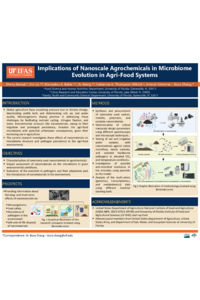
Introduction: The agri-food microbiome, which shows promise in addressing agricultural challenges by facilitating nutrient cycling, nitrogen fixation, and more, is increasingly threatened by environmental stressors like nanomaterials (NMs) due to their migration and prolonged persistence, potentially leading to unforeseen consequences as their use in agriculture grows.
Purpose: The current study investigates the effects of NMs on microbial structure and pathogen persistence in agri-food environments.
Methods: Commonly used metallic NMs in agri-food systems, viz., Ag, CuO, CeO2, Fe2O3, MgO, TiO2, and ZnO, were tested in soil collected from a site classified under the Apopka soil series. A total of eight soil pots for each treatment (seven NMs and a control) were maintained in a greenhouse facility for a period of 12 weeks. From each of these pots, cross-sectional samples at two different heights were collected periodically at time points of 0 weeks, 4 weeks, 8 weeks, and 12 weeks. Aerobic plate count (APC) data was recorded to gather information on the effect of variables such as NM migration due to rainfall and time. The collected samples were used to assess the impact of NMs on native soil microflora and foodborne pathogens using multi-omics and machine learning strategies.
Results: Among the tested NMs, Ag treatment significantly reduced bacterial growth, as indicated by the APC data. This reduction was observed at both soil pot depths, middle (p < 9.31 × 10⁻¹⁰) and bottom (p < 0.000128), at a 95% confidence interval, compared to the controls. However, within the Ag treatment, bacterial growth was not significantly affected by time at either the middle (p = 0.39) or bottom (p = 0.508) depths.
Significance: This research could provide information on Ag NMs’ long- and short-term effects on microbes, food safety, and pathogen persistence in the environment, in addition to shedding light on their safe end-of-life disposal.
Keywords
Nanomaterials
Food Safety
Food Microbiology
Agriculture
Poster
FoodsPoster_SherryBansal_Sciforum-134952.pdf
The impact of spray-dried potato flour on the techno-functional, rheological and digestibility traits of white sorghum flour-based flatbreads
Nondestructive foodborne pathogen detection using a colorimetric sensor enabled by machine learning and non-toxic dyes