Event submissions
Published
This submission belongs to the session A. Food Technology and Engineering of the event The 6th International Electronic Conference on Foods
Published date
27 Oct, 2025
Academic Editor
'%3e%3cpath%20d='M12.6657%2010.9104C12.4185%2010.325%2012.0599%209.79327%2011.6097%209.34482C11.1609%208.89508%2010.6293%208.5365%2010.0442%208.28888C10.0389%208.28626%2010.0337%208.28495%2010.0285%208.28233C10.8446%207.69279%2011.3752%206.73249%2011.3752%205.64904C11.3752%203.8542%209.92103%202.39999%208.1262%202.39999C6.33136%202.39999%204.87715%203.8542%204.87715%205.64904C4.87715%206.73249%205.40774%207.69279%206.22393%208.28364C6.21869%208.28626%206.21345%208.28757%206.20821%208.29019C5.62129%208.5378%205.09463%208.89284%204.64265%209.34613C4.1929%209.79493%203.83432%2010.3266%203.58671%2010.9117C3.34345%2011.4845%203.21226%2012.0987%203.20023%2012.7209C3.19988%2012.7349%203.20233%2012.7488%203.20744%2012.7619C3.21255%2012.7749%203.22022%2012.7867%203.22998%2012.7968C3.23975%2012.8068%203.25142%2012.8147%203.26431%2012.8202C3.2772%2012.8256%203.29105%2012.8284%203.30504%2012.8284H4.09109C4.14874%2012.8284%204.19459%2012.7825%204.1959%2012.7262C4.2221%2011.7148%204.62823%2010.7676%205.34617%2010.0497C6.08899%209.30683%207.0755%208.89808%208.1262%208.89808C9.17689%208.89808%2010.1634%209.30683%2010.9062%2010.0497C11.6242%2010.7676%2012.0303%2011.7148%2012.0565%2012.7262C12.0578%2012.7838%2012.1037%2012.8284%2012.1613%2012.8284H12.9474C12.9613%2012.8284%2012.9752%2012.8256%2012.9881%2012.8202C13.001%2012.8147%2013.0126%2012.8068%2013.0224%2012.7968C13.0322%2012.7867%2013.0398%2012.7749%2013.0449%2012.7619C13.0501%2012.7488%2013.0525%2012.7349%2013.0522%2012.7209C13.0391%2012.0947%2012.9094%2011.4855%2012.6657%2010.9104ZM8.1262%207.9024C7.52486%207.9024%206.9589%207.6679%206.53312%207.24211C6.10733%206.81633%205.87283%206.25037%205.87283%205.64904C5.87283%205.0477%206.10733%204.48174%206.53312%204.05596C6.9589%203.63018%207.52486%203.39567%208.1262%203.39567C8.72753%203.39567%209.29349%203.63018%209.71927%204.05596C10.1451%204.48174%2010.3796%205.0477%2010.3796%205.64904C10.3796%206.25037%2010.1451%206.81633%209.71927%207.24211C9.29349%207.6679%208.72753%207.9024%208.1262%207.9024Z'%20fill='%235D1EE1'/%3e%3c/g%3e%3c/svg%3e) Cristobal Aguilar
Cristobal AguilarCitation
Inmaculada Gómez, Hayat Makroudi, Beatriz Melero, Miriam Ortega-Heras, Characterization of by-products from the production of blackberry juice and liqueur, in Proceedings of The 6th International Electronic Conference on Foods, 28 October–30 October 2025, MDPI: Basel, Switzerland
Share
Email
Facebook
Twitter
LinkedIn
Characterization of by-products from the production of blackberry juice and liqueur
'%3e%3cpath%20d='M12.6647%2010.9104C12.4176%2010.325%2012.0589%209.7933%2011.6088%209.34485C11.16%208.89511%2010.6283%208.53653%2010.0432%208.28891C10.038%208.28629%2010.0327%208.28498%2010.0275%208.28236C10.8437%207.69282%2011.3743%206.73252%2011.3743%205.64907C11.3743%203.85423%209.92005%202.40002%208.12522%202.40002C6.33038%202.40002%204.87618%203.85423%204.87618%205.64907C4.87618%206.73252%205.40677%207.69282%206.22296%208.28367C6.21772%208.28629%206.21248%208.2876%206.20724%208.29022C5.62031%208.53783%205.09365%208.89287%204.64167%209.34616C4.19192%209.79496%203.83334%2010.3266%203.58573%2010.9117C3.34247%2011.4846%203.21128%2012.0987%203.19925%2012.721C3.1989%2012.735%203.20135%2012.7489%203.20646%2012.7619C3.21157%2012.7749%203.21924%2012.7868%203.22901%2012.7968C3.23877%2012.8068%203.25045%2012.8148%203.26334%2012.8202C3.27623%2012.8256%203.29007%2012.8284%203.30406%2012.8284H4.09012C4.14776%2012.8284%204.19362%2012.7825%204.19493%2012.7262C4.22113%2011.7148%204.62726%2010.7676%205.34519%2010.0497C6.08802%209.30686%207.07452%208.89811%208.12522%208.89811C9.17592%208.89811%2010.1624%209.30686%2010.9052%2010.0497C11.6232%2010.7676%2012.0293%2011.7148%2012.0555%2012.7262C12.0568%2012.7839%2012.1027%2012.8284%2012.1603%2012.8284H12.9464C12.9604%2012.8284%2012.9742%2012.8256%2012.9871%2012.8202C13%2012.8148%2013.0117%2012.8068%2013.0214%2012.7968C13.0312%2012.7868%2013.0389%2012.7749%2013.044%2012.7619C13.0491%2012.7489%2013.0515%2012.735%2013.0512%2012.721C13.0381%2012.0947%2012.9084%2011.4856%2012.6647%2010.9104ZM8.12522%207.90243C7.52388%207.90243%206.95792%207.66793%206.53214%207.24215C6.10636%206.81636%205.87185%206.2504%205.87185%205.64907C5.87185%205.04773%206.10636%204.48177%206.53214%204.05599C6.95792%203.63021%207.52388%203.3957%208.12522%203.3957C8.72655%203.3957%209.29252%203.63021%209.7183%204.05599C10.1441%204.48177%2010.3786%205.04773%2010.3786%205.64907C10.3786%206.2504%2010.1441%206.81636%209.7183%207.24215C9.29252%207.66793%208.72655%207.90243%208.12522%207.90243Z'%20fill='%235D1EE1'/%3e%3c/g%3e%3c/svg%3e)
Inmaculada Gómez 1
Hayat Makroudi 1
Beatriz Melero 1
Miriam Ortega-Heras 1
1. Department of Biotechnology and Food Science, Faculty of Sciences, University of Burgos, Burgos, 09001, Spain
Abstract
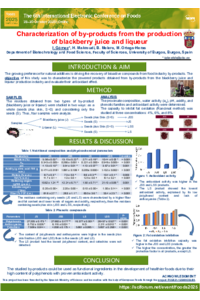
The growing preference for natural additives is driving the recovery of bioactive compounds from food industry by-products. The objective of this study was to characterize the powered products obtained from by-products from the blackberry juice and liqueur production industry and evaluate their antioxidant effects. The residues obtained from two types of by-product (blackberry juice or liqueur) were studied in two ways: as a whole (seeds plus skin, S+S) and considering only the seeds (S). Thus, four samples were analyzed based on the type by-product and the fraction studied: juice-S+S (JSS), juice-S (JS), liqueur-S+S (LSS), and liqueur-S (LS). The proximate composition, water activity (aw), pH, acidity, and polyphenols were determined. The capacity to inhibit fat oxidation (Rancimat method) was studied at three concentrations: 4%, 6%, and 8%. All the analyses were carried out in duplicate. ANOVA and Tukey's test were performed. The residues containing only seeds (JS and LS) were characterized by a higher fiber (81.6 - 83.5 %) and fat content (11.7 -12.5 %) and lower levels of sugars (10.6 -1.50 %) and acidity (0.474 -0.205 g citric acid/100 g), respectively, compared to the residues containing seeds plus skin (JSS and LSS, respectively), which showed the following contents of fiber (28.3 - 53.4 %), fat (4.3 -8.4 %), sugars (42.2 -24.4 %), and acidity (1.59 -1.43 g citric acid/100 g). The content of polyphenols (27.7 -28.4 mg GAE/ g) and anthocyanins (6.12 -2.21 mg cyanidin-3-glucoside /g) were higher in the seeds plus skin fraction (JSS and LSS) than in the seeds (polyphenol content: JS 27.2, LS 16.4 mg GAE/g; anthocyanin content: JS 0.752, LS no detected mg cyanidin-3-glucoside/g). The antioxidant activity and fat oxidation inhibition capacity was also higher in the JSS and LSS products. Therefore, the studied by-products could be used as functional ingredients in the development of healthier foods due to their high content of polyphenols with proven antioxidant activity.
Keywords
blackberry by-product
antioxidant activity
proximate composition
fat oxidation inhibition
Poster
Gómez I-ID sciforum-134694.pdf
Impact of pre- and post-annealing treatments on crosslinked and octenyl succinic anhydride-modified potato starch
Multi-digestive enzyme coronas on starch nanoparticles: Formation mechanisms, activity regulation, and controlled release of bioactive compounds