Event submissions
Published
This submission belongs to the session B. Nutritional and Functional Foods of the event The 6th International Electronic Conference on Foods
Published date
27 Oct, 2025
Academic Editor
'%3e%3cpath%20d='M12.6657%2010.9104C12.4185%2010.325%2012.0599%209.79327%2011.6097%209.34482C11.1609%208.89508%2010.6293%208.5365%2010.0442%208.28888C10.0389%208.28626%2010.0337%208.28495%2010.0285%208.28233C10.8446%207.69279%2011.3752%206.73249%2011.3752%205.64904C11.3752%203.8542%209.92103%202.39999%208.1262%202.39999C6.33136%202.39999%204.87715%203.8542%204.87715%205.64904C4.87715%206.73249%205.40774%207.69279%206.22393%208.28364C6.21869%208.28626%206.21345%208.28757%206.20821%208.29019C5.62129%208.5378%205.09463%208.89284%204.64265%209.34613C4.1929%209.79493%203.83432%2010.3266%203.58671%2010.9117C3.34345%2011.4845%203.21226%2012.0987%203.20023%2012.7209C3.19988%2012.7349%203.20233%2012.7488%203.20744%2012.7619C3.21255%2012.7749%203.22022%2012.7867%203.22998%2012.7968C3.23975%2012.8068%203.25142%2012.8147%203.26431%2012.8202C3.2772%2012.8256%203.29105%2012.8284%203.30504%2012.8284H4.09109C4.14874%2012.8284%204.19459%2012.7825%204.1959%2012.7262C4.2221%2011.7148%204.62823%2010.7676%205.34617%2010.0497C6.08899%209.30683%207.0755%208.89808%208.1262%208.89808C9.17689%208.89808%2010.1634%209.30683%2010.9062%2010.0497C11.6242%2010.7676%2012.0303%2011.7148%2012.0565%2012.7262C12.0578%2012.7838%2012.1037%2012.8284%2012.1613%2012.8284H12.9474C12.9613%2012.8284%2012.9752%2012.8256%2012.9881%2012.8202C13.001%2012.8147%2013.0126%2012.8068%2013.0224%2012.7968C13.0322%2012.7867%2013.0398%2012.7749%2013.0449%2012.7619C13.0501%2012.7488%2013.0525%2012.7349%2013.0522%2012.7209C13.0391%2012.0947%2012.9094%2011.4855%2012.6657%2010.9104ZM8.1262%207.9024C7.52486%207.9024%206.9589%207.6679%206.53312%207.24211C6.10733%206.81633%205.87283%206.25037%205.87283%205.64904C5.87283%205.0477%206.10733%204.48174%206.53312%204.05596C6.9589%203.63018%207.52486%203.39567%208.1262%203.39567C8.72753%203.39567%209.29349%203.63018%209.71927%204.05596C10.1451%204.48174%2010.3796%205.0477%2010.3796%205.64904C10.3796%206.25037%2010.1451%206.81633%209.71927%207.24211C9.29349%207.6679%208.72753%207.9024%208.1262%207.9024Z'%20fill='%235D1EE1'/%3e%3c/g%3e%3c/svg%3e) Manuel Viuda-Martos
Manuel Viuda-MartosCitation
Joanna Bryś, Diana Mańko-Jurkowska, Marta Siol, Eunika Nowicka, Bartłomiej Zieniuk, Andrzej Bryś, Oxidative and hydrolytic stability and composition of flaxseed oil ethyl ester and milk thistle oil blends during storage, in Proceedings of The 6th International Electronic Conference on Foods, 28 October–30 October 2025, MDPI: Basel, Switzerland
Share
Email
Facebook
Twitter
LinkedIn
Oxidative and hydrolytic stability and composition of flaxseed oil ethyl ester and milk thistle oil blends during storage

Joanna Bryś 1

Diana Mańko-Jurkowska 1
'%3e%3cpath%20d='M12.6647%2010.9104C12.4176%2010.325%2012.0589%209.7933%2011.6088%209.34485C11.16%208.89511%2010.6283%208.53653%2010.0432%208.28891C10.038%208.28629%2010.0327%208.28498%2010.0275%208.28236C10.8437%207.69282%2011.3743%206.73252%2011.3743%205.64907C11.3743%203.85423%209.92005%202.40002%208.12522%202.40002C6.33038%202.40002%204.87618%203.85423%204.87618%205.64907C4.87618%206.73252%205.40677%207.69282%206.22296%208.28367C6.21772%208.28629%206.21248%208.2876%206.20724%208.29022C5.62031%208.53783%205.09365%208.89287%204.64167%209.34616C4.19192%209.79496%203.83334%2010.3266%203.58573%2010.9117C3.34247%2011.4846%203.21128%2012.0987%203.19925%2012.721C3.1989%2012.735%203.20135%2012.7489%203.20646%2012.7619C3.21157%2012.7749%203.21924%2012.7868%203.22901%2012.7968C3.23877%2012.8068%203.25045%2012.8148%203.26334%2012.8202C3.27623%2012.8256%203.29007%2012.8284%203.30406%2012.8284H4.09012C4.14776%2012.8284%204.19362%2012.7825%204.19493%2012.7262C4.22113%2011.7148%204.62726%2010.7676%205.34519%2010.0497C6.08802%209.30686%207.07452%208.89811%208.12522%208.89811C9.17592%208.89811%2010.1624%209.30686%2010.9052%2010.0497C11.6232%2010.7676%2012.0293%2011.7148%2012.0555%2012.7262C12.0568%2012.7839%2012.1027%2012.8284%2012.1603%2012.8284H12.9464C12.9604%2012.8284%2012.9742%2012.8256%2012.9871%2012.8202C13%2012.8148%2013.0117%2012.8068%2013.0214%2012.7968C13.0312%2012.7868%2013.0389%2012.7749%2013.044%2012.7619C13.0491%2012.7489%2013.0515%2012.735%2013.0512%2012.721C13.0381%2012.0947%2012.9084%2011.4856%2012.6647%2010.9104ZM8.12522%207.90243C7.52388%207.90243%206.95792%207.66793%206.53214%207.24215C6.10636%206.81636%205.87185%206.2504%205.87185%205.64907C5.87185%205.04773%206.10636%204.48177%206.53214%204.05599C6.95792%203.63021%207.52388%203.3957%208.12522%203.3957C8.72655%203.3957%209.29252%203.63021%209.7183%204.05599C10.1441%204.48177%2010.3786%205.04773%2010.3786%205.64907C10.3786%206.2504%2010.1441%206.81636%209.7183%207.24215C9.29252%207.66793%208.72655%207.90243%208.12522%207.90243Z'%20fill='%235D1EE1'/%3e%3c/g%3e%3c/svg%3e)
Marta Siol 1
Eunika Nowicka 1

Bartłomiej Zieniuk 1

Andrzej Bryś 2
1. Department of Chemistry, Institute of Food Sciences, Warsaw University of Life Sciences, 159c, Nowoursynowska St., 02-776 Warsaw, Poland
2. Department of Fundamental Engineering and Energetics, Institute of Mechanical Engineering, Warsaw University of Life Sciences, Warsaw, Poland
Abstract
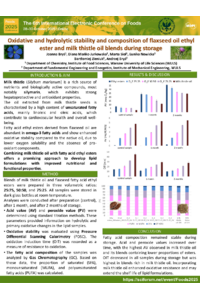
Milk thistle (Silybum marianum) is a valuable source of nutrients and bioactive compounds, particularly silymarin, known for its hepatoprotective and antioxidant properties. Its oil contains high levels of unsaturated fatty acids, especially linoleic and oleic acids, which may help prevent cardiovascular diseases, among other health conditions. Fatty acid ethyl esters, derived from flaxseed oil, are rich in omega-3 fatty acids and exhibit better oxidative stability than the corresponding oil due to reduced oxygen solubility and the absence of pro-oxidant components. Blending milk thistle oil with fatty acid ethyl esters can increase both the nutritional and functional value of lipid formulations.
This study evaluated blends of milk thistle oil and flaxseed ethyl esters in ratios of 25:75, 50:50 and 75:25, alongside pure ingredients. Samples were stored at room temperature and analyzed at baseline, after one month, and after two months of storage. Acid and peroxide values were determined by titration, oxidative stability was assessed by Pressure Differential Scanning Calorimetry (PDSC), and fatty acid composition was assessed by Gas Chromatography (GC).
Fatty acid profiles remained stable during storage. Acid values increased with time, with the highest values observed in milk thistle oil and its blends containing lower proportions of esters. Peroxide values increased most rapidly in ethyl esters and their blends, indicating active primary oxidation. Oxidation induction time measured by PDSC decreased with storage in all samples, especially in ethyl esters. Blends with higher milk thistle oil content showed longer induction times and greater resistance to oxidative degradation. These results suggest that incorporation of milk thistle oil into ester-based lipid systems can improve oxidative stability and extend shelf life, thus supporting the development of functional and stable lipid ingredients for food or nutraceutical applications.
Keywords
Milk thistle oil
Ethyl esters of fatty acids
Oxidative stability
Hydrolytic stability
Fatty acid profile
Poster
J.Bryś_Oxidative and hydrolytic stability_Foods 2025.pdf
Multi-digestive enzyme coronas on starch nanoparticles: Formation mechanisms, activity regulation, and controlled release of bioactive compounds
Innovative Processing Approaches for Heavy Metal Detoxification in Seafood