Event submissions
Published
This submission belongs to the session B. Nutritional and Functional Foods of the event The 6th International Electronic Conference on Foods
Published date
27 Oct, 2025
Academic Editor
'%3e%3cpath%20d='M12.6657%2010.9104C12.4185%2010.325%2012.0599%209.79327%2011.6097%209.34482C11.1609%208.89508%2010.6293%208.5365%2010.0442%208.28888C10.0389%208.28626%2010.0337%208.28495%2010.0285%208.28233C10.8446%207.69279%2011.3752%206.73249%2011.3752%205.64904C11.3752%203.8542%209.92103%202.39999%208.1262%202.39999C6.33136%202.39999%204.87715%203.8542%204.87715%205.64904C4.87715%206.73249%205.40774%207.69279%206.22393%208.28364C6.21869%208.28626%206.21345%208.28757%206.20821%208.29019C5.62129%208.5378%205.09463%208.89284%204.64265%209.34613C4.1929%209.79493%203.83432%2010.3266%203.58671%2010.9117C3.34345%2011.4845%203.21226%2012.0987%203.20023%2012.7209C3.19988%2012.7349%203.20233%2012.7488%203.20744%2012.7619C3.21255%2012.7749%203.22022%2012.7867%203.22998%2012.7968C3.23975%2012.8068%203.25142%2012.8147%203.26431%2012.8202C3.2772%2012.8256%203.29105%2012.8284%203.30504%2012.8284H4.09109C4.14874%2012.8284%204.19459%2012.7825%204.1959%2012.7262C4.2221%2011.7148%204.62823%2010.7676%205.34617%2010.0497C6.08899%209.30683%207.0755%208.89808%208.1262%208.89808C9.17689%208.89808%2010.1634%209.30683%2010.9062%2010.0497C11.6242%2010.7676%2012.0303%2011.7148%2012.0565%2012.7262C12.0578%2012.7838%2012.1037%2012.8284%2012.1613%2012.8284H12.9474C12.9613%2012.8284%2012.9752%2012.8256%2012.9881%2012.8202C13.001%2012.8147%2013.0126%2012.8068%2013.0224%2012.7968C13.0322%2012.7867%2013.0398%2012.7749%2013.0449%2012.7619C13.0501%2012.7488%2013.0525%2012.7349%2013.0522%2012.7209C13.0391%2012.0947%2012.9094%2011.4855%2012.6657%2010.9104ZM8.1262%207.9024C7.52486%207.9024%206.9589%207.6679%206.53312%207.24211C6.10733%206.81633%205.87283%206.25037%205.87283%205.64904C5.87283%205.0477%206.10733%204.48174%206.53312%204.05596C6.9589%203.63018%207.52486%203.39567%208.1262%203.39567C8.72753%203.39567%209.29349%203.63018%209.71927%204.05596C10.1451%204.48174%2010.3796%205.0477%2010.3796%205.64904C10.3796%206.25037%2010.1451%206.81633%209.71927%207.24211C9.29349%207.6679%208.72753%207.9024%208.1262%207.9024Z'%20fill='%235D1EE1'/%3e%3c/g%3e%3c/svg%3e) Antonello Santini
Antonello SantiniCitation
Marta Siol, Diana Mańko-Jurkowska, Marko Obranović, Joanna Bryś, From Waste to Wealth: Valorizing Pomegranate Seeds into Bioactive Oil by Microwave and Soxhlet Extraction, in Proceedings of The 6th International Electronic Conference on Foods, 28 October–30 October 2025, MDPI: Basel, Switzerland
Share
Email
Facebook
Twitter
LinkedIn
From Waste to Wealth: Valorizing Pomegranate Seeds into Bioactive Oil by Microwave and Soxhlet Extraction
'%3e%3cpath%20d='M12.6647%2010.9104C12.4176%2010.325%2012.0589%209.7933%2011.6088%209.34485C11.16%208.89511%2010.6283%208.53653%2010.0432%208.28891C10.038%208.28629%2010.0327%208.28498%2010.0275%208.28236C10.8437%207.69282%2011.3743%206.73252%2011.3743%205.64907C11.3743%203.85423%209.92005%202.40002%208.12522%202.40002C6.33038%202.40002%204.87618%203.85423%204.87618%205.64907C4.87618%206.73252%205.40677%207.69282%206.22296%208.28367C6.21772%208.28629%206.21248%208.2876%206.20724%208.29022C5.62031%208.53783%205.09365%208.89287%204.64167%209.34616C4.19192%209.79496%203.83334%2010.3266%203.58573%2010.9117C3.34247%2011.4846%203.21128%2012.0987%203.19925%2012.721C3.1989%2012.735%203.20135%2012.7489%203.20646%2012.7619C3.21157%2012.7749%203.21924%2012.7868%203.22901%2012.7968C3.23877%2012.8068%203.25045%2012.8148%203.26334%2012.8202C3.27623%2012.8256%203.29007%2012.8284%203.30406%2012.8284H4.09012C4.14776%2012.8284%204.19362%2012.7825%204.19493%2012.7262C4.22113%2011.7148%204.62726%2010.7676%205.34519%2010.0497C6.08802%209.30686%207.07452%208.89811%208.12522%208.89811C9.17592%208.89811%2010.1624%209.30686%2010.9052%2010.0497C11.6232%2010.7676%2012.0293%2011.7148%2012.0555%2012.7262C12.0568%2012.7839%2012.1027%2012.8284%2012.1603%2012.8284H12.9464C12.9604%2012.8284%2012.9742%2012.8256%2012.9871%2012.8202C13%2012.8148%2013.0117%2012.8068%2013.0214%2012.7968C13.0312%2012.7868%2013.0389%2012.7749%2013.044%2012.7619C13.0491%2012.7489%2013.0515%2012.735%2013.0512%2012.721C13.0381%2012.0947%2012.9084%2011.4856%2012.6647%2010.9104ZM8.12522%207.90243C7.52388%207.90243%206.95792%207.66793%206.53214%207.24215C6.10636%206.81636%205.87185%206.2504%205.87185%205.64907C5.87185%205.04773%206.10636%204.48177%206.53214%204.05599C6.95792%203.63021%207.52388%203.3957%208.12522%203.3957C8.72655%203.3957%209.29252%203.63021%209.7183%204.05599C10.1441%204.48177%2010.3786%205.04773%2010.3786%205.64907C10.3786%206.2504%2010.1441%206.81636%209.7183%207.24215C9.29252%207.66793%208.72655%207.90243%208.12522%207.90243Z'%20fill='%235D1EE1'/%3e%3c/g%3e%3c/svg%3e)
Marta Siol 1

Diana Mańko-Jurkowska 1
Marko Obranović 2

Joanna Bryś 1
1. Department of Chemistry, Institute of Food Sciences, Warsaw University of Life Sciences, Warsaw, 02-776, Poland
2. Department of Food Engineering, Faculty of Food Technology and Biotechnology, University of Zagreb, 10000, Croatia
Abstract
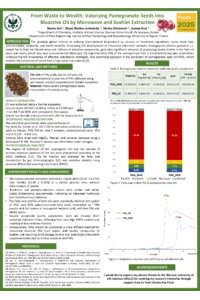
The growing global interest in utilizing plant-derived by-products as sources of functional ingredients stems from their environmental, economic, and health benefits, stimulating the development of innovative extraction methods. Pomegranate (Punica granatum L.), valued for its high nutritional value and richness in bioactive compounds, generates significant amounts of processing waste, mainly in the form of peels and seeds, which may pose environmental challenges. Approximately 50% of the pomegranate fruit is discarded during juice production, underscoring the importance of effective valorization strategies. One promising approach is the extraction of pomegranate seed oil (PSO), which enables the conversion of waste into a high-value raw material.
The aim of this study was to compare the physicochemical properties of PSO obtained using microwave-assisted extraction and Soxhlet extraction. The degree of hydrolysis was evaluated using the acid value, while the peroxide value was used to determine the content of primary oxidation products, in accordance with AOCS methods. Oxidative stability was assessed using pressure differential scanning calorimetry (PDSC), and the fatty acid profile was determined by gas chromatography (GC).
The results demonstrated that microwave-assisted extraction was more efficient than the Soxhlet method. The extracted PSO contained over 85% polyunsaturated fatty acids (PUFAs), including approximately 70% punicic acid, which is characteristic of this oil. Despite the low oxidative stability attributed to the high PUFA content, the oils showed good hydrolytic stability, with acid and peroxide values meeting the requirements specified in the Codex Alimentarius.
Overall, PSO serves as a valuable reservoir of bioactive compounds, particularly polyunsaturated fatty acids, and holds significant potential as a functional ingredient in food and nutraceutical formulations; however, further investigation is necessary to address its limited oxidative stability.
Keywords
pomegranate seed oil
antioxidants
antioxidative stability
pressure differential scanning calorimetry
Poster
sciforum-134323.pdf
DESIGN AND EVALUATION OF THE PROCESS TO OBTAIN MIXED PUREE OF PUMPKIN (CUCURBITA MOSCHATA) AND CARROT (DAUCUS CAROTA) TO BE PRESERVED BY SOUS VIDE TECHNOLOGY
Unveiling Popularity Shifts in Natural Nootropics: A Time Series Clustering of Reddit Discussions