Event submissions
Published
This submission belongs to the session E. Chemistry and Physicochemical Properties of the event The 6th International Electronic Conference on Foods
Published date
27 Oct, 2025
Academic Editor
'%3e%3cpath%20d='M12.6657%2010.9104C12.4185%2010.325%2012.0599%209.79327%2011.6097%209.34482C11.1609%208.89508%2010.6293%208.5365%2010.0442%208.28888C10.0389%208.28626%2010.0337%208.28495%2010.0285%208.28233C10.8446%207.69279%2011.3752%206.73249%2011.3752%205.64904C11.3752%203.8542%209.92103%202.39999%208.1262%202.39999C6.33136%202.39999%204.87715%203.8542%204.87715%205.64904C4.87715%206.73249%205.40774%207.69279%206.22393%208.28364C6.21869%208.28626%206.21345%208.28757%206.20821%208.29019C5.62129%208.5378%205.09463%208.89284%204.64265%209.34613C4.1929%209.79493%203.83432%2010.3266%203.58671%2010.9117C3.34345%2011.4845%203.21226%2012.0987%203.20023%2012.7209C3.19988%2012.7349%203.20233%2012.7488%203.20744%2012.7619C3.21255%2012.7749%203.22022%2012.7867%203.22998%2012.7968C3.23975%2012.8068%203.25142%2012.8147%203.26431%2012.8202C3.2772%2012.8256%203.29105%2012.8284%203.30504%2012.8284H4.09109C4.14874%2012.8284%204.19459%2012.7825%204.1959%2012.7262C4.2221%2011.7148%204.62823%2010.7676%205.34617%2010.0497C6.08899%209.30683%207.0755%208.89808%208.1262%208.89808C9.17689%208.89808%2010.1634%209.30683%2010.9062%2010.0497C11.6242%2010.7676%2012.0303%2011.7148%2012.0565%2012.7262C12.0578%2012.7838%2012.1037%2012.8284%2012.1613%2012.8284H12.9474C12.9613%2012.8284%2012.9752%2012.8256%2012.9881%2012.8202C13.001%2012.8147%2013.0126%2012.8068%2013.0224%2012.7968C13.0322%2012.7867%2013.0398%2012.7749%2013.0449%2012.7619C13.0501%2012.7488%2013.0525%2012.7349%2013.0522%2012.7209C13.0391%2012.0947%2012.9094%2011.4855%2012.6657%2010.9104ZM8.1262%207.9024C7.52486%207.9024%206.9589%207.6679%206.53312%207.24211C6.10733%206.81633%205.87283%206.25037%205.87283%205.64904C5.87283%205.0477%206.10733%204.48174%206.53312%204.05596C6.9589%203.63018%207.52486%203.39567%208.1262%203.39567C8.72753%203.39567%209.29349%203.63018%209.71927%204.05596C10.1451%204.48174%2010.3796%205.0477%2010.3796%205.64904C10.3796%206.25037%2010.1451%206.81633%209.71927%207.24211C9.29349%207.6679%208.72753%207.9024%208.1262%207.9024Z'%20fill='%235D1EE1'/%3e%3c/g%3e%3c/svg%3e) Joana Amaral
Joana AmaralCitation
Danica Mostoles, Fleur de Krijger, Andrea Mara, Gavino Sanna, Javier Saurina, Sonia Sentellas, Oscar Núñez, Characterization of honey for geographical origin authentication, in Proceedings of The 6th International Electronic Conference on Foods, 28 October–30 October 2025, MDPI: Basel, Switzerland
Share
Email
Facebook
Twitter
LinkedIn
Characterization of honey for geographical origin authentication
'%3e%3cpath%20d='M12.6647%2010.9104C12.4176%2010.325%2012.0589%209.7933%2011.6088%209.34485C11.16%208.89511%2010.6283%208.53653%2010.0432%208.28891C10.038%208.28629%2010.0327%208.28498%2010.0275%208.28236C10.8437%207.69282%2011.3743%206.73252%2011.3743%205.64907C11.3743%203.85423%209.92005%202.40002%208.12522%202.40002C6.33038%202.40002%204.87618%203.85423%204.87618%205.64907C4.87618%206.73252%205.40677%207.69282%206.22296%208.28367C6.21772%208.28629%206.21248%208.2876%206.20724%208.29022C5.62031%208.53783%205.09365%208.89287%204.64167%209.34616C4.19192%209.79496%203.83334%2010.3266%203.58573%2010.9117C3.34247%2011.4846%203.21128%2012.0987%203.19925%2012.721C3.1989%2012.735%203.20135%2012.7489%203.20646%2012.7619C3.21157%2012.7749%203.21924%2012.7868%203.22901%2012.7968C3.23877%2012.8068%203.25045%2012.8148%203.26334%2012.8202C3.27623%2012.8256%203.29007%2012.8284%203.30406%2012.8284H4.09012C4.14776%2012.8284%204.19362%2012.7825%204.19493%2012.7262C4.22113%2011.7148%204.62726%2010.7676%205.34519%2010.0497C6.08802%209.30686%207.07452%208.89811%208.12522%208.89811C9.17592%208.89811%2010.1624%209.30686%2010.9052%2010.0497C11.6232%2010.7676%2012.0293%2011.7148%2012.0555%2012.7262C12.0568%2012.7839%2012.1027%2012.8284%2012.1603%2012.8284H12.9464C12.9604%2012.8284%2012.9742%2012.8256%2012.9871%2012.8202C13%2012.8148%2013.0117%2012.8068%2013.0214%2012.7968C13.0312%2012.7868%2013.0389%2012.7749%2013.044%2012.7619C13.0491%2012.7489%2013.0515%2012.735%2013.0512%2012.721C13.0381%2012.0947%2012.9084%2011.4856%2012.6647%2010.9104ZM8.12522%207.90243C7.52388%207.90243%206.95792%207.66793%206.53214%207.24215C6.10636%206.81636%205.87185%206.2504%205.87185%205.64907C5.87185%205.04773%206.10636%204.48177%206.53214%204.05599C6.95792%203.63021%207.52388%203.3957%208.12522%203.3957C8.72655%203.3957%209.29252%203.63021%209.7183%204.05599C10.1441%204.48177%2010.3786%205.04773%2010.3786%205.64907C10.3786%206.2504%2010.1441%206.81636%209.7183%207.24215C9.29252%207.66793%208.72655%207.90243%208.12522%207.90243Z'%20fill='%235D1EE1'/%3e%3c/g%3e%3c/svg%3e)
Danica Mostoles 1
Fleur de Krijger 1

Andrea Mara 2

Gavino Sanna 2

Javier Saurina 1,3

Sonia Sentellas 1,3,4

Oscar Núñez 1,3,4
1. Department of Chemical Engineering and Analytical Chemistry, University of Barcelona, Martí i Franqués 1, 08028 Barcelona, Spain
2. Department of Chemical, Physical, Mathematical, and Natural Sciences, University of Sassari, 07100 Sassari, Italy
3. Research Institute in Food Nutrition and Food Safety, University of Barcelona, Santa Coloma de Gramenet, Martí i Franqués 1, 08028 Barcelona, Spain
4. Generalitat de Catalunya, Martí i Franqués 1, 08028 Barcelona, Spain
Abstract
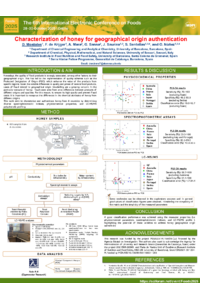
Nowadays, the quality of food products is strongly linked, among other factors, to their geographical origin, leading to the implementation of quality schemes such as the Protected Designation of Origin (PDO), enhancing the value of the products from certain regions. Given the differences in quality and prices of several food products, cases of fraud related to geographical origin mislabeling are a growing concern. In the particular scenario of honey, due to its high value, fraud cases arise from price differences between products of different origins and qualities. For this reason, in order to ensure its high quality and prevent fraud cases, it is important to recognize the differences in the chemical attributes of honey from different origins.
In this work, the characterization and classification of 68 honey samples from eight countries and diverse botanical origins (including acacia, chestnut, and eucalyptus, among others) relied on physicochemical parameters (pH, conductivity, sugar and water contents), spectrophotometric indexes (total phenolic content, ferric reducing antioxidant power, and 3,5-dinitrosalicylic acid assay), and LC-MS/MS polyphenolic profiling. The data generated in the studies were analyzed statistically (ANOVA and t-test) and with exploratory and classification methods (PCA and PLS-DA).
The statistical and chemometric analyses helped to identify different trends among the sample groups. Good classification error values were obtained with the parameters studied, especially with LC-MS/MS data, obtaining cross-validated values of classification error lower than 34.4%. Therefore, the variables studied in the present contribution were effective in distinguishing honey from diverse geographical origins, which will be helpful when addressing authentication issues.
Keywords
honey
geographical origin
authentication
characterization
Poster
poster_honey_characterization.pdf
Convergence or divergence: a comparative analysis of scientific and traditional cassava processing practices and their implications for the uptake of agro-processing technologies
Development of a predictive model for the effects of product and process parameters on thermal inactivation of heat-resistant spoilage yeast in simulated fruit juice