Event submissions
Published
This submission belongs to the session B. Nutritional and Functional Foods of the event The 6th International Electronic Conference on Foods
Published date
27 Oct, 2025
Academic Editor
'%3e%3cpath%20d='M12.6657%2010.9104C12.4185%2010.325%2012.0599%209.79327%2011.6097%209.34482C11.1609%208.89508%2010.6293%208.5365%2010.0442%208.28888C10.0389%208.28626%2010.0337%208.28495%2010.0285%208.28233C10.8446%207.69279%2011.3752%206.73249%2011.3752%205.64904C11.3752%203.8542%209.92103%202.39999%208.1262%202.39999C6.33136%202.39999%204.87715%203.8542%204.87715%205.64904C4.87715%206.73249%205.40774%207.69279%206.22393%208.28364C6.21869%208.28626%206.21345%208.28757%206.20821%208.29019C5.62129%208.5378%205.09463%208.89284%204.64265%209.34613C4.1929%209.79493%203.83432%2010.3266%203.58671%2010.9117C3.34345%2011.4845%203.21226%2012.0987%203.20023%2012.7209C3.19988%2012.7349%203.20233%2012.7488%203.20744%2012.7619C3.21255%2012.7749%203.22022%2012.7867%203.22998%2012.7968C3.23975%2012.8068%203.25142%2012.8147%203.26431%2012.8202C3.2772%2012.8256%203.29105%2012.8284%203.30504%2012.8284H4.09109C4.14874%2012.8284%204.19459%2012.7825%204.1959%2012.7262C4.2221%2011.7148%204.62823%2010.7676%205.34617%2010.0497C6.08899%209.30683%207.0755%208.89808%208.1262%208.89808C9.17689%208.89808%2010.1634%209.30683%2010.9062%2010.0497C11.6242%2010.7676%2012.0303%2011.7148%2012.0565%2012.7262C12.0578%2012.7838%2012.1037%2012.8284%2012.1613%2012.8284H12.9474C12.9613%2012.8284%2012.9752%2012.8256%2012.9881%2012.8202C13.001%2012.8147%2013.0126%2012.8068%2013.0224%2012.7968C13.0322%2012.7867%2013.0398%2012.7749%2013.0449%2012.7619C13.0501%2012.7488%2013.0525%2012.7349%2013.0522%2012.7209C13.0391%2012.0947%2012.9094%2011.4855%2012.6657%2010.9104ZM8.1262%207.9024C7.52486%207.9024%206.9589%207.6679%206.53312%207.24211C6.10733%206.81633%205.87283%206.25037%205.87283%205.64904C5.87283%205.0477%206.10733%204.48174%206.53312%204.05596C6.9589%203.63018%207.52486%203.39567%208.1262%203.39567C8.72753%203.39567%209.29349%203.63018%209.71927%204.05596C10.1451%204.48174%2010.3796%205.0477%2010.3796%205.64904C10.3796%206.25037%2010.1451%206.81633%209.71927%207.24211C9.29349%207.6679%208.72753%207.9024%208.1262%207.9024Z'%20fill='%235D1EE1'/%3e%3c/g%3e%3c/svg%3e) Manuel Viuda-Martos
Manuel Viuda-MartosCitation
Ezgi Nur YUKSEK, A. Gonzalez Pereira, Javier Echave, F. Chamorro, P. Donn, S. Seyyedi-Mansour, M. A. Prieto, Camellia japonica Leaves: A Promising Ingredient for Health-Promoting Plant-Based Beverages, in Proceedings of The 6th International Electronic Conference on Foods, 28 October–30 October 2025, MDPI: Basel, Switzerland
Share
Email
Facebook
Twitter
LinkedIn
Camellia japonica Leaves: A Promising Ingredient for Health-Promoting Plant-Based Beverages

Ezgi Nur YUKSEK 1

A. Gonzalez Pereira 1,2

Javier Echave 1,3

F. Chamorro 4
'%3e%3cpath%20d='M12.6647%2010.9104C12.4176%2010.325%2012.0589%209.7933%2011.6088%209.34485C11.16%208.89511%2010.6283%208.53653%2010.0432%208.28891C10.038%208.28629%2010.0327%208.28498%2010.0275%208.28236C10.8437%207.69282%2011.3743%206.73252%2011.3743%205.64907C11.3743%203.85423%209.92005%202.40002%208.12522%202.40002C6.33038%202.40002%204.87618%203.85423%204.87618%205.64907C4.87618%206.73252%205.40677%207.69282%206.22296%208.28367C6.21772%208.28629%206.21248%208.2876%206.20724%208.29022C5.62031%208.53783%205.09365%208.89287%204.64167%209.34616C4.19192%209.79496%203.83334%2010.3266%203.58573%2010.9117C3.34247%2011.4846%203.21128%2012.0987%203.19925%2012.721C3.1989%2012.735%203.20135%2012.7489%203.20646%2012.7619C3.21157%2012.7749%203.21924%2012.7868%203.22901%2012.7968C3.23877%2012.8068%203.25045%2012.8148%203.26334%2012.8202C3.27623%2012.8256%203.29007%2012.8284%203.30406%2012.8284H4.09012C4.14776%2012.8284%204.19362%2012.7825%204.19493%2012.7262C4.22113%2011.7148%204.62726%2010.7676%205.34519%2010.0497C6.08802%209.30686%207.07452%208.89811%208.12522%208.89811C9.17592%208.89811%2010.1624%209.30686%2010.9052%2010.0497C11.6232%2010.7676%2012.0293%2011.7148%2012.0555%2012.7262C12.0568%2012.7839%2012.1027%2012.8284%2012.1603%2012.8284H12.9464C12.9604%2012.8284%2012.9742%2012.8256%2012.9871%2012.8202C13%2012.8148%2013.0117%2012.8068%2013.0214%2012.7968C13.0312%2012.7868%2013.0389%2012.7749%2013.044%2012.7619C13.0491%2012.7489%2013.0515%2012.735%2013.0512%2012.721C13.0381%2012.0947%2012.9084%2011.4856%2012.6647%2010.9104ZM8.12522%207.90243C7.52388%207.90243%206.95792%207.66793%206.53214%207.24215C6.10636%206.81636%205.87185%206.2504%205.87185%205.64907C5.87185%205.04773%206.10636%204.48177%206.53214%204.05599C6.95792%203.63021%207.52388%203.3957%208.12522%203.3957C8.72655%203.3957%209.29252%203.63021%209.7183%204.05599C10.1441%204.48177%2010.3786%205.04773%2010.3786%205.64907C10.3786%206.2504%2010.1441%206.81636%209.7183%207.24215C9.29252%207.66793%208.72655%207.90243%208.12522%207.90243Z'%20fill='%235D1EE1'/%3e%3c/g%3e%3c/svg%3e)
P. Donn 1
S. Seyyedi-Mansour 1

M. A. Prieto 1
1. Instituto de Agroecoloxía e Alimentación (IAA), Universidade de Vigo, Nutrition and Food Group (NuFoG), Campus Auga, 32004 Ourense, Spain.
2. Investigaciones Agroalimentarias Research Group, Galicia Sur Health Research Institute (IIS Galicia Sur). SERGAS-UVIGO, Vigo, 36213, Spain
3. CIMO, LA SusTEC, Instituto Politécnico de Bragança, Campus de Santa Apolónia, 5300- 253 Bragança, Portugal.
4. Instituto de Agroecoloxía e Alimentación (IAA), Universidade de Vigo, Nutrition and Food Group (NuFoG), Campus Auga, 32004 Ourense, Spain
Abstract
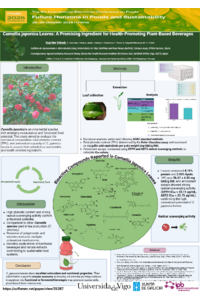
Camellia japonica, widely appreciated as an ornamental plant, has recently attracted interest for its leaves as a potential source of nutritional and bioactive compounds. This study investigated the nutritional composition, total phenolic content (TPC), and antioxidant capacity of C. japonica leaves to assess their functional food potential. Nutritional analysis showed that the leaves contain 4.19% protein and 2.90% lipids, suggesting a low-fat, plant-based protein source. The total phenolic content (TPC), quantified using the Folin–Ciocalteu assay, was 36.67 ± 4.05 mg GAE/g dry weight, reflecting a substantial abundance of polyphenolic compounds.
Antioxidant activity, assessed via DPPH and ABTS radical scavenging assays, yielded IC₅₀ values of 33.11 ± 7.25 µg/mL and 23.75 ± 10.97 µg/mL, respectively, demonstrating notable antioxidant potential. These findings suggest that C. japonica leaves have both nutritional and functional value, supporting their potential use in the development of health-oriented food products. A promising application would be the formulation of a functional or fermented beverage such as kombucha, using C. japonica leaf extracts. These products could deliver natural antioxidants and polyphenols to consumers, offering benefits related to oxidative stress reduction and general well-being. Additionally, using leaves from ornamental pruning supports circular economy strategies and sustainable ingredient sourcing.
In conclusion, C. japonica leaves, traditionally underutilized, exhibit significant potential as a novel ingredient in the functional food sector. Their integration into plant-based beverages represents an innovative, sustainable approach to valorizing horticultural byproducts while contributing to the development of antioxidant-rich dietary options.
Keywords
Camellia japonica
nutritional composition
antioxidant activity
polyphenols
functional food
herbal beverages
natural extract
sustainable food systems.
Poster
sciforum-135011.pdf
COMPARISON OF VARIOUS ASSAYS OF ANTIOXIDANT ACTIVITY/CAPACITY: LIMITED SIGNIFICANCE OF THE REDOX POTENTIAL OF OXIDANTS/INDICATORS
Association between dietary profiles and chronic disease patterns