Event submissions
Published
This submission belongs to the session B. Nutritional and Functional Foods of the event The 6th International Electronic Conference on Foods
Published date
27 Oct, 2025
Academic Editor
'%3e%3cpath%20d='M12.6657%2010.9104C12.4185%2010.325%2012.0599%209.79327%2011.6097%209.34482C11.1609%208.89508%2010.6293%208.5365%2010.0442%208.28888C10.0389%208.28626%2010.0337%208.28495%2010.0285%208.28233C10.8446%207.69279%2011.3752%206.73249%2011.3752%205.64904C11.3752%203.8542%209.92103%202.39999%208.1262%202.39999C6.33136%202.39999%204.87715%203.8542%204.87715%205.64904C4.87715%206.73249%205.40774%207.69279%206.22393%208.28364C6.21869%208.28626%206.21345%208.28757%206.20821%208.29019C5.62129%208.5378%205.09463%208.89284%204.64265%209.34613C4.1929%209.79493%203.83432%2010.3266%203.58671%2010.9117C3.34345%2011.4845%203.21226%2012.0987%203.20023%2012.7209C3.19988%2012.7349%203.20233%2012.7488%203.20744%2012.7619C3.21255%2012.7749%203.22022%2012.7867%203.22998%2012.7968C3.23975%2012.8068%203.25142%2012.8147%203.26431%2012.8202C3.2772%2012.8256%203.29105%2012.8284%203.30504%2012.8284H4.09109C4.14874%2012.8284%204.19459%2012.7825%204.1959%2012.7262C4.2221%2011.7148%204.62823%2010.7676%205.34617%2010.0497C6.08899%209.30683%207.0755%208.89808%208.1262%208.89808C9.17689%208.89808%2010.1634%209.30683%2010.9062%2010.0497C11.6242%2010.7676%2012.0303%2011.7148%2012.0565%2012.7262C12.0578%2012.7838%2012.1037%2012.8284%2012.1613%2012.8284H12.9474C12.9613%2012.8284%2012.9752%2012.8256%2012.9881%2012.8202C13.001%2012.8147%2013.0126%2012.8068%2013.0224%2012.7968C13.0322%2012.7867%2013.0398%2012.7749%2013.0449%2012.7619C13.0501%2012.7488%2013.0525%2012.7349%2013.0522%2012.7209C13.0391%2012.0947%2012.9094%2011.4855%2012.6657%2010.9104ZM8.1262%207.9024C7.52486%207.9024%206.9589%207.6679%206.53312%207.24211C6.10733%206.81633%205.87283%206.25037%205.87283%205.64904C5.87283%205.0477%206.10733%204.48174%206.53312%204.05596C6.9589%203.63018%207.52486%203.39567%208.1262%203.39567C8.72753%203.39567%209.29349%203.63018%209.71927%204.05596C10.1451%204.48174%2010.3796%205.0477%2010.3796%205.64904C10.3796%206.25037%2010.1451%206.81633%209.71927%207.24211C9.29349%207.6679%208.72753%207.9024%208.1262%207.9024Z'%20fill='%235D1EE1'/%3e%3c/g%3e%3c/svg%3e) Manuel Viuda-Martos
Manuel Viuda-MartosCitation
Sandra Stamenković Stojanović, Ljubica Živković, Bojana Danilović, Stojan Mančić, Ivana Karabegović, Valorizing Raspberry Pomace for Improved Physicochemical Stability and Sensory Acceptance of Kefir during Cold Storage, in Proceedings of The 6th International Electronic Conference on Foods, 28 October–30 October 2025, MDPI: Basel, Switzerland
Share
Email
Facebook
Twitter
LinkedIn
Valorizing Raspberry Pomace for Improved Physicochemical Stability and Sensory Acceptance of Kefir during Cold Storage

Sandra Stamenković Stojanović 1
'%3e%3cpath%20d='M12.6647%2010.9104C12.4176%2010.325%2012.0589%209.7933%2011.6088%209.34485C11.16%208.89511%2010.6283%208.53653%2010.0432%208.28891C10.038%208.28629%2010.0327%208.28498%2010.0275%208.28236C10.8437%207.69282%2011.3743%206.73252%2011.3743%205.64907C11.3743%203.85423%209.92005%202.40002%208.12522%202.40002C6.33038%202.40002%204.87618%203.85423%204.87618%205.64907C4.87618%206.73252%205.40677%207.69282%206.22296%208.28367C6.21772%208.28629%206.21248%208.2876%206.20724%208.29022C5.62031%208.53783%205.09365%208.89287%204.64167%209.34616C4.19192%209.79496%203.83334%2010.3266%203.58573%2010.9117C3.34247%2011.4846%203.21128%2012.0987%203.19925%2012.721C3.1989%2012.735%203.20135%2012.7489%203.20646%2012.7619C3.21157%2012.7749%203.21924%2012.7868%203.22901%2012.7968C3.23877%2012.8068%203.25045%2012.8148%203.26334%2012.8202C3.27623%2012.8256%203.29007%2012.8284%203.30406%2012.8284H4.09012C4.14776%2012.8284%204.19362%2012.7825%204.19493%2012.7262C4.22113%2011.7148%204.62726%2010.7676%205.34519%2010.0497C6.08802%209.30686%207.07452%208.89811%208.12522%208.89811C9.17592%208.89811%2010.1624%209.30686%2010.9052%2010.0497C11.6232%2010.7676%2012.0293%2011.7148%2012.0555%2012.7262C12.0568%2012.7839%2012.1027%2012.8284%2012.1603%2012.8284H12.9464C12.9604%2012.8284%2012.9742%2012.8256%2012.9871%2012.8202C13%2012.8148%2013.0117%2012.8068%2013.0214%2012.7968C13.0312%2012.7868%2013.0389%2012.7749%2013.044%2012.7619C13.0491%2012.7489%2013.0515%2012.735%2013.0512%2012.721C13.0381%2012.0947%2012.9084%2011.4856%2012.6647%2010.9104ZM8.12522%207.90243C7.52388%207.90243%206.95792%207.66793%206.53214%207.24215C6.10636%206.81636%205.87185%206.2504%205.87185%205.64907C5.87185%205.04773%206.10636%204.48177%206.53214%204.05599C6.95792%203.63021%207.52388%203.3957%208.12522%203.3957C8.72655%203.3957%209.29252%203.63021%209.7183%204.05599C10.1441%204.48177%2010.3786%205.04773%2010.3786%205.64907C10.3786%206.2504%2010.1441%206.81636%209.7183%207.24215C9.29252%207.66793%208.72655%207.90243%208.12522%207.90243Z'%20fill='%235D1EE1'/%3e%3c/g%3e%3c/svg%3e)
Ljubica Živković 1
Bojana Danilović 1
Stojan Mančić 1

Ivana Karabegović 1
1. Faculty of Technology in Leskovac, University of Niš, Bulevar Oslobođenja 124, 16000 Leskovac, Serbia
Abstract
Kefir is a traditional milk beverage characterized by a mildly sour, slightly tangy taste, which sometimes requires enhancement due to consumer sensitivity to its natural tartness. Incorporating fruits or their derivatives, such as raspberry pomace, which is a nutrient-rich by-product, can significantly improve kefir's sensory and nutritional properties while addressing environmental concerns associated with waste disposal. Despite this potential, limited research exists on the impact of fruit pomace addition on kefir, particularly during the maturation period. Therefore, this study evaluated how different concentrations of raspberry pomace (10% and 20%), retained or strained post-fermentation, affect kefir's physicochemical characteristics and sensory acceptance during refrigerated storage. Kefir samples were prepared using pasteurized cow’s milk with 2.8% fat, inoculated with kefir grains, fermented at 23°C for 14 hours, and then stored at 4°C for 14 days. The results of this study showed that raspberry pomace significantly influenced physicochemical stability, notably reducing pH and total solids content while increasing titratable acidity. The most pronounced changes occurred in the 20% pomace-retained samples, with pH decreasing to 3.99, acidity rising to 27.8 °SH, and total solids content declining from 112.14 to 75.43 g/L. High pomace content and prolonged storage led to increased acidity and changes in texture, which negatively affected sensory acceptance after 10 days, indicating this period of time as an optimal storage duration. The results of the sensory evaluation indicate that the addition of raspberry pomace influenced the sensory attributes of kefir samples, particularly in terms of smell, color, texture, and acidity. While the presence of pomace improved color and smell scores, it negatively impacted the texture. Strained raspberry pomace kefir samples were better accepted, achieving scores of up to 7.8 out of 9 for appealing flavor profile, demonstrating that optimizing pomace concentration and processing method is essential for balancing functional benefits and consumer preference.
Keywords
functional food
kefir
raspberry pomace
maturation
stability.
Poster
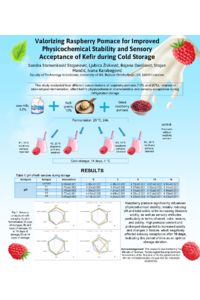
poster pdf.pdf
Characterising the nutritional and physicochemical properties and lipase and lipoxygenase activity of fermented Kabuli chickpea (Cicer arietinum L.) flours and the sensory properties of plant cheese formulated from these ingredients
STRUCTURAL CHARACTERIZATION OF EDIBLE FILMS WITH INCORPORATED LACTIC ACID BACTERIA FROM DAIRY BY-PRODUCTS