Event submissions
Published
This submission belongs to the session A. Food Technology and Engineering of the event The 6th International Electronic Conference on Foods
Published date
27 Oct, 2025
Academic Editor
'%3e%3cpath%20d='M12.6657%2010.9104C12.4185%2010.325%2012.0599%209.79327%2011.6097%209.34482C11.1609%208.89508%2010.6293%208.5365%2010.0442%208.28888C10.0389%208.28626%2010.0337%208.28495%2010.0285%208.28233C10.8446%207.69279%2011.3752%206.73249%2011.3752%205.64904C11.3752%203.8542%209.92103%202.39999%208.1262%202.39999C6.33136%202.39999%204.87715%203.8542%204.87715%205.64904C4.87715%206.73249%205.40774%207.69279%206.22393%208.28364C6.21869%208.28626%206.21345%208.28757%206.20821%208.29019C5.62129%208.5378%205.09463%208.89284%204.64265%209.34613C4.1929%209.79493%203.83432%2010.3266%203.58671%2010.9117C3.34345%2011.4845%203.21226%2012.0987%203.20023%2012.7209C3.19988%2012.7349%203.20233%2012.7488%203.20744%2012.7619C3.21255%2012.7749%203.22022%2012.7867%203.22998%2012.7968C3.23975%2012.8068%203.25142%2012.8147%203.26431%2012.8202C3.2772%2012.8256%203.29105%2012.8284%203.30504%2012.8284H4.09109C4.14874%2012.8284%204.19459%2012.7825%204.1959%2012.7262C4.2221%2011.7148%204.62823%2010.7676%205.34617%2010.0497C6.08899%209.30683%207.0755%208.89808%208.1262%208.89808C9.17689%208.89808%2010.1634%209.30683%2010.9062%2010.0497C11.6242%2010.7676%2012.0303%2011.7148%2012.0565%2012.7262C12.0578%2012.7838%2012.1037%2012.8284%2012.1613%2012.8284H12.9474C12.9613%2012.8284%2012.9752%2012.8256%2012.9881%2012.8202C13.001%2012.8147%2013.0126%2012.8068%2013.0224%2012.7968C13.0322%2012.7867%2013.0398%2012.7749%2013.0449%2012.7619C13.0501%2012.7488%2013.0525%2012.7349%2013.0522%2012.7209C13.0391%2012.0947%2012.9094%2011.4855%2012.6657%2010.9104ZM8.1262%207.9024C7.52486%207.9024%206.9589%207.6679%206.53312%207.24211C6.10733%206.81633%205.87283%206.25037%205.87283%205.64904C5.87283%205.0477%206.10733%204.48174%206.53312%204.05596C6.9589%203.63018%207.52486%203.39567%208.1262%203.39567C8.72753%203.39567%209.29349%203.63018%209.71927%204.05596C10.1451%204.48174%2010.3796%205.0477%2010.3796%205.64904C10.3796%206.25037%2010.1451%206.81633%209.71927%207.24211C9.29349%207.6679%208.72753%207.9024%208.1262%207.9024Z'%20fill='%235D1EE1'/%3e%3c/g%3e%3c/svg%3e) Mohsen Gavahian
Mohsen GavahianCitation
Agne Vasiliauskaite, Elvidas Aleksandrovas, Joana T. Martins, Jorge M. Vieira, Antonio A. Vicente, Mindaugas Malakauskas, Loreta Serniene, STRUCTURAL CHARACTERIZATION OF EDIBLE FILMS WITH INCORPORATED LACTIC ACID BACTERIA FROM DAIRY BY-PRODUCTS, in Proceedings of The 6th International Electronic Conference on Foods, 28 October–30 October 2025, MDPI: Basel, Switzerland
Share
Email
Facebook
Twitter
LinkedIn
STRUCTURAL CHARACTERIZATION OF EDIBLE FILMS WITH INCORPORATED LACTIC ACID BACTERIA FROM DAIRY BY-PRODUCTS
'%3e%3cpath%20d='M12.6647%2010.9104C12.4176%2010.325%2012.0589%209.7933%2011.6088%209.34485C11.16%208.89511%2010.6283%208.53653%2010.0432%208.28891C10.038%208.28629%2010.0327%208.28498%2010.0275%208.28236C10.8437%207.69282%2011.3743%206.73252%2011.3743%205.64907C11.3743%203.85423%209.92005%202.40002%208.12522%202.40002C6.33038%202.40002%204.87618%203.85423%204.87618%205.64907C4.87618%206.73252%205.40677%207.69282%206.22296%208.28367C6.21772%208.28629%206.21248%208.2876%206.20724%208.29022C5.62031%208.53783%205.09365%208.89287%204.64167%209.34616C4.19192%209.79496%203.83334%2010.3266%203.58573%2010.9117C3.34247%2011.4846%203.21128%2012.0987%203.19925%2012.721C3.1989%2012.735%203.20135%2012.7489%203.20646%2012.7619C3.21157%2012.7749%203.21924%2012.7868%203.22901%2012.7968C3.23877%2012.8068%203.25045%2012.8148%203.26334%2012.8202C3.27623%2012.8256%203.29007%2012.8284%203.30406%2012.8284H4.09012C4.14776%2012.8284%204.19362%2012.7825%204.19493%2012.7262C4.22113%2011.7148%204.62726%2010.7676%205.34519%2010.0497C6.08802%209.30686%207.07452%208.89811%208.12522%208.89811C9.17592%208.89811%2010.1624%209.30686%2010.9052%2010.0497C11.6232%2010.7676%2012.0293%2011.7148%2012.0555%2012.7262C12.0568%2012.7839%2012.1027%2012.8284%2012.1603%2012.8284H12.9464C12.9604%2012.8284%2012.9742%2012.8256%2012.9871%2012.8202C13%2012.8148%2013.0117%2012.8068%2013.0214%2012.7968C13.0312%2012.7868%2013.0389%2012.7749%2013.044%2012.7619C13.0491%2012.7489%2013.0515%2012.735%2013.0512%2012.721C13.0381%2012.0947%2012.9084%2011.4856%2012.6647%2010.9104ZM8.12522%207.90243C7.52388%207.90243%206.95792%207.66793%206.53214%207.24215C6.10636%206.81636%205.87185%206.2504%205.87185%205.64907C5.87185%205.04773%206.10636%204.48177%206.53214%204.05599C6.95792%203.63021%207.52388%203.3957%208.12522%203.3957C8.72655%203.3957%209.29252%203.63021%209.7183%204.05599C10.1441%204.48177%2010.3786%205.04773%2010.3786%205.64907C10.3786%206.2504%2010.1441%206.81636%209.7183%207.24215C9.29252%207.66793%208.72655%207.90243%208.12522%207.90243Z'%20fill='%235D1EE1'/%3e%3c/g%3e%3c/svg%3e)
Agne Vasiliauskaite 1
Elvidas Aleksandrovas 1
Joana T. Martins 2,3
Jorge M. Vieira 2,3
Antonio A. Vicente 2,3

Mindaugas Malakauskas 1

Loreta Serniene 1
1. Department of Food Safety and Quality, Faculty of Veterinary Medicine, Veterinary Academy, Lithuanian University of Health Sciences, Tilzes str. 18, LT-47181 Kaunas, Lithuania
2. Centre of Biological Engineering (CEB), University of Minho, Campus de Gualtar, 4710-057 Braga, Portugal
3. LABBELS – Associate Laboratory, 4710-057 Braga/Guimarães, Portugal
Abstract
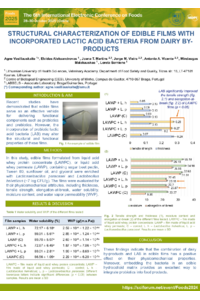
Recent studies have demonstrated that edible films serve as an effective vehicle for delivering functional components such as probiotics and prebiotics. However, the incorporation of probiotic lactic acid bacteria (LAB) may alter the structural and functional properties of these films.
In this study, edible films formulated from liquid acid whey protein concentrate (LAWPC) or liquid acid whey permeate (LAWP), containing sugar beet pectin, Tween 80, sunflower oil, and glycerol, were enriched with Lacticaseibacillus paracasei and Lactobacillus helveticus (~7 log CFU/g). The films were evaluated for their physicomechanical attributes, including thickness, tensile strength, elongation at break, water solubility, moisture content, and water vapor permeability (WVP).
The plain LAWP film exhibited significantly higher moisture content (28%), reduced thickness (54%), and greater stretchability (70%) compared to the plain LAWPC film (p < 0.05). Incorporation of both L. paracasei and L. helveticus into LAWPC films significantly enhanced their stretchability and tensile strength (p < 0.05). Additionally, L. helveticus reduced the thickness of LAWPC films, while L. paracasei increased the solubility of LAWP films (p < 0.05). However, the film type and LAB strain used did not affect water solubility, with mean values of 69.41% for LAWPC films and 77.26% for LAWP films (p ≥ 0.05). No statistically significant differences were observed in WVP among the film samples, with an overall mean of 2.60 × 10⁻⁶ ± 1.03 × 10⁻⁷ (g/(m.s.Pa)) (p ≥ 0.05).
These findings indicate that the combination of dairy by-products and LAB in edible films has a positive effect on their physicomechanical properties. Moreover, embedding the bacteria in an edible hydrocolloid matrix provides an excellent way to integrate probiotics into food products.
Keywords
lactic acid bacteria
dairy by-products
biopolymer films
physicomechanical properties.
Poster
Vasiliauskaite. foods.pdf
Valorizing Raspberry Pomace for Improved Physicochemical Stability and Sensory Acceptance of Kefir during Cold Storage
Innovative lab-on-chip for the rapid detection of polyphenolic compounds in olives and their derivatives