Event submissions
Published
This submission belongs to the session A. Food Technology and Engineering of the event The 6th International Electronic Conference on Foods
Published date
27 Oct, 2025
Academic Editor
'%3e%3cpath%20d='M12.6657%2010.9104C12.4185%2010.325%2012.0599%209.79327%2011.6097%209.34482C11.1609%208.89508%2010.6293%208.5365%2010.0442%208.28888C10.0389%208.28626%2010.0337%208.28495%2010.0285%208.28233C10.8446%207.69279%2011.3752%206.73249%2011.3752%205.64904C11.3752%203.8542%209.92103%202.39999%208.1262%202.39999C6.33136%202.39999%204.87715%203.8542%204.87715%205.64904C4.87715%206.73249%205.40774%207.69279%206.22393%208.28364C6.21869%208.28626%206.21345%208.28757%206.20821%208.29019C5.62129%208.5378%205.09463%208.89284%204.64265%209.34613C4.1929%209.79493%203.83432%2010.3266%203.58671%2010.9117C3.34345%2011.4845%203.21226%2012.0987%203.20023%2012.7209C3.19988%2012.7349%203.20233%2012.7488%203.20744%2012.7619C3.21255%2012.7749%203.22022%2012.7867%203.22998%2012.7968C3.23975%2012.8068%203.25142%2012.8147%203.26431%2012.8202C3.2772%2012.8256%203.29105%2012.8284%203.30504%2012.8284H4.09109C4.14874%2012.8284%204.19459%2012.7825%204.1959%2012.7262C4.2221%2011.7148%204.62823%2010.7676%205.34617%2010.0497C6.08899%209.30683%207.0755%208.89808%208.1262%208.89808C9.17689%208.89808%2010.1634%209.30683%2010.9062%2010.0497C11.6242%2010.7676%2012.0303%2011.7148%2012.0565%2012.7262C12.0578%2012.7838%2012.1037%2012.8284%2012.1613%2012.8284H12.9474C12.9613%2012.8284%2012.9752%2012.8256%2012.9881%2012.8202C13.001%2012.8147%2013.0126%2012.8068%2013.0224%2012.7968C13.0322%2012.7867%2013.0398%2012.7749%2013.0449%2012.7619C13.0501%2012.7488%2013.0525%2012.7349%2013.0522%2012.7209C13.0391%2012.0947%2012.9094%2011.4855%2012.6657%2010.9104ZM8.1262%207.9024C7.52486%207.9024%206.9589%207.6679%206.53312%207.24211C6.10733%206.81633%205.87283%206.25037%205.87283%205.64904C5.87283%205.0477%206.10733%204.48174%206.53312%204.05596C6.9589%203.63018%207.52486%203.39567%208.1262%203.39567C8.72753%203.39567%209.29349%203.63018%209.71927%204.05596C10.1451%204.48174%2010.3796%205.0477%2010.3796%205.64904C10.3796%206.25037%2010.1451%206.81633%209.71927%207.24211C9.29349%207.6679%208.72753%207.9024%208.1262%207.9024Z'%20fill='%235D1EE1'/%3e%3c/g%3e%3c/svg%3e) Elsa Gonçalves
Elsa GonçalvesCitation
Alessandro Bianchi, Giorgia Tori, Neetu Malik, Isabella Taglieri, Mariacristina Gagliardi, Marco Cecchini, Antonella Battisti, Francesca Venturi, Chiara Sanmartin, Innovative lab-on-chip for the rapid detection of polyphenolic compounds in olives and their derivatives , in Proceedings of The 6th International Electronic Conference on Foods, 28 October–30 October 2025, MDPI: Basel, Switzerland
Share
Email
Facebook
Twitter
LinkedIn
Innovative lab-on-chip for the rapid detection of polyphenolic compounds in olives and their derivatives

Alessandro Bianchi 1
'%3e%3cpath%20d='M12.6647%2010.9104C12.4176%2010.325%2012.0589%209.7933%2011.6088%209.34485C11.16%208.89511%2010.6283%208.53653%2010.0432%208.28891C10.038%208.28629%2010.0327%208.28498%2010.0275%208.28236C10.8437%207.69282%2011.3743%206.73252%2011.3743%205.64907C11.3743%203.85423%209.92005%202.40002%208.12522%202.40002C6.33038%202.40002%204.87618%203.85423%204.87618%205.64907C4.87618%206.73252%205.40677%207.69282%206.22296%208.28367C6.21772%208.28629%206.21248%208.2876%206.20724%208.29022C5.62031%208.53783%205.09365%208.89287%204.64167%209.34616C4.19192%209.79496%203.83334%2010.3266%203.58573%2010.9117C3.34247%2011.4846%203.21128%2012.0987%203.19925%2012.721C3.1989%2012.735%203.20135%2012.7489%203.20646%2012.7619C3.21157%2012.7749%203.21924%2012.7868%203.22901%2012.7968C3.23877%2012.8068%203.25045%2012.8148%203.26334%2012.8202C3.27623%2012.8256%203.29007%2012.8284%203.30406%2012.8284H4.09012C4.14776%2012.8284%204.19362%2012.7825%204.19493%2012.7262C4.22113%2011.7148%204.62726%2010.7676%205.34519%2010.0497C6.08802%209.30686%207.07452%208.89811%208.12522%208.89811C9.17592%208.89811%2010.1624%209.30686%2010.9052%2010.0497C11.6232%2010.7676%2012.0293%2011.7148%2012.0555%2012.7262C12.0568%2012.7839%2012.1027%2012.8284%2012.1603%2012.8284H12.9464C12.9604%2012.8284%2012.9742%2012.8256%2012.9871%2012.8202C13%2012.8148%2013.0117%2012.8068%2013.0214%2012.7968C13.0312%2012.7868%2013.0389%2012.7749%2013.044%2012.7619C13.0491%2012.7489%2013.0515%2012.735%2013.0512%2012.721C13.0381%2012.0947%2012.9084%2011.4856%2012.6647%2010.9104ZM8.12522%207.90243C7.52388%207.90243%206.95792%207.66793%206.53214%207.24215C6.10636%206.81636%205.87185%206.2504%205.87185%205.64907C5.87185%205.04773%206.10636%204.48177%206.53214%204.05599C6.95792%203.63021%207.52388%203.3957%208.12522%203.3957C8.72655%203.3957%209.29252%203.63021%209.7183%204.05599C10.1441%204.48177%2010.3786%205.04773%2010.3786%205.64907C10.3786%206.2504%2010.1441%206.81636%209.7183%207.24215C9.29252%207.66793%208.72655%207.90243%208.12522%207.90243Z'%20fill='%235D1EE1'/%3e%3c/g%3e%3c/svg%3e)
Giorgia Tori 2
Neetu Malik 2
Isabella Taglieri 1
Mariacristina Gagliardi 2

Marco Cecchini 2

Antonella Battisti 2

Francesca Venturi 1

Chiara Sanmartin 1
1. Department of Agriculture, Food and Environment, University of Pisa, via del Borghetto 80, 56124 Pisa, Italy
2. NEST, Nanoscience Institute – CNR and Scuola Normale Superiore, p.zza S. Silvestro 12, 56127 Pisa, Italy
Abstract
Polyphenols are key quality markers in olives and extra virgin olive oil (EVOO), influencing antioxidant potential, sensory traits, and shelf-life. Measuring polyphenol levels in fruits provides insight into the physiological condition of the plant, environmental interactions, and the overall quality of the harvest. This study aimed to develop a portable Lab-On-Chip platform integrating Quartz Crystal Microbalance with Dissipation monitoring (QCM-D) for the rapid assessment of olive phenolic content at various ripening stages, minimizing the need for expensive and time-consuming laboratory procedures. Sixty olive samples were collected at different ripening stages (green to fully ripe) across three cultivars, and thirty corresponding oil samples were analyzed. Olive phenolics were quantified using both aQCM-D device and the Folin–Ciocalteu (FC) method, allowing for direct comparison. Sensor surfaces were functionalized with bio-derived polymers (thiolated chitosan and carboxymethylcellulose), enabling selective binding of polyphenols. Standard solutions of hydroxytyrosol and tyrosol were used for calibration. QCM-D responses (Δf and ΔD) showed a strong correlation (R² = 0.91) with total polyphenol content measured using the FC method (range: 250–1300 mg GAE/kg). The repeatability of the QCM-D method showed an RSD < 5%, with the analysis time under 10 minutes per sample. Compared to FC, the QCM-D method required only a non-toxic hydroalcoholic solvent (20% ethanol), offering faster turnaround and potential in situ application. The system successfully differentiated samples according to ripening stage, with early-harvest olives exhibiting the highest polyphenolic load and QCM-D signal. A multivariate predictive model (PLS regression) is being developed to correlate QCM-D fingerprints with the phenolic profiles and sensory parameters of the resulting oils. This integrated platform represents a valuable tool for quick and accurate phenolic analysis, enabling improved decision-making regarding harvest timing. Ultimately, it supports quality control practices that align with market trends and consumer preferences.
Keywords
polyphenols
olives
quality control
non-destructive analytical techniques
Quartz Crystal Microbalance (QCM)
Poster
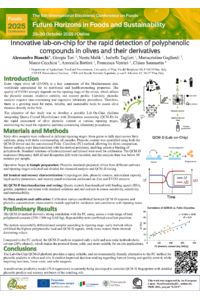
Poster Foods conference 2025-Bianchi-LOVE.pdf
STRUCTURAL CHARACTERIZATION OF EDIBLE FILMS WITH INCORPORATED LACTIC ACID BACTERIA FROM DAIRY BY-PRODUCTS
Integrative Profiling of Nutritional and Phytochemical Constituents in Bombax ceiba L. Flowers for Fortified Food Development