Event submissions
Published
This submission belongs to the session B. Nutritional and Functional Foods of the event The 6th International Electronic Conference on Foods
Published date
27 Oct, 2025
Academic Editor
'%3e%3cpath%20d='M12.6657%2010.9104C12.4185%2010.325%2012.0599%209.79327%2011.6097%209.34482C11.1609%208.89508%2010.6293%208.5365%2010.0442%208.28888C10.0389%208.28626%2010.0337%208.28495%2010.0285%208.28233C10.8446%207.69279%2011.3752%206.73249%2011.3752%205.64904C11.3752%203.8542%209.92103%202.39999%208.1262%202.39999C6.33136%202.39999%204.87715%203.8542%204.87715%205.64904C4.87715%206.73249%205.40774%207.69279%206.22393%208.28364C6.21869%208.28626%206.21345%208.28757%206.20821%208.29019C5.62129%208.5378%205.09463%208.89284%204.64265%209.34613C4.1929%209.79493%203.83432%2010.3266%203.58671%2010.9117C3.34345%2011.4845%203.21226%2012.0987%203.20023%2012.7209C3.19988%2012.7349%203.20233%2012.7488%203.20744%2012.7619C3.21255%2012.7749%203.22022%2012.7867%203.22998%2012.7968C3.23975%2012.8068%203.25142%2012.8147%203.26431%2012.8202C3.2772%2012.8256%203.29105%2012.8284%203.30504%2012.8284H4.09109C4.14874%2012.8284%204.19459%2012.7825%204.1959%2012.7262C4.2221%2011.7148%204.62823%2010.7676%205.34617%2010.0497C6.08899%209.30683%207.0755%208.89808%208.1262%208.89808C9.17689%208.89808%2010.1634%209.30683%2010.9062%2010.0497C11.6242%2010.7676%2012.0303%2011.7148%2012.0565%2012.7262C12.0578%2012.7838%2012.1037%2012.8284%2012.1613%2012.8284H12.9474C12.9613%2012.8284%2012.9752%2012.8256%2012.9881%2012.8202C13.001%2012.8147%2013.0126%2012.8068%2013.0224%2012.7968C13.0322%2012.7867%2013.0398%2012.7749%2013.0449%2012.7619C13.0501%2012.7488%2013.0525%2012.7349%2013.0522%2012.7209C13.0391%2012.0947%2012.9094%2011.4855%2012.6657%2010.9104ZM8.1262%207.9024C7.52486%207.9024%206.9589%207.6679%206.53312%207.24211C6.10733%206.81633%205.87283%206.25037%205.87283%205.64904C5.87283%205.0477%206.10733%204.48174%206.53312%204.05596C6.9589%203.63018%207.52486%203.39567%208.1262%203.39567C8.72753%203.39567%209.29349%203.63018%209.71927%204.05596C10.1451%204.48174%2010.3796%205.0477%2010.3796%205.64904C10.3796%206.25037%2010.1451%206.81633%209.71927%207.24211C9.29349%207.6679%208.72753%207.9024%208.1262%207.9024Z'%20fill='%235D1EE1'/%3e%3c/g%3e%3c/svg%3e) Antonello Santini
Antonello SantiniCitation
Agata Wojciechowicz-Budzisz, Ewa Pejcz, Agata Milcarz, Oliwia Paroń, Patryk Słota, Rafał Wiśniewski, Joanna Harasym, Impact of Apple Pomace Addition on the Chemical Composition of Blends and the Rheological Properties of Wheat Dough, in Proceedings of The 6th International Electronic Conference on Foods, 28 October–30 October 2025, MDPI: Basel, Switzerland
Share
Email
Facebook
Twitter
LinkedIn
Impact of Apple Pomace Addition on the Chemical Composition of Blends and the Rheological Properties of Wheat Dough

Agata Wojciechowicz-Budzisz 1
'%3e%3cpath%20d='M12.6647%2010.9104C12.4176%2010.325%2012.0589%209.7933%2011.6088%209.34485C11.16%208.89511%2010.6283%208.53653%2010.0432%208.28891C10.038%208.28629%2010.0327%208.28498%2010.0275%208.28236C10.8437%207.69282%2011.3743%206.73252%2011.3743%205.64907C11.3743%203.85423%209.92005%202.40002%208.12522%202.40002C6.33038%202.40002%204.87618%203.85423%204.87618%205.64907C4.87618%206.73252%205.40677%207.69282%206.22296%208.28367C6.21772%208.28629%206.21248%208.2876%206.20724%208.29022C5.62031%208.53783%205.09365%208.89287%204.64167%209.34616C4.19192%209.79496%203.83334%2010.3266%203.58573%2010.9117C3.34247%2011.4846%203.21128%2012.0987%203.19925%2012.721C3.1989%2012.735%203.20135%2012.7489%203.20646%2012.7619C3.21157%2012.7749%203.21924%2012.7868%203.22901%2012.7968C3.23877%2012.8068%203.25045%2012.8148%203.26334%2012.8202C3.27623%2012.8256%203.29007%2012.8284%203.30406%2012.8284H4.09012C4.14776%2012.8284%204.19362%2012.7825%204.19493%2012.7262C4.22113%2011.7148%204.62726%2010.7676%205.34519%2010.0497C6.08802%209.30686%207.07452%208.89811%208.12522%208.89811C9.17592%208.89811%2010.1624%209.30686%2010.9052%2010.0497C11.6232%2010.7676%2012.0293%2011.7148%2012.0555%2012.7262C12.0568%2012.7839%2012.1027%2012.8284%2012.1603%2012.8284H12.9464C12.9604%2012.8284%2012.9742%2012.8256%2012.9871%2012.8202C13%2012.8148%2013.0117%2012.8068%2013.0214%2012.7968C13.0312%2012.7868%2013.0389%2012.7749%2013.044%2012.7619C13.0491%2012.7489%2013.0515%2012.735%2013.0512%2012.721C13.0381%2012.0947%2012.9084%2011.4856%2012.6647%2010.9104ZM8.12522%207.90243C7.52388%207.90243%206.95792%207.66793%206.53214%207.24215C6.10636%206.81636%205.87185%206.2504%205.87185%205.64907C5.87185%205.04773%206.10636%204.48177%206.53214%204.05599C6.95792%203.63021%207.52388%203.3957%208.12522%203.3957C8.72655%203.3957%209.29252%203.63021%209.7183%204.05599C10.1441%204.48177%2010.3786%205.04773%2010.3786%205.64907C10.3786%206.2504%2010.1441%206.81636%209.7183%207.24215C9.29252%207.66793%208.72655%207.90243%208.12522%207.90243Z'%20fill='%235D1EE1'/%3e%3c/g%3e%3c/svg%3e)
Ewa Pejcz 1
Agata Milcarz 1
Oliwia Paroń 1
Patryk Słota 1
Rafał Wiśniewski 1

Joanna Harasym 1
1. Department of Biotechnology and Food Analysis, Wroclaw University of Economics and Business, Wrocław, 53-345, Komandorska 118 Street, Poland
Abstract
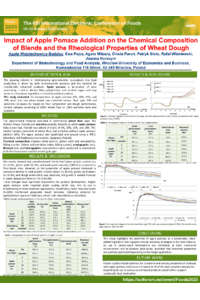
The growing interest in reintroducing agro-industrial by-products into food production is driven by both environmental concerns and the demand for nutritionally enhanced products. Apple pomace, a by-product of juice processing, is rich in dietary fiber, polyphenols, and residual sugars and may serve as a functional ingredient in cereal-based formulations. This study evaluated the incorporation of apple pomace (5%, 10%, 15%, and 20% w/w) into two wheat-based raw materials—wheat flour type 750 and semolina—to assess its impact on flour composition and dough performance. Control samples consisting of 100% wheat flour or 100% semolina were also analyzed.
Chemical composition analyses, amylographic tests, Mixolab tests, and farinographic measurements were conducted to characterize both the flour blends and the resulting doughs. Our results showed that semolina-based blends had higher protein content (up to 12.2%), gluten yield (21.2%), and peak paste viscosity (1049 AU) compared to flour-based ones. However, as the proportion of apple pomace increased, a consistent decline in total protein content (down to 10.4%), gluten yield (down to 13.4%), and dough extensibility was observed, along with a marked increase in water absorption (from 54.7% to 62.9%).
These changes have significant implications for product development. Higher apple pomace levels impaired gluten quality, which may limit its use in breadmaking or other leavened applications. Nonetheless, lower inclusion levels (5–10%) maintained acceptable dough behavior, indicating potential for applications in pasta or flatbreads, where high extensibility is not critical.
This study highlights the potential of apple pomace as a sustainable, value-added ingredient that supports circular economy strategies in the food industry. Its use in cereal-based formulations can contribute to both nutritional enhancement and by-product valorization, provided that functional properties are carefully optimized depending on the target application.
Keywords
fruit processing by-products
wheat blends
wheat dough
quality
functional food ingredients
Poster
apple pomace.pdf
EVALUATION OF OLIVE SEED POWDER IN THE DEVELOPMENT OF BIO-BASED PACKAGING MATERIALS
Chitosan-Based Active Films Enriched with Moroccan Essential Oils for Antimicrobial Packaging Applications