Event submissions
Published
This submission belongs to the session C. Food Quality and Safety of the event The 6th International Electronic Conference on Foods
Published date
27 Oct, 2025
Academic Editor
'%3e%3cpath%20d='M12.6657%2010.9104C12.4185%2010.325%2012.0599%209.79327%2011.6097%209.34482C11.1609%208.89508%2010.6293%208.5365%2010.0442%208.28888C10.0389%208.28626%2010.0337%208.28495%2010.0285%208.28233C10.8446%207.69279%2011.3752%206.73249%2011.3752%205.64904C11.3752%203.8542%209.92103%202.39999%208.1262%202.39999C6.33136%202.39999%204.87715%203.8542%204.87715%205.64904C4.87715%206.73249%205.40774%207.69279%206.22393%208.28364C6.21869%208.28626%206.21345%208.28757%206.20821%208.29019C5.62129%208.5378%205.09463%208.89284%204.64265%209.34613C4.1929%209.79493%203.83432%2010.3266%203.58671%2010.9117C3.34345%2011.4845%203.21226%2012.0987%203.20023%2012.7209C3.19988%2012.7349%203.20233%2012.7488%203.20744%2012.7619C3.21255%2012.7749%203.22022%2012.7867%203.22998%2012.7968C3.23975%2012.8068%203.25142%2012.8147%203.26431%2012.8202C3.2772%2012.8256%203.29105%2012.8284%203.30504%2012.8284H4.09109C4.14874%2012.8284%204.19459%2012.7825%204.1959%2012.7262C4.2221%2011.7148%204.62823%2010.7676%205.34617%2010.0497C6.08899%209.30683%207.0755%208.89808%208.1262%208.89808C9.17689%208.89808%2010.1634%209.30683%2010.9062%2010.0497C11.6242%2010.7676%2012.0303%2011.7148%2012.0565%2012.7262C12.0578%2012.7838%2012.1037%2012.8284%2012.1613%2012.8284H12.9474C12.9613%2012.8284%2012.9752%2012.8256%2012.9881%2012.8202C13.001%2012.8147%2013.0126%2012.8068%2013.0224%2012.7968C13.0322%2012.7867%2013.0398%2012.7749%2013.0449%2012.7619C13.0501%2012.7488%2013.0525%2012.7349%2013.0522%2012.7209C13.0391%2012.0947%2012.9094%2011.4855%2012.6657%2010.9104ZM8.1262%207.9024C7.52486%207.9024%206.9589%207.6679%206.53312%207.24211C6.10733%206.81633%205.87283%206.25037%205.87283%205.64904C5.87283%205.0477%206.10733%204.48174%206.53312%204.05596C6.9589%203.63018%207.52486%203.39567%208.1262%203.39567C8.72753%203.39567%209.29349%203.63018%209.71927%204.05596C10.1451%204.48174%2010.3796%205.0477%2010.3796%205.64904C10.3796%206.25037%2010.1451%206.81633%209.71927%207.24211C9.29349%207.6679%208.72753%207.9024%208.1262%207.9024Z'%20fill='%235D1EE1'/%3e%3c/g%3e%3c/svg%3e) Susana Casal
Susana CasalCitation
Nahla Chakroun, Ahmed Lamarti, Alain Badoc, Patrick Martin, Alexis Spalletta, Nicolas Joly, Ahmed Chelouan, Abdenbi Ben Driss, Ali Aghmiz, Quality evaluation of essential oils from fennel achenes grown in Morocco for industrial use, in Proceedings of The 6th International Electronic Conference on Foods, 28 October–30 October 2025, MDPI: Basel, Switzerland
Share
Email
Facebook
Twitter
LinkedIn
Quality evaluation of essential oils from fennel achenes grown in Morocco for industrial use
'%3e%3cpath%20d='M12.6647%2010.9104C12.4176%2010.325%2012.0589%209.7933%2011.6088%209.34485C11.16%208.89511%2010.6283%208.53653%2010.0432%208.28891C10.038%208.28629%2010.0327%208.28498%2010.0275%208.28236C10.8437%207.69282%2011.3743%206.73252%2011.3743%205.64907C11.3743%203.85423%209.92005%202.40002%208.12522%202.40002C6.33038%202.40002%204.87618%203.85423%204.87618%205.64907C4.87618%206.73252%205.40677%207.69282%206.22296%208.28367C6.21772%208.28629%206.21248%208.2876%206.20724%208.29022C5.62031%208.53783%205.09365%208.89287%204.64167%209.34616C4.19192%209.79496%203.83334%2010.3266%203.58573%2010.9117C3.34247%2011.4846%203.21128%2012.0987%203.19925%2012.721C3.1989%2012.735%203.20135%2012.7489%203.20646%2012.7619C3.21157%2012.7749%203.21924%2012.7868%203.22901%2012.7968C3.23877%2012.8068%203.25045%2012.8148%203.26334%2012.8202C3.27623%2012.8256%203.29007%2012.8284%203.30406%2012.8284H4.09012C4.14776%2012.8284%204.19362%2012.7825%204.19493%2012.7262C4.22113%2011.7148%204.62726%2010.7676%205.34519%2010.0497C6.08802%209.30686%207.07452%208.89811%208.12522%208.89811C9.17592%208.89811%2010.1624%209.30686%2010.9052%2010.0497C11.6232%2010.7676%2012.0293%2011.7148%2012.0555%2012.7262C12.0568%2012.7839%2012.1027%2012.8284%2012.1603%2012.8284H12.9464C12.9604%2012.8284%2012.9742%2012.8256%2012.9871%2012.8202C13%2012.8148%2013.0117%2012.8068%2013.0214%2012.7968C13.0312%2012.7868%2013.0389%2012.7749%2013.044%2012.7619C13.0491%2012.7489%2013.0515%2012.735%2013.0512%2012.721C13.0381%2012.0947%2012.9084%2011.4856%2012.6647%2010.9104ZM8.12522%207.90243C7.52388%207.90243%206.95792%207.66793%206.53214%207.24215C6.10636%206.81636%205.87185%206.2504%205.87185%205.64907C5.87185%205.04773%206.10636%204.48177%206.53214%204.05599C6.95792%203.63021%207.52388%203.3957%208.12522%203.3957C8.72655%203.3957%209.29252%203.63021%209.7183%204.05599C10.1441%204.48177%2010.3786%205.04773%2010.3786%205.64907C10.3786%206.2504%2010.1441%206.81636%209.7183%207.24215C9.29252%207.66793%208.72655%207.90243%208.12522%207.90243Z'%20fill='%235D1EE1'/%3e%3c/g%3e%3c/svg%3e)
Nahla Chakroun 1
Ahmed Lamarti 1
Alain Badoc 2

Patrick Martin 3
Alexis Spalletta 3

Nicolas Joly 3
Ahmed Chelouan 1
Abdenbi Ben Driss 4
Ali Aghmiz 1
1. Laboratory of Chemistry, Applied Microbiology & Biotechnology, Department of Chemistry, Faculty of Science, Abdelmalek Essaadi University, Mhannech II, Sebta Avenue, Box 2121, Tetouan 93002, Morocco
2. Oenology Research Unit (UMR1366), Department of Life Sciences & Health, Institute of Vine & Wine Sciences, Bordeaux University, Villenave d’Ornon, F‐33140, Department of Characterization & Development of Agricultural Products of National Institute of Agri
3. Transformation & Agro-Resources Unit (UTA, ULR7519), University Institute of Technology, Artois University-UniLaSalle Polytechnic Institute F-62408, Bethune 62400, France
4. Laboratory of Biology, Ecology & Health, Department of Biology, Faculty of Science, Abdelmalek Essaadi University, Mhannech II, Sebta Avenue, Box 2121, Tetouan 93002, Morocco
Abstract
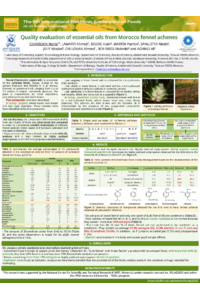
The fennel plant is an aromatic Apiaceae, widely cultivated in the Mediterranean basin to serve as a vegetable (azoricum variety, bulbous) and condiment (dulce variety, sweet) and for the production of EO rich in (E)-anethole (vulgare variety, bitter). Our previous work has shown that the EOs of the dulce and azoricum varieties contain more limonene and less α-pinene and fenchone compared to the vulgare variety. The latter is a more productive EO than the dulce variety, as it provides more fruit but is less rich in (E)-anethole and limonene and contains a large quantity of bitter-flavored substances such as α-pinene and fenchone.
The aim of our investigations was to formulate standards that must be met before fennel fruit can be marketed.
We carried out a study on the EO composition of 14 batches of cultivated fennel fruits marketed in Morocco. The compounds detected were determined by means of GC-MS and 25 compounds are identified (16 monoterpenes and 9 arylpropenes). We report the unusual presence of sabinene hydrate, p-butylanisole, elemicin, and two isomers, methyleugenol and methylisoeugenol.
Among the 14 batches analyzed, six samples of sweet fennel and just one batch of bulbous fennel were suitable for consumption. The consumer has the right to expect a product with an aniseed taste, with more than 50% (E)-anethole, less than 20% fenchone, and less than 20% (E)-anethole oxidation compounds, under the names "sweet fennel", "bulbous fennel", and "bitter fennel". We propose that fennel containing more than 10% estragole, or highly oxidized arylpropenes (20%) with a less aniseed taste, should be marked fennel rich in estragole or rich in elemicin. This latter molecule is structurally close to mescaline and is psychoactive at high doses. The gradual accumulation of this substance in the body following repeated consumption over a long period leads to serious adverse effects (cumulative toxicity).
Keywords
Key words: Fennel
fruits
essential oils
(E)-anethole
standards
quality.
Poster
Poster - CHAKROUN Nahla.pdf
Sustainable Utilisation of Banana Peel: Pectin Extraction and Fat Replacement in Cookies
Development and Validation of a Novel GC–MS Method for the Determination of Flavonoids in mallorcan Carob (Ceratonia siliqua) Honey