Event submissions
Published
This submission belongs to the session C. Food Quality and Safety of the event The 6th International Electronic Conference on Foods
Published date
27 Oct, 2025
Academic Editor
'%3e%3cpath%20d='M12.6657%2010.9104C12.4185%2010.325%2012.0599%209.79327%2011.6097%209.34482C11.1609%208.89508%2010.6293%208.5365%2010.0442%208.28888C10.0389%208.28626%2010.0337%208.28495%2010.0285%208.28233C10.8446%207.69279%2011.3752%206.73249%2011.3752%205.64904C11.3752%203.8542%209.92103%202.39999%208.1262%202.39999C6.33136%202.39999%204.87715%203.8542%204.87715%205.64904C4.87715%206.73249%205.40774%207.69279%206.22393%208.28364C6.21869%208.28626%206.21345%208.28757%206.20821%208.29019C5.62129%208.5378%205.09463%208.89284%204.64265%209.34613C4.1929%209.79493%203.83432%2010.3266%203.58671%2010.9117C3.34345%2011.4845%203.21226%2012.0987%203.20023%2012.7209C3.19988%2012.7349%203.20233%2012.7488%203.20744%2012.7619C3.21255%2012.7749%203.22022%2012.7867%203.22998%2012.7968C3.23975%2012.8068%203.25142%2012.8147%203.26431%2012.8202C3.2772%2012.8256%203.29105%2012.8284%203.30504%2012.8284H4.09109C4.14874%2012.8284%204.19459%2012.7825%204.1959%2012.7262C4.2221%2011.7148%204.62823%2010.7676%205.34617%2010.0497C6.08899%209.30683%207.0755%208.89808%208.1262%208.89808C9.17689%208.89808%2010.1634%209.30683%2010.9062%2010.0497C11.6242%2010.7676%2012.0303%2011.7148%2012.0565%2012.7262C12.0578%2012.7838%2012.1037%2012.8284%2012.1613%2012.8284H12.9474C12.9613%2012.8284%2012.9752%2012.8256%2012.9881%2012.8202C13.001%2012.8147%2013.0126%2012.8068%2013.0224%2012.7968C13.0322%2012.7867%2013.0398%2012.7749%2013.0449%2012.7619C13.0501%2012.7488%2013.0525%2012.7349%2013.0522%2012.7209C13.0391%2012.0947%2012.9094%2011.4855%2012.6657%2010.9104ZM8.1262%207.9024C7.52486%207.9024%206.9589%207.6679%206.53312%207.24211C6.10733%206.81633%205.87283%206.25037%205.87283%205.64904C5.87283%205.0477%206.10733%204.48174%206.53312%204.05596C6.9589%203.63018%207.52486%203.39567%208.1262%203.39567C8.72753%203.39567%209.29349%203.63018%209.71927%204.05596C10.1451%204.48174%2010.3796%205.0477%2010.3796%205.64904C10.3796%206.25037%2010.1451%206.81633%209.71927%207.24211C9.29349%207.6679%208.72753%207.9024%208.1262%207.9024Z'%20fill='%235D1EE1'/%3e%3c/g%3e%3c/svg%3e) Susana Casal
Susana CasalCitation
Benoît Grossiord, Short food supply chains and food safety issues: HACCP utilization, opportunities and limits, in Proceedings of The 6th International Electronic Conference on Foods, 28 October–30 October 2025, MDPI: Basel, Switzerland
Share
Email
Facebook
Twitter
LinkedIn
Short food supply chains and food safety issues: HACCP utilization, opportunities and limits

Benoît Grossiord 1
1. Bordeaux Sciences Agro, 1 Cours du Général de Gaulle, CS 40201, 33175 Gradignan, France
Abstract
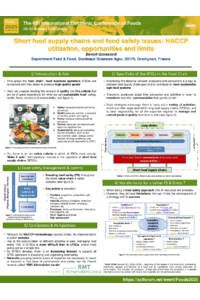
In order to maintain their farming activities and to appropriately respond to the expectations of consumers and society, farmers are developing new ways to valorize their products. One of these ways consists of shortening the distance between producers and consumers by developing new strategies that allow for a direct producer–consumer relation, like the so-called short food supply chains (SFSCs).
When developing SFSCs, producers have to use new skills to manage and control all the steps involved in the processing, storing, marketing or transport of the end products they put on the market. Through the whole process, from rearing animals or growing crops to end products, the producer has to face many stakes related to those new activities. One of the main stakes is the management and control of food safety. Like all other food business operators, producers involved in SFSCs must respect the EU regulation on food safety (Food Law). Here, we focus on Article 6 of the Food Law and its application in SFSCs.
Article 6 deals with risk analysis, which consists of three successive actions: risk assessment, risk management, and risk communication. The HACCP method (Hazard Analysis and Critical Control Point) is universal, and this report explores its utilization in SFSCs. The HACCP allows for a full analysis of the steps involved in the elaboration of end products, from the production of raw materials to commercialization. It is therefore a powerful tool for raising operators' awareness of the many hazards (physical, chemical, biological) that must be managed along the food chain, while also helping them to identify and apply proper good hygiene practices (GHPs). A better understanding and utilization of the HACCP will contribute to the improvement of the food safety culture (FSC), as is expected along the food chain.
Keywords
Short food supply chains
food safety
risk management
HACCP
Poster
sciforum-120109-B-Grossiord.pdf
NMR-Based Descriptors for the Detection of Dairy Product Adulteration
Assessment of Market Potential of Korean Dried Persimmon in Europe: A Qualitative Review