Event submissions
Published
This submission belongs to the session E. Chemistry and Physicochemical Properties of the event The 6th International Electronic Conference on Foods
Published date
27 Oct, 2025
Academic Editor
'%3e%3cpath%20d='M12.6657%2010.9104C12.4185%2010.325%2012.0599%209.79327%2011.6097%209.34482C11.1609%208.89508%2010.6293%208.5365%2010.0442%208.28888C10.0389%208.28626%2010.0337%208.28495%2010.0285%208.28233C10.8446%207.69279%2011.3752%206.73249%2011.3752%205.64904C11.3752%203.8542%209.92103%202.39999%208.1262%202.39999C6.33136%202.39999%204.87715%203.8542%204.87715%205.64904C4.87715%206.73249%205.40774%207.69279%206.22393%208.28364C6.21869%208.28626%206.21345%208.28757%206.20821%208.29019C5.62129%208.5378%205.09463%208.89284%204.64265%209.34613C4.1929%209.79493%203.83432%2010.3266%203.58671%2010.9117C3.34345%2011.4845%203.21226%2012.0987%203.20023%2012.7209C3.19988%2012.7349%203.20233%2012.7488%203.20744%2012.7619C3.21255%2012.7749%203.22022%2012.7867%203.22998%2012.7968C3.23975%2012.8068%203.25142%2012.8147%203.26431%2012.8202C3.2772%2012.8256%203.29105%2012.8284%203.30504%2012.8284H4.09109C4.14874%2012.8284%204.19459%2012.7825%204.1959%2012.7262C4.2221%2011.7148%204.62823%2010.7676%205.34617%2010.0497C6.08899%209.30683%207.0755%208.89808%208.1262%208.89808C9.17689%208.89808%2010.1634%209.30683%2010.9062%2010.0497C11.6242%2010.7676%2012.0303%2011.7148%2012.0565%2012.7262C12.0578%2012.7838%2012.1037%2012.8284%2012.1613%2012.8284H12.9474C12.9613%2012.8284%2012.9752%2012.8256%2012.9881%2012.8202C13.001%2012.8147%2013.0126%2012.8068%2013.0224%2012.7968C13.0322%2012.7867%2013.0398%2012.7749%2013.0449%2012.7619C13.0501%2012.7488%2013.0525%2012.7349%2013.0522%2012.7209C13.0391%2012.0947%2012.9094%2011.4855%2012.6657%2010.9104ZM8.1262%207.9024C7.52486%207.9024%206.9589%207.6679%206.53312%207.24211C6.10733%206.81633%205.87283%206.25037%205.87283%205.64904C5.87283%205.0477%206.10733%204.48174%206.53312%204.05596C6.9589%203.63018%207.52486%203.39567%208.1262%203.39567C8.72753%203.39567%209.29349%203.63018%209.71927%204.05596C10.1451%204.48174%2010.3796%205.0477%2010.3796%205.64904C10.3796%206.25037%2010.1451%206.81633%209.71927%207.24211C9.29349%207.6679%208.72753%207.9024%208.1262%207.9024Z'%20fill='%235D1EE1'/%3e%3c/g%3e%3c/svg%3e) Joana Amaral
Joana AmaralCitation
Mariana Robalo Santos, Veronica Capdevila, Carolina Iraporda, Maria Belen Fernandez, FTIR-ATR Characterization of By-products from Canola Oil Processing, in Proceedings of The 6th International Electronic Conference on Foods, 28 October–30 October 2025, MDPI: Basel, Switzerland
Share
Email
Facebook
Twitter
LinkedIn
FTIR-ATR Characterization of By-products from Canola Oil Processing
'%3e%3cpath%20d='M12.6647%2010.9104C12.4176%2010.325%2012.0589%209.7933%2011.6088%209.34485C11.16%208.89511%2010.6283%208.53653%2010.0432%208.28891C10.038%208.28629%2010.0327%208.28498%2010.0275%208.28236C10.8437%207.69282%2011.3743%206.73252%2011.3743%205.64907C11.3743%203.85423%209.92005%202.40002%208.12522%202.40002C6.33038%202.40002%204.87618%203.85423%204.87618%205.64907C4.87618%206.73252%205.40677%207.69282%206.22296%208.28367C6.21772%208.28629%206.21248%208.2876%206.20724%208.29022C5.62031%208.53783%205.09365%208.89287%204.64167%209.34616C4.19192%209.79496%203.83334%2010.3266%203.58573%2010.9117C3.34247%2011.4846%203.21128%2012.0987%203.19925%2012.721C3.1989%2012.735%203.20135%2012.7489%203.20646%2012.7619C3.21157%2012.7749%203.21924%2012.7868%203.22901%2012.7968C3.23877%2012.8068%203.25045%2012.8148%203.26334%2012.8202C3.27623%2012.8256%203.29007%2012.8284%203.30406%2012.8284H4.09012C4.14776%2012.8284%204.19362%2012.7825%204.19493%2012.7262C4.22113%2011.7148%204.62726%2010.7676%205.34519%2010.0497C6.08802%209.30686%207.07452%208.89811%208.12522%208.89811C9.17592%208.89811%2010.1624%209.30686%2010.9052%2010.0497C11.6232%2010.7676%2012.0293%2011.7148%2012.0555%2012.7262C12.0568%2012.7839%2012.1027%2012.8284%2012.1603%2012.8284H12.9464C12.9604%2012.8284%2012.9742%2012.8256%2012.9871%2012.8202C13%2012.8148%2013.0117%2012.8068%2013.0214%2012.7968C13.0312%2012.7868%2013.0389%2012.7749%2013.044%2012.7619C13.0491%2012.7489%2013.0515%2012.735%2013.0512%2012.721C13.0381%2012.0947%2012.9084%2011.4856%2012.6647%2010.9104ZM8.12522%207.90243C7.52388%207.90243%206.95792%207.66793%206.53214%207.24215C6.10636%206.81636%205.87185%206.2504%205.87185%205.64907C5.87185%205.04773%206.10636%204.48177%206.53214%204.05599C6.95792%203.63021%207.52388%203.3957%208.12522%203.3957C8.72655%203.3957%209.29252%203.63021%209.7183%204.05599C10.1441%204.48177%2010.3786%205.04773%2010.3786%205.64907C10.3786%206.2504%2010.1441%206.81636%209.7183%207.24215C9.29252%207.66793%208.72655%207.90243%208.12522%207.90243Z'%20fill='%235D1EE1'/%3e%3c/g%3e%3c/svg%3e)
Mariana Robalo Santos 1,2
Veronica Capdevila 1
Carolina Iraporda 1,2
Maria Belen Fernandez 1,2,3
1. Seeds and Foods Technology (TECSE); Department of Chemical Engineering and Food Technology, Faculty of Engineering, National University of the Center of the Province of Buenos Aires (UNCPBA), Olavarría, B7400JWI, Argentina
2. National Scientific and Technical Research Council (CONICET), Olavarría, B7400JWI, Argentina
3. Research Center in Physics and Engineering of the Center of the Province of Buenos Aires (CIFICEN), UNCPBA–CICPBA–CONICET, Olavarría, B7400JWI, Argentina
Abstract
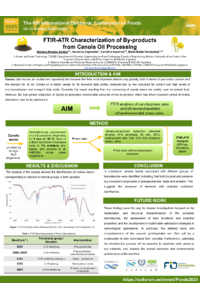
Currently, the meals resulting from the processing of canola seeds are mainly used as animal feed. However, the high global production of canola oil generates considerable amounts of this by-product, which has driven research aimed at finding alternative uses for its valorization. This work proposes the analysis, via FTIR, of two by-products: press cake and press cake subjected to ethanol extraction assisted by ultrasound. Canola seeds were provided by Al High Tech (Argentina). These seeds were hydrothermally pretreated in a VZ autoclave (Argentina) for 5 min at 130 °C, dried in a BGH QuickChef microwave oven to 7% moisture (dry basis), and pressed in an IMEGEN screw press (Argentina). The resulting press cake was subjected to ultrasound-assisted extraction (absolute ethanol, 57% amplitude, 60 min, 38°C, solid–solvent ratio 1:28, VCX 500 ultrasonic probe, USA). Press cake samples with and without subsequent extraction were analyzed by means of FTIR-ATR (IRXross, Shimadzu, Japan). The analysis of the spectra allowed for the identification of various bands corresponding to relevant functional groups in both samples. Bands were observed at 1031 cm⁻¹, which were attributed to C–O stretching vibrations, characteristic of polysaccharides. The signals in the region from 2920 to 2930 cm⁻¹ correspond to C–H stretching vibrations, indicative of the presence of polysaccharides. Similarly, the band registered at 1741 cm⁻¹ is related to the presence of carbonyl bonds (C=O) found in lipids, indicating the presence of residual oil. Absorptions near 1230 cm⁻¹ can be attributed to C–H bending vibrations. Finally, peaks were recorded at 3003 cm⁻¹, assigned to C=CH stretching, which may indicate the presence of proteins in the meals. These results suggest that both by-products retain relevant structural components of polysaccharides and proteins, encouraging further analysis aimed at their separation, structural characterization, study of functional properties, and promotion of their valorization in technological applications.
Keywords
Canola Press Cake
FTIR-ATR
ethanolic ultrasound extraction
Poster
poster conference in foods.pptx.pdf
Physicochemical and techno-functional properties of pumpkin seed (Cucurbita pepo var styrica) flour
The Influence of Oat Milk on the Rheological Properties and Compositional Properties of Basil-Enriched Functional Ice Cream