Event submissions
Published
This submission belongs to the session B. Nutritional and Functional Foods of the event The 6th International Electronic Conference on Foods
Published date
27 Oct, 2025
Academic Editor
'%3e%3cpath%20d='M12.6657%2010.9104C12.4185%2010.325%2012.0599%209.79327%2011.6097%209.34482C11.1609%208.89508%2010.6293%208.5365%2010.0442%208.28888C10.0389%208.28626%2010.0337%208.28495%2010.0285%208.28233C10.8446%207.69279%2011.3752%206.73249%2011.3752%205.64904C11.3752%203.8542%209.92103%202.39999%208.1262%202.39999C6.33136%202.39999%204.87715%203.8542%204.87715%205.64904C4.87715%206.73249%205.40774%207.69279%206.22393%208.28364C6.21869%208.28626%206.21345%208.28757%206.20821%208.29019C5.62129%208.5378%205.09463%208.89284%204.64265%209.34613C4.1929%209.79493%203.83432%2010.3266%203.58671%2010.9117C3.34345%2011.4845%203.21226%2012.0987%203.20023%2012.7209C3.19988%2012.7349%203.20233%2012.7488%203.20744%2012.7619C3.21255%2012.7749%203.22022%2012.7867%203.22998%2012.7968C3.23975%2012.8068%203.25142%2012.8147%203.26431%2012.8202C3.2772%2012.8256%203.29105%2012.8284%203.30504%2012.8284H4.09109C4.14874%2012.8284%204.19459%2012.7825%204.1959%2012.7262C4.2221%2011.7148%204.62823%2010.7676%205.34617%2010.0497C6.08899%209.30683%207.0755%208.89808%208.1262%208.89808C9.17689%208.89808%2010.1634%209.30683%2010.9062%2010.0497C11.6242%2010.7676%2012.0303%2011.7148%2012.0565%2012.7262C12.0578%2012.7838%2012.1037%2012.8284%2012.1613%2012.8284H12.9474C12.9613%2012.8284%2012.9752%2012.8256%2012.9881%2012.8202C13.001%2012.8147%2013.0126%2012.8068%2013.0224%2012.7968C13.0322%2012.7867%2013.0398%2012.7749%2013.0449%2012.7619C13.0501%2012.7488%2013.0525%2012.7349%2013.0522%2012.7209C13.0391%2012.0947%2012.9094%2011.4855%2012.6657%2010.9104ZM8.1262%207.9024C7.52486%207.9024%206.9589%207.6679%206.53312%207.24211C6.10733%206.81633%205.87283%206.25037%205.87283%205.64904C5.87283%205.0477%206.10733%204.48174%206.53312%204.05596C6.9589%203.63018%207.52486%203.39567%208.1262%203.39567C8.72753%203.39567%209.29349%203.63018%209.71927%204.05596C10.1451%204.48174%2010.3796%205.0477%2010.3796%205.64904C10.3796%206.25037%2010.1451%206.81633%209.71927%207.24211C9.29349%207.6679%208.72753%207.9024%208.1262%207.9024Z'%20fill='%235D1EE1'/%3e%3c/g%3e%3c/svg%3e) Antonello Santini
Antonello SantiniCitation
Carla Bonifacino, Luis Alberto Panizzolo, Gonzalo Gastón Palazolo, Analía Rodríguez, Alejandra Medrano, Cecilia Abirached, Defatted rice bran as a source of functional compounds: enzymatic release of bioaccessible peptides and phenolics, in Proceedings of The 6th International Electronic Conference on Foods, 28 October–30 October 2025, MDPI: Basel, Switzerland
Share
Email
Facebook
Twitter
LinkedIn
Defatted rice bran as a source of functional compounds: enzymatic release of bioaccessible peptides and phenolics

Carla Bonifacino 1
'%3e%3cpath%20d='M12.6647%2010.9104C12.4176%2010.325%2012.0589%209.7933%2011.6088%209.34485C11.16%208.89511%2010.6283%208.53653%2010.0432%208.28891C10.038%208.28629%2010.0327%208.28498%2010.0275%208.28236C10.8437%207.69282%2011.3743%206.73252%2011.3743%205.64907C11.3743%203.85423%209.92005%202.40002%208.12522%202.40002C6.33038%202.40002%204.87618%203.85423%204.87618%205.64907C4.87618%206.73252%205.40677%207.69282%206.22296%208.28367C6.21772%208.28629%206.21248%208.2876%206.20724%208.29022C5.62031%208.53783%205.09365%208.89287%204.64167%209.34616C4.19192%209.79496%203.83334%2010.3266%203.58573%2010.9117C3.34247%2011.4846%203.21128%2012.0987%203.19925%2012.721C3.1989%2012.735%203.20135%2012.7489%203.20646%2012.7619C3.21157%2012.7749%203.21924%2012.7868%203.22901%2012.7968C3.23877%2012.8068%203.25045%2012.8148%203.26334%2012.8202C3.27623%2012.8256%203.29007%2012.8284%203.30406%2012.8284H4.09012C4.14776%2012.8284%204.19362%2012.7825%204.19493%2012.7262C4.22113%2011.7148%204.62726%2010.7676%205.34519%2010.0497C6.08802%209.30686%207.07452%208.89811%208.12522%208.89811C9.17592%208.89811%2010.1624%209.30686%2010.9052%2010.0497C11.6232%2010.7676%2012.0293%2011.7148%2012.0555%2012.7262C12.0568%2012.7839%2012.1027%2012.8284%2012.1603%2012.8284H12.9464C12.9604%2012.8284%2012.9742%2012.8256%2012.9871%2012.8202C13%2012.8148%2013.0117%2012.8068%2013.0214%2012.7968C13.0312%2012.7868%2013.0389%2012.7749%2013.044%2012.7619C13.0491%2012.7489%2013.0515%2012.735%2013.0512%2012.721C13.0381%2012.0947%2012.9084%2011.4856%2012.6647%2010.9104ZM8.12522%207.90243C7.52388%207.90243%206.95792%207.66793%206.53214%207.24215C6.10636%206.81636%205.87185%206.2504%205.87185%205.64907C5.87185%205.04773%206.10636%204.48177%206.53214%204.05599C6.95792%203.63021%207.52388%203.3957%208.12522%203.3957C8.72655%203.3957%209.29252%203.63021%209.7183%204.05599C10.1441%204.48177%2010.3786%205.04773%2010.3786%205.64907C10.3786%206.2504%2010.1441%206.81636%209.7183%207.24215C9.29252%207.66793%208.72655%207.90243%208.12522%207.90243Z'%20fill='%235D1EE1'/%3e%3c/g%3e%3c/svg%3e)
Luis Alberto Panizzolo 1
Gonzalo Gastón Palazolo 2
Analía Rodríguez 1
Alejandra Medrano 1

Cecilia Abirached 1
1. Department of Food Science and Technology, Chemistry School, Universidad de la República, Montevideo, 11800, Uruguay
2. Food Functionality and Technology Research Laboratory, Department of Science and Technology, National University of Quilmes, Roque Sáenz Peña 352, B1876BXD, Bernal, Buenos Aires, Argentina
Abstract
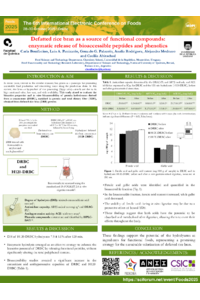
In recent years, interest in the circular economy has grown as a paradigm for promoting sustainable food production and minimizing waste along the production chain. In this context, rice bran—a by-product of rice processing (Oryza sativa)—stands out due to its high nutritional value, low cost, and wide availability. This study aimed to evaluate the bioactive properties and in vitro bioaccessibility of protein hydrolysates derived from a concentrate (DRBC), enriched in protein and total dietary fiber (TDF), obtained from defatted rice bran (DRB) powder. Enzymatic hydrolysis of DRBC was carried out using 1.0 mL L⁻¹ of Bacillus licheniformis protease (Subtilisin A, ≥2.4 U g⁻¹, P4860) at 50 °C, under stirring (150 rpm) and pH 8.0. The reaction was stopped at intervals ranging from 5 to 120 minutes to monitor changes in the hydrolysates' properties.
The assessment of bioaccessibility, performed via in vitro gastrointestinal simulation following the standardized INFOGEST 2.0 protocol, revealed a significant increase in the antioxidant and antihypertensive capacities of DRBC and its hydrolysates—particularly after 120 minutes of hydrolysis. Thus, enzymatic hydrolysis emerged as an effective strategy to enhance the bioactive potential of DRBC by releasing functional peptides without affecting total polyphenol content. In the bioaccessible fraction, ferulic and gallic acids were identified and quantified via HPLC-DAD. An increase in ferulic acid content and a decrease in gallic acid content were observed post-digestion. The stability of ferulic acid during digestion may be attributed to a protective effect provided by its association with TDF.
These results suggest that both acids may be absorbed and metabolized after digestion, enabling systemic bioactivity. Overall, these findings support the potential application of DRBC hydrolysates as functional food ingredients and offer a promising strategy for the sustainable valorization of defatted rice bran.
Keywords
Oryza sativa
enzymatic hydrolysis
proteins
bioaccessibility
bioactive properties
Poster
Bonifacino Foods 2025.pdf
Strategies to Overcome Barriers to the Implementation of Agriculture 4.0 Technologies in the Brazilian Agri-food System
Advancing Cold Brew Coffee through Probiotic Integration