Event submissions
Published
This submission belongs to the session C. Food Quality and Safety of the event The 6th International Electronic Conference on Foods
Published date
27 Oct, 2025
Academic Editor
'%3e%3cpath%20d='M12.6657%2010.9104C12.4185%2010.325%2012.0599%209.79327%2011.6097%209.34482C11.1609%208.89508%2010.6293%208.5365%2010.0442%208.28888C10.0389%208.28626%2010.0337%208.28495%2010.0285%208.28233C10.8446%207.69279%2011.3752%206.73249%2011.3752%205.64904C11.3752%203.8542%209.92103%202.39999%208.1262%202.39999C6.33136%202.39999%204.87715%203.8542%204.87715%205.64904C4.87715%206.73249%205.40774%207.69279%206.22393%208.28364C6.21869%208.28626%206.21345%208.28757%206.20821%208.29019C5.62129%208.5378%205.09463%208.89284%204.64265%209.34613C4.1929%209.79493%203.83432%2010.3266%203.58671%2010.9117C3.34345%2011.4845%203.21226%2012.0987%203.20023%2012.7209C3.19988%2012.7349%203.20233%2012.7488%203.20744%2012.7619C3.21255%2012.7749%203.22022%2012.7867%203.22998%2012.7968C3.23975%2012.8068%203.25142%2012.8147%203.26431%2012.8202C3.2772%2012.8256%203.29105%2012.8284%203.30504%2012.8284H4.09109C4.14874%2012.8284%204.19459%2012.7825%204.1959%2012.7262C4.2221%2011.7148%204.62823%2010.7676%205.34617%2010.0497C6.08899%209.30683%207.0755%208.89808%208.1262%208.89808C9.17689%208.89808%2010.1634%209.30683%2010.9062%2010.0497C11.6242%2010.7676%2012.0303%2011.7148%2012.0565%2012.7262C12.0578%2012.7838%2012.1037%2012.8284%2012.1613%2012.8284H12.9474C12.9613%2012.8284%2012.9752%2012.8256%2012.9881%2012.8202C13.001%2012.8147%2013.0126%2012.8068%2013.0224%2012.7968C13.0322%2012.7867%2013.0398%2012.7749%2013.0449%2012.7619C13.0501%2012.7488%2013.0525%2012.7349%2013.0522%2012.7209C13.0391%2012.0947%2012.9094%2011.4855%2012.6657%2010.9104ZM8.1262%207.9024C7.52486%207.9024%206.9589%207.6679%206.53312%207.24211C6.10733%206.81633%205.87283%206.25037%205.87283%205.64904C5.87283%205.0477%206.10733%204.48174%206.53312%204.05596C6.9589%203.63018%207.52486%203.39567%208.1262%203.39567C8.72753%203.39567%209.29349%203.63018%209.71927%204.05596C10.1451%204.48174%2010.3796%205.0477%2010.3796%205.64904C10.3796%206.25037%2010.1451%206.81633%209.71927%207.24211C9.29349%207.6679%208.72753%207.9024%208.1262%207.9024Z'%20fill='%235D1EE1'/%3e%3c/g%3e%3c/svg%3e) Susana Casal
Susana CasalCitation
Matteo Vitali, Mónica Gandia, Antonio Cilla, Amparo Gamero, Shelf-life and consumer acceptance of rice and tiger nut plant-based fermented beverages, in Proceedings of The 6th International Electronic Conference on Foods, 28 October–30 October 2025, MDPI: Basel, Switzerland
Share
Email
Facebook
Twitter
LinkedIn
Shelf-life and consumer acceptance of rice and tiger nut plant-based fermented beverages
'%3e%3cpath%20d='M12.6647%2010.9104C12.4176%2010.325%2012.0589%209.7933%2011.6088%209.34485C11.16%208.89511%2010.6283%208.53653%2010.0432%208.28891C10.038%208.28629%2010.0327%208.28498%2010.0275%208.28236C10.8437%207.69282%2011.3743%206.73252%2011.3743%205.64907C11.3743%203.85423%209.92005%202.40002%208.12522%202.40002C6.33038%202.40002%204.87618%203.85423%204.87618%205.64907C4.87618%206.73252%205.40677%207.69282%206.22296%208.28367C6.21772%208.28629%206.21248%208.2876%206.20724%208.29022C5.62031%208.53783%205.09365%208.89287%204.64167%209.34616C4.19192%209.79496%203.83334%2010.3266%203.58573%2010.9117C3.34247%2011.4846%203.21128%2012.0987%203.19925%2012.721C3.1989%2012.735%203.20135%2012.7489%203.20646%2012.7619C3.21157%2012.7749%203.21924%2012.7868%203.22901%2012.7968C3.23877%2012.8068%203.25045%2012.8148%203.26334%2012.8202C3.27623%2012.8256%203.29007%2012.8284%203.30406%2012.8284H4.09012C4.14776%2012.8284%204.19362%2012.7825%204.19493%2012.7262C4.22113%2011.7148%204.62726%2010.7676%205.34519%2010.0497C6.08802%209.30686%207.07452%208.89811%208.12522%208.89811C9.17592%208.89811%2010.1624%209.30686%2010.9052%2010.0497C11.6232%2010.7676%2012.0293%2011.7148%2012.0555%2012.7262C12.0568%2012.7839%2012.1027%2012.8284%2012.1603%2012.8284H12.9464C12.9604%2012.8284%2012.9742%2012.8256%2012.9871%2012.8202C13%2012.8148%2013.0117%2012.8068%2013.0214%2012.7968C13.0312%2012.7868%2013.0389%2012.7749%2013.044%2012.7619C13.0491%2012.7489%2013.0515%2012.735%2013.0512%2012.721C13.0381%2012.0947%2012.9084%2011.4856%2012.6647%2010.9104ZM8.12522%207.90243C7.52388%207.90243%206.95792%207.66793%206.53214%207.24215C6.10636%206.81636%205.87185%206.2504%205.87185%205.64907C5.87185%205.04773%206.10636%204.48177%206.53214%204.05599C6.95792%203.63021%207.52388%203.3957%208.12522%203.3957C8.72655%203.3957%209.29252%203.63021%209.7183%204.05599C10.1441%204.48177%2010.3786%205.04773%2010.3786%205.64907C10.3786%206.2504%2010.1441%206.81636%209.7183%207.24215C9.29252%207.66793%208.72655%207.90243%208.12522%207.90243Z'%20fill='%235D1EE1'/%3e%3c/g%3e%3c/svg%3e)
Matteo Vitali 1

Mónica Gandia 1

Antonio Cilla 1

Amparo Gamero 1
1. Department of Preventive Medicine and Public Health, Food Sciences, Toxicology and Forensic Medicine.Nutrition and Food Science Area, Faculty of Pharmacy and Food Sciences, University of Valencia, Av. Vicente An-drés Estellés s/n, 46100, Valencia, Spain
Abstract
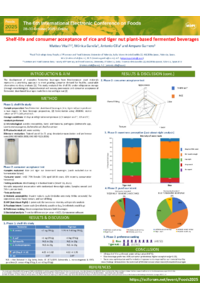
The development of innovative fermented beverages from Mediterranean plant materials represents a promising approach to meet growing consumer demand for healthy, sustainable alternatives to dairy products. This study evaluated the shelf life, through microbiological, physicochemical and sensory parameters, and consumer acceptance of fermented plant-based beverages made from rice and tiger nut.
The plant-based beverages were produced with these raw materials followed by controlled fermentation at 37°C using VEGE061 commercial starter until reaching pH 4.0-4.5. Shelf-life studies were conducted over 10 days under refrigerated storage conditions (1/3 at 4°C and 2/3 at 8°C). Consumer acceptance was assessed for fermented rice and tiger nut beverages using a 60-member untrained panel through hedonic scale (1-9 points), Just-About-Right (JAR) analysis, and purchase intention evaluation.
Results demonstrated microbiological safety throughout storage (mesophilic aerobes, molds and yeasts) with high acidolactic bacteria counts (6-7 log CFU/g) and confirmed toxicological safety. pH values decreased slightly during 10-day shelf-life (rice: from 4.05 to 3.82; tiger nut: from 4.24 to 4.12; carob: from 4.35 to 4.19), while water activity remained stable (aw = 0.97-0.98). Phase separation during storage was reversible upon agitation. Consumer testing revealed significant differences in acceptance, with fermented rice-based beverages receiving the highest scores across all sensory attributes. Fermented rice beverages achieved mean acceptance scores of 5.17-5.82, while fermented tiger nut beverages scored 3.30-5.38. Ranking analysis showed 80% consumer preference for fermented rice beverages versus 20% for fermented tiger nut beverages. JAR analysis indicated insufficient sweetness as the primary limiting factor. Purchase intention was notably higher for fermented rice beverages (37% positive) compared to fermented tiger nut drinks (10% positive).
These findings demonstrate the commercial potential of Mediterranean plant-based fermented beverages, particularly rice-based formulations, and the need for sweetness optimization to enhance consumer acceptance and market viability.
Keywords
fermented beverages
plant-based
Mediterranean crops
shelf-life
consumer ac-ceptance
rice
tiger nut
Poster
sciforum-130939.pdf
Chemical Composition, Antioxidant Capacity, and Volatile Profile of Laser trilobum (Kefe Cumin) Seeds Grown in Turkey
Acoustic impedance of some fruits and vegetables from the region of Zacatecas, Mexico: An approach to the quality of agricultural products