Event submissions
Published
This submission belongs to the session C. Food Quality and Safety of the event The 6th International Electronic Conference on Foods
Published date
27 Oct, 2025
Academic Editor
'%3e%3cpath%20d='M12.6657%2010.9104C12.4185%2010.325%2012.0599%209.79327%2011.6097%209.34482C11.1609%208.89508%2010.6293%208.5365%2010.0442%208.28888C10.0389%208.28626%2010.0337%208.28495%2010.0285%208.28233C10.8446%207.69279%2011.3752%206.73249%2011.3752%205.64904C11.3752%203.8542%209.92103%202.39999%208.1262%202.39999C6.33136%202.39999%204.87715%203.8542%204.87715%205.64904C4.87715%206.73249%205.40774%207.69279%206.22393%208.28364C6.21869%208.28626%206.21345%208.28757%206.20821%208.29019C5.62129%208.5378%205.09463%208.89284%204.64265%209.34613C4.1929%209.79493%203.83432%2010.3266%203.58671%2010.9117C3.34345%2011.4845%203.21226%2012.0987%203.20023%2012.7209C3.19988%2012.7349%203.20233%2012.7488%203.20744%2012.7619C3.21255%2012.7749%203.22022%2012.7867%203.22998%2012.7968C3.23975%2012.8068%203.25142%2012.8147%203.26431%2012.8202C3.2772%2012.8256%203.29105%2012.8284%203.30504%2012.8284H4.09109C4.14874%2012.8284%204.19459%2012.7825%204.1959%2012.7262C4.2221%2011.7148%204.62823%2010.7676%205.34617%2010.0497C6.08899%209.30683%207.0755%208.89808%208.1262%208.89808C9.17689%208.89808%2010.1634%209.30683%2010.9062%2010.0497C11.6242%2010.7676%2012.0303%2011.7148%2012.0565%2012.7262C12.0578%2012.7838%2012.1037%2012.8284%2012.1613%2012.8284H12.9474C12.9613%2012.8284%2012.9752%2012.8256%2012.9881%2012.8202C13.001%2012.8147%2013.0126%2012.8068%2013.0224%2012.7968C13.0322%2012.7867%2013.0398%2012.7749%2013.0449%2012.7619C13.0501%2012.7488%2013.0525%2012.7349%2013.0522%2012.7209C13.0391%2012.0947%2012.9094%2011.4855%2012.6657%2010.9104ZM8.1262%207.9024C7.52486%207.9024%206.9589%207.6679%206.53312%207.24211C6.10733%206.81633%205.87283%206.25037%205.87283%205.64904C5.87283%205.0477%206.10733%204.48174%206.53312%204.05596C6.9589%203.63018%207.52486%203.39567%208.1262%203.39567C8.72753%203.39567%209.29349%203.63018%209.71927%204.05596C10.1451%204.48174%2010.3796%205.0477%2010.3796%205.64904C10.3796%206.25037%2010.1451%206.81633%209.71927%207.24211C9.29349%207.6679%208.72753%207.9024%208.1262%207.9024Z'%20fill='%235D1EE1'/%3e%3c/g%3e%3c/svg%3e) Susana Casal
Susana CasalCitation
Alexandra Santomá-Martí, Oscar Nuñez, AUTHENTICATION OF HALAL AND KOSHER MEATS BY HIGH PERFORMANCE LIQUID CHROMATOGRAPHY WITH ULTRAVIOLET (HPLC-UV) FINGERPRINTING AND CHEMOMETRICS, in Proceedings of The 6th International Electronic Conference on Foods, 28 October–30 October 2025, MDPI: Basel, Switzerland
Share
Email
Facebook
Twitter
LinkedIn
AUTHENTICATION OF HALAL AND KOSHER MEATS BY HIGH PERFORMANCE LIQUID CHROMATOGRAPHY WITH ULTRAVIOLET (HPLC-UV) FINGERPRINTING AND CHEMOMETRICS
'%3e%3cpath%20d='M12.6647%2010.9104C12.4176%2010.325%2012.0589%209.7933%2011.6088%209.34485C11.16%208.89511%2010.6283%208.53653%2010.0432%208.28891C10.038%208.28629%2010.0327%208.28498%2010.0275%208.28236C10.8437%207.69282%2011.3743%206.73252%2011.3743%205.64907C11.3743%203.85423%209.92005%202.40002%208.12522%202.40002C6.33038%202.40002%204.87618%203.85423%204.87618%205.64907C4.87618%206.73252%205.40677%207.69282%206.22296%208.28367C6.21772%208.28629%206.21248%208.2876%206.20724%208.29022C5.62031%208.53783%205.09365%208.89287%204.64167%209.34616C4.19192%209.79496%203.83334%2010.3266%203.58573%2010.9117C3.34247%2011.4846%203.21128%2012.0987%203.19925%2012.721C3.1989%2012.735%203.20135%2012.7489%203.20646%2012.7619C3.21157%2012.7749%203.21924%2012.7868%203.22901%2012.7968C3.23877%2012.8068%203.25045%2012.8148%203.26334%2012.8202C3.27623%2012.8256%203.29007%2012.8284%203.30406%2012.8284H4.09012C4.14776%2012.8284%204.19362%2012.7825%204.19493%2012.7262C4.22113%2011.7148%204.62726%2010.7676%205.34519%2010.0497C6.08802%209.30686%207.07452%208.89811%208.12522%208.89811C9.17592%208.89811%2010.1624%209.30686%2010.9052%2010.0497C11.6232%2010.7676%2012.0293%2011.7148%2012.0555%2012.7262C12.0568%2012.7839%2012.1027%2012.8284%2012.1603%2012.8284H12.9464C12.9604%2012.8284%2012.9742%2012.8256%2012.9871%2012.8202C13%2012.8148%2013.0117%2012.8068%2013.0214%2012.7968C13.0312%2012.7868%2013.0389%2012.7749%2013.044%2012.7619C13.0491%2012.7489%2013.0515%2012.735%2013.0512%2012.721C13.0381%2012.0947%2012.9084%2011.4856%2012.6647%2010.9104ZM8.12522%207.90243C7.52388%207.90243%206.95792%207.66793%206.53214%207.24215C6.10636%206.81636%205.87185%206.2504%205.87185%205.64907C5.87185%205.04773%206.10636%204.48177%206.53214%204.05599C6.95792%203.63021%207.52388%203.3957%208.12522%203.3957C8.72655%203.3957%209.29252%203.63021%209.7183%204.05599C10.1441%204.48177%2010.3786%205.04773%2010.3786%205.64907C10.3786%206.2504%2010.1441%206.81636%209.7183%207.24215C9.29252%207.66793%208.72655%207.90243%208.12522%207.90243Z'%20fill='%235D1EE1'/%3e%3c/g%3e%3c/svg%3e)
Alexandra Santomá-Martí 1

Oscar Nuñez 1,2,3
1. Department of Chemical Engineering and Analytical Chemistry, University of Barcelona, Martí i Franquès 1-11, E08028 Barcelona, Spain
2. Research Institute in Food Nutrition and Food Safety, University of Barcelona, Recinte Torribera, Av. Prat de la Riba 171, Edifici de Recerca (Gaudí), Santa Coloma de Gramenet, E08921 Barcelona, Spain
3. Departament de Recerca i Universitats, Generalitat de Catalunya, Via Laietana 2, E08003 Barcelona, Spain
Abstract
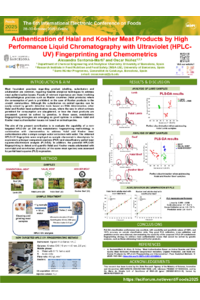
Fraudulent meat practices regarding product labelling, substitution, and adulteration are common, requiring feasible analytical techniques to address meat authentication issues. Frauds of relevant importance are those involving cultural/religious practices, such as in Muslim countries (Halal products), where the consumption of pork is prohibited, or the case of Kosher products in Jewish communities. Although the substitution of animal species can be easily solved by genetic detection tools based on DNA determination, other Halal and Kosher meat authentication issues, where the way in which animals permitted for consumption are slaughtered, or how the meat products are processed, cannot be solved by genetics. In these cases, metabolomic fingerprinting strategies are emerging as good options to address Halal and Kosher meat authentication issues not based on animal species.
A simple HPLC-UV fingerprinting strategy was developed to address Halal and Kosher meat authentication. A total of 100 meat samples (lamb, Halal lamb, beef, Halal beef, and Kosher beef), all of them produced in Catalonia (Spain), were employed. Analysis consisted in a sonication (15 min) extraction with water (1 g sample with 10 mL water) followed by reversed-phase C18 HPLC under universal gradient elution conditions. The obtained fingerprints were employed as sample chemical descriptors to address meat classification by partial least squares-discriminant analysis (PLS-DA). PLS-DA classification performance was excellent, with sensitivity and specificity values of 100%, and 100% accuracy on sample classification ratio. In addition, the potential of HPLC-UV fingerprinting to detect and quantify Halal and Kosher meats adulterated with non-Halal and non-Kosher products (of the same animal species) at different adulteration levels (from 15 to 85% adulteration) was assessed by partial least squares (PLS) regression. PLS calibration, cross-validation, and prediction errors within the ranges of 1.7–6.2%, 3.9–7.9%, and 2.4–6.4%, respectively, were obtained, demonstrating the capability of the proposed HPLC-UV metabolomic fingerprinting strategy to address meat authentication issues that genetic analyses cannot solve.
Keywords
Meat authentication
HPLC-UV fingerprinting
chemometrics
Poster
Poster Foods-Meat.pdf
Exploring chemical drivers of acidity in arabica coffee via a flavoromics approach
Wheat dry pasta enriched with aromatic herb powders: technological and textural properties