Event submissions
Published
This submission belongs to the session A. Food Technology and Engineering of the event The 6th International Electronic Conference on Foods
Published date
27 Oct, 2025
Academic Editor
'%3e%3cpath%20d='M12.6657%2010.9104C12.4185%2010.325%2012.0599%209.79327%2011.6097%209.34482C11.1609%208.89508%2010.6293%208.5365%2010.0442%208.28888C10.0389%208.28626%2010.0337%208.28495%2010.0285%208.28233C10.8446%207.69279%2011.3752%206.73249%2011.3752%205.64904C11.3752%203.8542%209.92103%202.39999%208.1262%202.39999C6.33136%202.39999%204.87715%203.8542%204.87715%205.64904C4.87715%206.73249%205.40774%207.69279%206.22393%208.28364C6.21869%208.28626%206.21345%208.28757%206.20821%208.29019C5.62129%208.5378%205.09463%208.89284%204.64265%209.34613C4.1929%209.79493%203.83432%2010.3266%203.58671%2010.9117C3.34345%2011.4845%203.21226%2012.0987%203.20023%2012.7209C3.19988%2012.7349%203.20233%2012.7488%203.20744%2012.7619C3.21255%2012.7749%203.22022%2012.7867%203.22998%2012.7968C3.23975%2012.8068%203.25142%2012.8147%203.26431%2012.8202C3.2772%2012.8256%203.29105%2012.8284%203.30504%2012.8284H4.09109C4.14874%2012.8284%204.19459%2012.7825%204.1959%2012.7262C4.2221%2011.7148%204.62823%2010.7676%205.34617%2010.0497C6.08899%209.30683%207.0755%208.89808%208.1262%208.89808C9.17689%208.89808%2010.1634%209.30683%2010.9062%2010.0497C11.6242%2010.7676%2012.0303%2011.7148%2012.0565%2012.7262C12.0578%2012.7838%2012.1037%2012.8284%2012.1613%2012.8284H12.9474C12.9613%2012.8284%2012.9752%2012.8256%2012.9881%2012.8202C13.001%2012.8147%2013.0126%2012.8068%2013.0224%2012.7968C13.0322%2012.7867%2013.0398%2012.7749%2013.0449%2012.7619C13.0501%2012.7488%2013.0525%2012.7349%2013.0522%2012.7209C13.0391%2012.0947%2012.9094%2011.4855%2012.6657%2010.9104ZM8.1262%207.9024C7.52486%207.9024%206.9589%207.6679%206.53312%207.24211C6.10733%206.81633%205.87283%206.25037%205.87283%205.64904C5.87283%205.0477%206.10733%204.48174%206.53312%204.05596C6.9589%203.63018%207.52486%203.39567%208.1262%203.39567C8.72753%203.39567%209.29349%203.63018%209.71927%204.05596C10.1451%204.48174%2010.3796%205.0477%2010.3796%205.64904C10.3796%206.25037%2010.1451%206.81633%209.71927%207.24211C9.29349%207.6679%208.72753%207.9024%208.1262%207.9024Z'%20fill='%235D1EE1'/%3e%3c/g%3e%3c/svg%3e) Elsa Gonçalves
Elsa GonçalvesCitation
María Belén Vignola, Mariela Cecilia Bustos, Luciano Neyra, Gabriela Teresa Pérez, Alfonsina Ester Andreatta, Wheat dry pasta enriched with aromatic herb powders: technological and textural properties, in Proceedings of The 6th International Electronic Conference on Foods, 28 October–30 October 2025, MDPI: Basel, Switzerland
Share
Email
Facebook
Twitter
LinkedIn
Wheat dry pasta enriched with aromatic herb powders: technological and textural properties
'%3e%3cpath%20d='M12.6647%2010.9104C12.4176%2010.325%2012.0589%209.7933%2011.6088%209.34485C11.16%208.89511%2010.6283%208.53653%2010.0432%208.28891C10.038%208.28629%2010.0327%208.28498%2010.0275%208.28236C10.8437%207.69282%2011.3743%206.73252%2011.3743%205.64907C11.3743%203.85423%209.92005%202.40002%208.12522%202.40002C6.33038%202.40002%204.87618%203.85423%204.87618%205.64907C4.87618%206.73252%205.40677%207.69282%206.22296%208.28367C6.21772%208.28629%206.21248%208.2876%206.20724%208.29022C5.62031%208.53783%205.09365%208.89287%204.64167%209.34616C4.19192%209.79496%203.83334%2010.3266%203.58573%2010.9117C3.34247%2011.4846%203.21128%2012.0987%203.19925%2012.721C3.1989%2012.735%203.20135%2012.7489%203.20646%2012.7619C3.21157%2012.7749%203.21924%2012.7868%203.22901%2012.7968C3.23877%2012.8068%203.25045%2012.8148%203.26334%2012.8202C3.27623%2012.8256%203.29007%2012.8284%203.30406%2012.8284H4.09012C4.14776%2012.8284%204.19362%2012.7825%204.19493%2012.7262C4.22113%2011.7148%204.62726%2010.7676%205.34519%2010.0497C6.08802%209.30686%207.07452%208.89811%208.12522%208.89811C9.17592%208.89811%2010.1624%209.30686%2010.9052%2010.0497C11.6232%2010.7676%2012.0293%2011.7148%2012.0555%2012.7262C12.0568%2012.7839%2012.1027%2012.8284%2012.1603%2012.8284H12.9464C12.9604%2012.8284%2012.9742%2012.8256%2012.9871%2012.8202C13%2012.8148%2013.0117%2012.8068%2013.0214%2012.7968C13.0312%2012.7868%2013.0389%2012.7749%2013.044%2012.7619C13.0491%2012.7489%2013.0515%2012.735%2013.0512%2012.721C13.0381%2012.0947%2012.9084%2011.4856%2012.6647%2010.9104ZM8.12522%207.90243C7.52388%207.90243%206.95792%207.66793%206.53214%207.24215C6.10636%206.81636%205.87185%206.2504%205.87185%205.64907C5.87185%205.04773%206.10636%204.48177%206.53214%204.05599C6.95792%203.63021%207.52388%203.3957%208.12522%203.3957C8.72655%203.3957%209.29252%203.63021%209.7183%204.05599C10.1441%204.48177%2010.3786%205.04773%2010.3786%205.64907C10.3786%206.2504%2010.1441%206.81636%209.7183%207.24215C9.29252%207.66793%208.72655%207.90243%208.12522%207.90243Z'%20fill='%235D1EE1'/%3e%3c/g%3e%3c/svg%3e)
María Belén Vignola 1
Mariela Cecilia Bustos 2
Luciano Neyra 1
Gabriela Teresa Pérez 2

Alfonsina Ester Andreatta 1
1. Centro UTN – Research Group InProSus, Facultad Regional San Francisco, Universidad Tecnológica Nacional (UTN), San Francisco, Córdoba, X2400DQR, Argentina
2. Instituto de Ciencia y Tecnología de los Alimentos Córdoba (ICYTAC), CONICET – Universidad Nacional de Córdoba (UNC), Córdoba, 5000, Argentina
Abstract
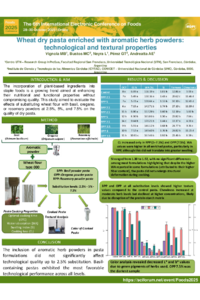
The incorporation of plant-based ingredients into staple foods is a growing trend aimed at enhancing their nutritional and functional properties without compromising quality. This study aimed to evaluate the effects of substituting wheat flour with basil, oregano, or rosemary powders at 2.5%, 5%, and 7.5% on the quality of dry pasta. Pasta samples were produced using common wheat flour (Triticum aestivum), and their technological quality, color, and texture parameters were analyzed. Cooking losses of all samples remained within the desirable range (7–8%). Pastas with basil at all levels and those with 2.5% oregano or rosemary showed cooking losses comparable to the control, while higher levels of oregano or rosemary showed increased losses. Pasta with basil percentages of 2.5% and 5% showed no significant differences compared to the control in terms of water absorption, whereas other formulations exhibited significantly higher values (up to 170.21%), likely due to the high water-holding capacity of dietary fiber in the aromatic powders. No significant differences in the swelling index were observed between the control and most herb-enriched samples, highlighting that despite the higher water absorption reported in some formulations (which was attributed to their higher fiber content), the pasta did not undergo structural deformation during cooking. Color analysis revealed decreased L* and b* values due to the green pigments of the herbs used; the darkest sample was 7.5% oregano pasta (L* = 27.07). Pasta samples formulated with all levels of basil and oregano substitution showed higher texture values compared to the control pasta. Cohesiveness and chewiness increased at moderate herb levels but declined at higher concentrations, likely due to disruption of the protein–starch matrix. The inclusion of aromatic herb powders in pasta formulations did not significantly affect technological quality up to 2.5% substitution. Basil-containing pastas exhibited the most favorable technological performance across all levels.
Keywords
wheat pasta-aromatic herbs-quality-color-texture
Poster
Poster MBV.pdf
AUTHENTICATION OF HALAL AND KOSHER MEATS BY HIGH PERFORMANCE LIQUID CHROMATOGRAPHY WITH ULTRAVIOLET (HPLC-UV) FINGERPRINTING AND CHEMOMETRICS
A Functional Approach to Dairy Innovation: Development of Digestive-Aiding Garlic Milk Powder