Event submissions
Published
This submission belongs to the session A. Food Technology and Engineering of the event The 6th International Electronic Conference on Foods
Published date
27 Oct, 2025
Academic Editor
'%3e%3cpath%20d='M12.6657%2010.9104C12.4185%2010.325%2012.0599%209.79327%2011.6097%209.34482C11.1609%208.89508%2010.6293%208.5365%2010.0442%208.28888C10.0389%208.28626%2010.0337%208.28495%2010.0285%208.28233C10.8446%207.69279%2011.3752%206.73249%2011.3752%205.64904C11.3752%203.8542%209.92103%202.39999%208.1262%202.39999C6.33136%202.39999%204.87715%203.8542%204.87715%205.64904C4.87715%206.73249%205.40774%207.69279%206.22393%208.28364C6.21869%208.28626%206.21345%208.28757%206.20821%208.29019C5.62129%208.5378%205.09463%208.89284%204.64265%209.34613C4.1929%209.79493%203.83432%2010.3266%203.58671%2010.9117C3.34345%2011.4845%203.21226%2012.0987%203.20023%2012.7209C3.19988%2012.7349%203.20233%2012.7488%203.20744%2012.7619C3.21255%2012.7749%203.22022%2012.7867%203.22998%2012.7968C3.23975%2012.8068%203.25142%2012.8147%203.26431%2012.8202C3.2772%2012.8256%203.29105%2012.8284%203.30504%2012.8284H4.09109C4.14874%2012.8284%204.19459%2012.7825%204.1959%2012.7262C4.2221%2011.7148%204.62823%2010.7676%205.34617%2010.0497C6.08899%209.30683%207.0755%208.89808%208.1262%208.89808C9.17689%208.89808%2010.1634%209.30683%2010.9062%2010.0497C11.6242%2010.7676%2012.0303%2011.7148%2012.0565%2012.7262C12.0578%2012.7838%2012.1037%2012.8284%2012.1613%2012.8284H12.9474C12.9613%2012.8284%2012.9752%2012.8256%2012.9881%2012.8202C13.001%2012.8147%2013.0126%2012.8068%2013.0224%2012.7968C13.0322%2012.7867%2013.0398%2012.7749%2013.0449%2012.7619C13.0501%2012.7488%2013.0525%2012.7349%2013.0522%2012.7209C13.0391%2012.0947%2012.9094%2011.4855%2012.6657%2010.9104ZM8.1262%207.9024C7.52486%207.9024%206.9589%207.6679%206.53312%207.24211C6.10733%206.81633%205.87283%206.25037%205.87283%205.64904C5.87283%205.0477%206.10733%204.48174%206.53312%204.05596C6.9589%203.63018%207.52486%203.39567%208.1262%203.39567C8.72753%203.39567%209.29349%203.63018%209.71927%204.05596C10.1451%204.48174%2010.3796%205.0477%2010.3796%205.64904C10.3796%206.25037%2010.1451%206.81633%209.71927%207.24211C9.29349%207.6679%208.72753%207.9024%208.1262%207.9024Z'%20fill='%235D1EE1'/%3e%3c/g%3e%3c/svg%3e) Cristobal Aguilar
Cristobal AguilarCitation
Domenico Mammolenti, Elisabetta Bruno, Francesca Romana Lupi, Noemi Baldino, Maria del Carmen García, José Muñoz, Domenico Gabriele, Microfluidized hydrogels and emulgels structured with insoluble dietary fiber: influence of processing on physical properties, in Proceedings of The 6th International Electronic Conference on Foods, 28 October–30 October 2025, MDPI: Basel, Switzerland
Share
Email
Facebook
Twitter
LinkedIn
Microfluidized hydrogels and emulgels structured with insoluble dietary fiber: influence of processing on physical properties
'%3e%3cpath%20d='M12.6647%2010.9104C12.4176%2010.325%2012.0589%209.7933%2011.6088%209.34485C11.16%208.89511%2010.6283%208.53653%2010.0432%208.28891C10.038%208.28629%2010.0327%208.28498%2010.0275%208.28236C10.8437%207.69282%2011.3743%206.73252%2011.3743%205.64907C11.3743%203.85423%209.92005%202.40002%208.12522%202.40002C6.33038%202.40002%204.87618%203.85423%204.87618%205.64907C4.87618%206.73252%205.40677%207.69282%206.22296%208.28367C6.21772%208.28629%206.21248%208.2876%206.20724%208.29022C5.62031%208.53783%205.09365%208.89287%204.64167%209.34616C4.19192%209.79496%203.83334%2010.3266%203.58573%2010.9117C3.34247%2011.4846%203.21128%2012.0987%203.19925%2012.721C3.1989%2012.735%203.20135%2012.7489%203.20646%2012.7619C3.21157%2012.7749%203.21924%2012.7868%203.22901%2012.7968C3.23877%2012.8068%203.25045%2012.8148%203.26334%2012.8202C3.27623%2012.8256%203.29007%2012.8284%203.30406%2012.8284H4.09012C4.14776%2012.8284%204.19362%2012.7825%204.19493%2012.7262C4.22113%2011.7148%204.62726%2010.7676%205.34519%2010.0497C6.08802%209.30686%207.07452%208.89811%208.12522%208.89811C9.17592%208.89811%2010.1624%209.30686%2010.9052%2010.0497C11.6232%2010.7676%2012.0293%2011.7148%2012.0555%2012.7262C12.0568%2012.7839%2012.1027%2012.8284%2012.1603%2012.8284H12.9464C12.9604%2012.8284%2012.9742%2012.8256%2012.9871%2012.8202C13%2012.8148%2013.0117%2012.8068%2013.0214%2012.7968C13.0312%2012.7868%2013.0389%2012.7749%2013.044%2012.7619C13.0491%2012.7489%2013.0515%2012.735%2013.0512%2012.721C13.0381%2012.0947%2012.9084%2011.4856%2012.6647%2010.9104ZM8.12522%207.90243C7.52388%207.90243%206.95792%207.66793%206.53214%207.24215C6.10636%206.81636%205.87185%206.2504%205.87185%205.64907C5.87185%205.04773%206.10636%204.48177%206.53214%204.05599C6.95792%203.63021%207.52388%203.3957%208.12522%203.3957C8.72655%203.3957%209.29252%203.63021%209.7183%204.05599C10.1441%204.48177%2010.3786%205.04773%2010.3786%205.64907C10.3786%206.2504%2010.1441%206.81636%209.7183%207.24215C9.29252%207.66793%208.72655%207.90243%208.12522%207.90243Z'%20fill='%235D1EE1'/%3e%3c/g%3e%3c/svg%3e)
Domenico Mammolenti 1
Elisabetta Bruno 1

Francesca Romana Lupi 1
Noemi Baldino 1
Maria del Carmen García 2

José Muñoz 2
Domenico Gabriele 1
1. Department of Information, Modeling, Electronics and Systems, (D.I.M.E.S.) University of Calabria, Via P. Bucci, Cubo 39C, 87036 Rende, Italy
2. Department of Chemical Engineering, University of Seville, EPS, C/ Virgen de Africa, 7, 41011, Seville, Spain
Abstract
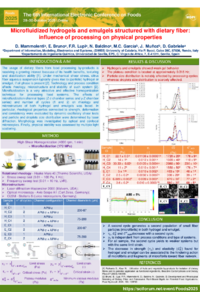
The utilization of insoluble dietary fibers (IDFs), like citrus fiber, in food formulations is receiving a lot of attention from both industry and academia. The interest in using IDFs is due to their physiological benefits and technological performance. Different homogenization techniques can be used to prepare both hydrogels and O/W emulgels containing IDFs. In the present research, hydrogels and emulgels containing citrus fiber as a structuring agent were produced by means of microfluidization. This study focuses on the effect of microfluidization cycles and channel geometry on the rheological and physical properties of hydrogels (with 0.01 w/w of citrus fiber) and emulgels (with 0.01 w/w of citrus fiber in water, 0.2 w/w of oil solution made of extra virgin olive oil, and 0.15 w/w of organic soy lecithin). After a pre-homogenization step, samples were homogenized by means of microfluidization at 172 MPa using two types of interaction chambers. In particular, samples were microfluidized using (a) two Z-type interaction chambers in series and (b) one Y-type followed by a Z-type interaction chamber. Samples were processed with one and two cycles. Rheological properties were investigated with stress sweep tests and frequency sweep tests within the linear viscoelastic range (LVR). Size distributions of both fiber particles and oil droplets (in emulgels) were determined by through laser diffraction; morphology was investigated by means of contrast phase optical microscopy, cryo-SEM, and confocal laser scanning microscopy, and, finally, physical stability of the emulgel samples was assessed via multiple light scattering (Turbiscan). Tests evidenced that a second cycle decreases consistency (in terms of plateau modulus and minimum loss modulus) and strength (in terms of limiting stress for LVR). The formation of smaller fiber particles after the second microfluidization cycle was associated with the weakening of the samples. Despite the different consistencies, all emulgels were physically stable for at least 14 days.
Keywords
Food processing
homogenization
dietary fiber
structured emulsions
food microstructure
Poster
Mammolenti_Poster_2_FOODS.pdf
A Functional Approach to Dairy Innovation: The Development of Digestive-Aiding Garlic Milk Powder
Preparation and characterization of emulgel structured with citrus fiber as potential carrier of curcumin (Curcuma longa): rheology, physical stability encapsulation efficiency and loading capacity