Event submissions
Published
This submission belongs to the session A. Food Technology and Engineering of the event The 6th International Electronic Conference on Foods
Published date
27 Oct, 2025
Academic Editor
'%3e%3cpath%20d='M12.6657%2010.9104C12.4185%2010.325%2012.0599%209.79327%2011.6097%209.34482C11.1609%208.89508%2010.6293%208.5365%2010.0442%208.28888C10.0389%208.28626%2010.0337%208.28495%2010.0285%208.28233C10.8446%207.69279%2011.3752%206.73249%2011.3752%205.64904C11.3752%203.8542%209.92103%202.39999%208.1262%202.39999C6.33136%202.39999%204.87715%203.8542%204.87715%205.64904C4.87715%206.73249%205.40774%207.69279%206.22393%208.28364C6.21869%208.28626%206.21345%208.28757%206.20821%208.29019C5.62129%208.5378%205.09463%208.89284%204.64265%209.34613C4.1929%209.79493%203.83432%2010.3266%203.58671%2010.9117C3.34345%2011.4845%203.21226%2012.0987%203.20023%2012.7209C3.19988%2012.7349%203.20233%2012.7488%203.20744%2012.7619C3.21255%2012.7749%203.22022%2012.7867%203.22998%2012.7968C3.23975%2012.8068%203.25142%2012.8147%203.26431%2012.8202C3.2772%2012.8256%203.29105%2012.8284%203.30504%2012.8284H4.09109C4.14874%2012.8284%204.19459%2012.7825%204.1959%2012.7262C4.2221%2011.7148%204.62823%2010.7676%205.34617%2010.0497C6.08899%209.30683%207.0755%208.89808%208.1262%208.89808C9.17689%208.89808%2010.1634%209.30683%2010.9062%2010.0497C11.6242%2010.7676%2012.0303%2011.7148%2012.0565%2012.7262C12.0578%2012.7838%2012.1037%2012.8284%2012.1613%2012.8284H12.9474C12.9613%2012.8284%2012.9752%2012.8256%2012.9881%2012.8202C13.001%2012.8147%2013.0126%2012.8068%2013.0224%2012.7968C13.0322%2012.7867%2013.0398%2012.7749%2013.0449%2012.7619C13.0501%2012.7488%2013.0525%2012.7349%2013.0522%2012.7209C13.0391%2012.0947%2012.9094%2011.4855%2012.6657%2010.9104ZM8.1262%207.9024C7.52486%207.9024%206.9589%207.6679%206.53312%207.24211C6.10733%206.81633%205.87283%206.25037%205.87283%205.64904C5.87283%205.0477%206.10733%204.48174%206.53312%204.05596C6.9589%203.63018%207.52486%203.39567%208.1262%203.39567C8.72753%203.39567%209.29349%203.63018%209.71927%204.05596C10.1451%204.48174%2010.3796%205.0477%2010.3796%205.64904C10.3796%206.25037%2010.1451%206.81633%209.71927%207.24211C9.29349%207.6679%208.72753%207.9024%208.1262%207.9024Z'%20fill='%235D1EE1'/%3e%3c/g%3e%3c/svg%3e) Cristobal Aguilar
Cristobal AguilarCitation
Domenico Mammolenti, Patrizia Formoso, Daniela Demasi, Francesca Romana Lupi, Noemi Baldino, Domenico Gabriele, Preparation and characterization of emulgel structured with citrus fiber as potential carrier of curcumin (Curcuma longa): rheology, physical stability encapsulation efficiency and loading capacity, in Proceedings of The 6th International Electronic Conference on Foods, 28 October–30 October 2025, MDPI: Basel, Switzerland
Share
Email
Facebook
Twitter
LinkedIn
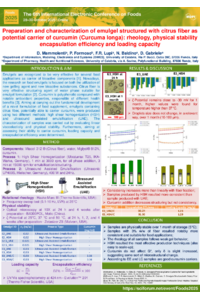
Preparation and characterization of emulgel structured with citrus fiber as potential carrier of curcumin (Curcuma longa): rheology, physical stability encapsulation efficiency and loading capacity
'%3e%3cpath%20d='M12.6647%2010.9104C12.4176%2010.325%2012.0589%209.7933%2011.6088%209.34485C11.16%208.89511%2010.6283%208.53653%2010.0432%208.28891C10.038%208.28629%2010.0327%208.28498%2010.0275%208.28236C10.8437%207.69282%2011.3743%206.73252%2011.3743%205.64907C11.3743%203.85423%209.92005%202.40002%208.12522%202.40002C6.33038%202.40002%204.87618%203.85423%204.87618%205.64907C4.87618%206.73252%205.40677%207.69282%206.22296%208.28367C6.21772%208.28629%206.21248%208.2876%206.20724%208.29022C5.62031%208.53783%205.09365%208.89287%204.64167%209.34616C4.19192%209.79496%203.83334%2010.3266%203.58573%2010.9117C3.34247%2011.4846%203.21128%2012.0987%203.19925%2012.721C3.1989%2012.735%203.20135%2012.7489%203.20646%2012.7619C3.21157%2012.7749%203.21924%2012.7868%203.22901%2012.7968C3.23877%2012.8068%203.25045%2012.8148%203.26334%2012.8202C3.27623%2012.8256%203.29007%2012.8284%203.30406%2012.8284H4.09012C4.14776%2012.8284%204.19362%2012.7825%204.19493%2012.7262C4.22113%2011.7148%204.62726%2010.7676%205.34519%2010.0497C6.08802%209.30686%207.07452%208.89811%208.12522%208.89811C9.17592%208.89811%2010.1624%209.30686%2010.9052%2010.0497C11.6232%2010.7676%2012.0293%2011.7148%2012.0555%2012.7262C12.0568%2012.7839%2012.1027%2012.8284%2012.1603%2012.8284H12.9464C12.9604%2012.8284%2012.9742%2012.8256%2012.9871%2012.8202C13%2012.8148%2013.0117%2012.8068%2013.0214%2012.7968C13.0312%2012.7868%2013.0389%2012.7749%2013.044%2012.7619C13.0491%2012.7489%2013.0515%2012.735%2013.0512%2012.721C13.0381%2012.0947%2012.9084%2011.4856%2012.6647%2010.9104ZM8.12522%207.90243C7.52388%207.90243%206.95792%207.66793%206.53214%207.24215C6.10636%206.81636%205.87185%206.2504%205.87185%205.64907C5.87185%205.04773%206.10636%204.48177%206.53214%204.05599C6.95792%203.63021%207.52388%203.3957%208.12522%203.3957C8.72655%203.3957%209.29252%203.63021%209.7183%204.05599C10.1441%204.48177%2010.3786%205.04773%2010.3786%205.64907C10.3786%206.2504%2010.1441%206.81636%209.7183%207.24215C9.29252%207.66793%208.72655%207.90243%208.12522%207.90243Z'%20fill='%235D1EE1'/%3e%3c/g%3e%3c/svg%3e)
Domenico Mammolenti 1

Patrizia Formoso 2
Daniela Demasi 2

Francesca Romana Lupi 1
Noemi Baldino 1
Domenico Gabriele 1
1. Department of Information, Modeling, Electronics and Systems, (D.I.M.E.S.) University of Calabria, Via P. Bucci, Cubo 39C, 87036 Rende, Italy
2. Department of Pharmacy, Health and Nutritional Sciences, University of Calabria, via A. Savino, Polyfunctional Building, 87036 Rende, Italy
Abstract
Curcumin is an active component with interesting properties that suggest its potential use as a food supplement; nevertheless, its poor water solubility makes its delivery difficult, and oil-based or biphasic systems must be used. Among different potential carriers, emulgels, i.e., two-phase systems where the dispersing phase is structured, are recognized as very effective in the delivery of bioactive components in several food applications. In this work, O/W emulgels, with a water phase structured using citrus fiber, were produced using different methods and proposed as potential carriers of curcumin. Emulgels containing 0.4 w/w of Miglyol® 812N and different amounts of citrus fiber in the water phase (0.020 w/w, 0.025 w/w, 0.030 w/w) were produced by high-speed homogenization (HSH) and ultrasound-assisted emulsification (UAE). Samples with 0.030 w/w of citrus fiber were loaded with curcumin (Curcuma longa) in the oil phase at 3.34 mg/ml. The size of the droplets was qualitatively evaluated using optical microscopy at 10x and at different times from preparation. ζ-potential was measured at different times from preparation and at different temperatures (25°C, 37°C, and 50°C). Rheological properties were investigated by conducting frequency sweep tests in linear conditions. For curcumin-loaded samples, the encapsulation efficiency and loading capacity were determined. No significant changes in droplet size (close to 10-100 μm) with varying times, and ζ-potentials (close to -30 mV), and temperatures were observed in all samples. HSH yields more consistent samples compared to UAE. Curcumin does not affect the consistency but decreases the structuring degree of the emulgel. The encapsulation efficiency of samples with curcumin was 91.90% when produced by HSH and 96.21% when produced by UAE, whereas loading capacities were 1.23 mg/g and 1.29 mg/g, respectively. The results are promising in view of using these emulgels as carriers of curcumin for potential applications as food supplements.
Keywords
Dietary fiber
food rheology
emulsification
food stability
polyphenols
Poster
Mammolenti_Poster_1_FOODS.pdf
Microfluidized hydrogels and emulgels structured with insoluble dietary fiber: influence of processing on physical properties
Comparative Evaluation of Milk Fat Globule Membrane from Bovine, Caprine and Human Milk in Enhancing Probiotic Efficacy and Gut Health Using In vitro and In vivo Models