Event submissions
Published
This submission belongs to the session A. Food Technology and Engineering of the event The 6th International Electronic Conference on Foods
Published date
27 Oct, 2025
Academic Editor
'%3e%3cpath%20d='M12.6657%2010.9104C12.4185%2010.325%2012.0599%209.79327%2011.6097%209.34482C11.1609%208.89508%2010.6293%208.5365%2010.0442%208.28888C10.0389%208.28626%2010.0337%208.28495%2010.0285%208.28233C10.8446%207.69279%2011.3752%206.73249%2011.3752%205.64904C11.3752%203.8542%209.92103%202.39999%208.1262%202.39999C6.33136%202.39999%204.87715%203.8542%204.87715%205.64904C4.87715%206.73249%205.40774%207.69279%206.22393%208.28364C6.21869%208.28626%206.21345%208.28757%206.20821%208.29019C5.62129%208.5378%205.09463%208.89284%204.64265%209.34613C4.1929%209.79493%203.83432%2010.3266%203.58671%2010.9117C3.34345%2011.4845%203.21226%2012.0987%203.20023%2012.7209C3.19988%2012.7349%203.20233%2012.7488%203.20744%2012.7619C3.21255%2012.7749%203.22022%2012.7867%203.22998%2012.7968C3.23975%2012.8068%203.25142%2012.8147%203.26431%2012.8202C3.2772%2012.8256%203.29105%2012.8284%203.30504%2012.8284H4.09109C4.14874%2012.8284%204.19459%2012.7825%204.1959%2012.7262C4.2221%2011.7148%204.62823%2010.7676%205.34617%2010.0497C6.08899%209.30683%207.0755%208.89808%208.1262%208.89808C9.17689%208.89808%2010.1634%209.30683%2010.9062%2010.0497C11.6242%2010.7676%2012.0303%2011.7148%2012.0565%2012.7262C12.0578%2012.7838%2012.1037%2012.8284%2012.1613%2012.8284H12.9474C12.9613%2012.8284%2012.9752%2012.8256%2012.9881%2012.8202C13.001%2012.8147%2013.0126%2012.8068%2013.0224%2012.7968C13.0322%2012.7867%2013.0398%2012.7749%2013.0449%2012.7619C13.0501%2012.7488%2013.0525%2012.7349%2013.0522%2012.7209C13.0391%2012.0947%2012.9094%2011.4855%2012.6657%2010.9104ZM8.1262%207.9024C7.52486%207.9024%206.9589%207.6679%206.53312%207.24211C6.10733%206.81633%205.87283%206.25037%205.87283%205.64904C5.87283%205.0477%206.10733%204.48174%206.53312%204.05596C6.9589%203.63018%207.52486%203.39567%208.1262%203.39567C8.72753%203.39567%209.29349%203.63018%209.71927%204.05596C10.1451%204.48174%2010.3796%205.0477%2010.3796%205.64904C10.3796%206.25037%2010.1451%206.81633%209.71927%207.24211C9.29349%207.6679%208.72753%207.9024%208.1262%207.9024Z'%20fill='%235D1EE1'/%3e%3c/g%3e%3c/svg%3e) Elsa Gonçalves
Elsa GonçalvesCitation
Elisabetta Bruno, Francesca Romana Lupi, Olga Mileti, Noemi Baldino, Domenico Gabriele, Citrus fiber–soy protein emulgels for plant-based foods: a rheological characterization and modeling, in Proceedings of The 6th International Electronic Conference on Foods, 28 October–30 October 2025, MDPI: Basel, Switzerland
Share
Email
Facebook
Twitter
LinkedIn
Citrus fiber–soy protein emulgels for plant-based foods: a rheological characterization and modeling
'%3e%3cpath%20d='M12.6647%2010.9104C12.4176%2010.325%2012.0589%209.7933%2011.6088%209.34485C11.16%208.89511%2010.6283%208.53653%2010.0432%208.28891C10.038%208.28629%2010.0327%208.28498%2010.0275%208.28236C10.8437%207.69282%2011.3743%206.73252%2011.3743%205.64907C11.3743%203.85423%209.92005%202.40002%208.12522%202.40002C6.33038%202.40002%204.87618%203.85423%204.87618%205.64907C4.87618%206.73252%205.40677%207.69282%206.22296%208.28367C6.21772%208.28629%206.21248%208.2876%206.20724%208.29022C5.62031%208.53783%205.09365%208.89287%204.64167%209.34616C4.19192%209.79496%203.83334%2010.3266%203.58573%2010.9117C3.34247%2011.4846%203.21128%2012.0987%203.19925%2012.721C3.1989%2012.735%203.20135%2012.7489%203.20646%2012.7619C3.21157%2012.7749%203.21924%2012.7868%203.22901%2012.7968C3.23877%2012.8068%203.25045%2012.8148%203.26334%2012.8202C3.27623%2012.8256%203.29007%2012.8284%203.30406%2012.8284H4.09012C4.14776%2012.8284%204.19362%2012.7825%204.19493%2012.7262C4.22113%2011.7148%204.62726%2010.7676%205.34519%2010.0497C6.08802%209.30686%207.07452%208.89811%208.12522%208.89811C9.17592%208.89811%2010.1624%209.30686%2010.9052%2010.0497C11.6232%2010.7676%2012.0293%2011.7148%2012.0555%2012.7262C12.0568%2012.7839%2012.1027%2012.8284%2012.1603%2012.8284H12.9464C12.9604%2012.8284%2012.9742%2012.8256%2012.9871%2012.8202C13%2012.8148%2013.0117%2012.8068%2013.0214%2012.7968C13.0312%2012.7868%2013.0389%2012.7749%2013.044%2012.7619C13.0491%2012.7489%2013.0515%2012.735%2013.0512%2012.721C13.0381%2012.0947%2012.9084%2011.4856%2012.6647%2010.9104ZM8.12522%207.90243C7.52388%207.90243%206.95792%207.66793%206.53214%207.24215C6.10636%206.81636%205.87185%206.2504%205.87185%205.64907C5.87185%205.04773%206.10636%204.48177%206.53214%204.05599C6.95792%203.63021%207.52388%203.3957%208.12522%203.3957C8.72655%203.3957%209.29252%203.63021%209.7183%204.05599C10.1441%204.48177%2010.3786%205.04773%2010.3786%205.64907C10.3786%206.2504%2010.1441%206.81636%209.7183%207.24215C9.29252%207.66793%208.72655%207.90243%208.12522%207.90243Z'%20fill='%235D1EE1'/%3e%3c/g%3e%3c/svg%3e)
Elisabetta Bruno 1

Francesca Romana Lupi 1
Olga Mileti 1
Noemi Baldino 1
Domenico Gabriele 1
1. Department of Information, Modeling, Electronics and System Engineering, (D.I.M.E.S.), University of Calabria, Via P. Bucci, Cubo 39C, 87036 Rende, Italy
Abstract
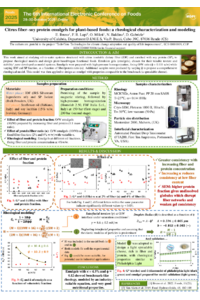
Plant-based systems are very attractive because they are thought to contribute to good health and they have significantly lower environmental footprints compared to their equivalent animal-based foods. This study focused on oil-in-water emulgels structured with insoluble dietary fiber from citrus and soy protein in the aqueous phase, aiming at proposing a predictive rheological model to design functional vegan food systems with tailored rheological characteristics for industrial uses. Thanks to their adjustable properties and enhanced stability, emulgels are interesting materials for developing plant-based or low-fat products with controlled texture and consistency.
As a preliminary step, emulgels were prepared using a high-pressure homogenizer by fixing the O/W ratio (ϕ = 0.111 w/w) and increasing the concentration of IDF and soy protein in the aqueous phase, either by keeping the fiber/protein ratio κ constant or by evaluating the effect of the variation of κ. Then, to evaluate the effect of the variation of ϕ, samples were also prepared by varying the dispersed phase fraction. Emulgels were characterized with small amplitude oscillations at 25°C in linear conditions, ζ potential determination, electron microscopy and particle size distribution. The obtained rheological properties were compared to those of commercially available products, which were used as benchmarks. The results showed that the increase in fiber and protein content leads to a more consistent and stable system, with fiber being more effective in tuning the consistency of samples. The rheological behavior of the samples was then modeled by adopting a modified Kerner equation, incorporating a single fitting parameter in the denominator. Both a simplified model, neglecting interfacial properties, and a more complex model, incorporating the interfacial tension between the two phases, provided a good fit to the experimental data. The rheological model was validated and used to design an emulgel formulation with rheological characteristics matching those of the benchmark.
Keywords
emulgels
dietary fiber
soy protein
rheological modeling
microstructure
Poster
Citrus fiber soy protein emulgels for plant based foods a rheological characterization and modeling.pdf
INFLUENCE OF MODIFIED-ATMOSPHERE PACKAGING, ANTIOXIDANTS AND MILD HEAT TREATMENT ON THE SHELF LIFE OF FRESH-CUT EGGPLANT (SOLANUM MELONGENA)
Process Optimization and Gelation Mechanism of Bangia fusco-purpurea-Based Vegetarian Sausages