Event submissions
Published
This submission belongs to the session A. Food Technology and Engineering of the event The 6th International Electronic Conference on Foods
Published date
27 Oct, 2025
Academic Editor
'%3e%3cpath%20d='M12.6657%2010.9104C12.4185%2010.325%2012.0599%209.79327%2011.6097%209.34482C11.1609%208.89508%2010.6293%208.5365%2010.0442%208.28888C10.0389%208.28626%2010.0337%208.28495%2010.0285%208.28233C10.8446%207.69279%2011.3752%206.73249%2011.3752%205.64904C11.3752%203.8542%209.92103%202.39999%208.1262%202.39999C6.33136%202.39999%204.87715%203.8542%204.87715%205.64904C4.87715%206.73249%205.40774%207.69279%206.22393%208.28364C6.21869%208.28626%206.21345%208.28757%206.20821%208.29019C5.62129%208.5378%205.09463%208.89284%204.64265%209.34613C4.1929%209.79493%203.83432%2010.3266%203.58671%2010.9117C3.34345%2011.4845%203.21226%2012.0987%203.20023%2012.7209C3.19988%2012.7349%203.20233%2012.7488%203.20744%2012.7619C3.21255%2012.7749%203.22022%2012.7867%203.22998%2012.7968C3.23975%2012.8068%203.25142%2012.8147%203.26431%2012.8202C3.2772%2012.8256%203.29105%2012.8284%203.30504%2012.8284H4.09109C4.14874%2012.8284%204.19459%2012.7825%204.1959%2012.7262C4.2221%2011.7148%204.62823%2010.7676%205.34617%2010.0497C6.08899%209.30683%207.0755%208.89808%208.1262%208.89808C9.17689%208.89808%2010.1634%209.30683%2010.9062%2010.0497C11.6242%2010.7676%2012.0303%2011.7148%2012.0565%2012.7262C12.0578%2012.7838%2012.1037%2012.8284%2012.1613%2012.8284H12.9474C12.9613%2012.8284%2012.9752%2012.8256%2012.9881%2012.8202C13.001%2012.8147%2013.0126%2012.8068%2013.0224%2012.7968C13.0322%2012.7867%2013.0398%2012.7749%2013.0449%2012.7619C13.0501%2012.7488%2013.0525%2012.7349%2013.0522%2012.7209C13.0391%2012.0947%2012.9094%2011.4855%2012.6657%2010.9104ZM8.1262%207.9024C7.52486%207.9024%206.9589%207.6679%206.53312%207.24211C6.10733%206.81633%205.87283%206.25037%205.87283%205.64904C5.87283%205.0477%206.10733%204.48174%206.53312%204.05596C6.9589%203.63018%207.52486%203.39567%208.1262%203.39567C8.72753%203.39567%209.29349%203.63018%209.71927%204.05596C10.1451%204.48174%2010.3796%205.0477%2010.3796%205.64904C10.3796%206.25037%2010.1451%206.81633%209.71927%207.24211C9.29349%207.6679%208.72753%207.9024%208.1262%207.9024Z'%20fill='%235D1EE1'/%3e%3c/g%3e%3c/svg%3e) Elsa Gonçalves
Elsa GonçalvesCitation
Manoj K Patel, Geoffrey Robert Mitchell, Digitalization of Food Materials: A key step for Industry 4.0, in Proceedings of The 6th International Electronic Conference on Foods, 28 October–30 October 2025, MDPI: Basel, Switzerland
Share
Email
Facebook
Twitter
LinkedIn
Digitalization of Food Materials: A key step for Industry 4.0

Manoj K Patel 1

Geoffrey Robert Mitchell 2
1. Central Scientific Instruments Organisation, Council of Scientific and Industrial Research, Chandigarh, 160030, India
2. Centre for Rapid and Sustainable Product Development, Polytechnic of Leiria , 2430-080, Marinha Grande, Portugal
Abstract
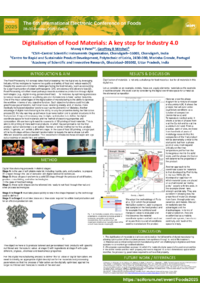
The Food Processing 4.0 concept takes food processing into the digital era by leveraging Industry 4.0 technologies to improve the quality and safety of food and reduce waste [1]. Despite the severe environmental challenges facing the food industry (such as accounting for a significant portion of global anthropogenic GHG emissions and biodiversity loss [2]), Food Processing 4.0 offers novel pathways towards sustainable production through digital technologies (e.g., digital mixing, personalised food) — for instance, by optimising processes to reduce resource waste or by utilising precision formulations to lower carbon footprints. One of the major advantages of the digitalisation of manufacturing is the ability to optimise the workflow in terms of any objective function. Such objective functions could include greenhouse gas emissions, nutritional value, reversing obesity and of course, more medically formulated objective functions such as the prevention of diabetes. Another advantage of digital manufacturing is the ability to vary the properties during the fabrication process [3], thereby opening up pathways to personalisation and to graded structures in the final product. A key and necessary step in digital optimisation is to define the digital coordinate space for food materials and the method of description of properties and composition. We are looking forward to a scenario of 3D printing of food materials. This is akin to 4D printing of more technical products, in which the part printed is not the final product, but is transformed via an optical, thermal or similar method to the final product, which in general will exhibit a different shape. In the case of food 3D printing, a major part of the fourth stage will be a thermal transformation to largely the same shape but with different properties and composition. This presentation introduces these concepts and lays out a roadmap of possibilities and actions.
Keywords
Digital Manufacturing
3D Printing
Industry 4.0
Food manufacturing
Personalised Food
Poster
Patel_mitchell2025.pdf
Proximate Composition and Physicochemical Properties of Matoa (Pometia pinnata) Seed and Seed Oil
Potential health benefits of optimised whole-wheat flour fermentation on intestinal cells