Event submissions
Published
This submission belongs to the session A. Food Technology and Engineering of the event The 6th International Electronic Conference on Foods
Published date
27 Oct, 2025
Academic Editor
'%3e%3cpath%20d='M12.6657%2010.9104C12.4185%2010.325%2012.0599%209.79327%2011.6097%209.34482C11.1609%208.89508%2010.6293%208.5365%2010.0442%208.28888C10.0389%208.28626%2010.0337%208.28495%2010.0285%208.28233C10.8446%207.69279%2011.3752%206.73249%2011.3752%205.64904C11.3752%203.8542%209.92103%202.39999%208.1262%202.39999C6.33136%202.39999%204.87715%203.8542%204.87715%205.64904C4.87715%206.73249%205.40774%207.69279%206.22393%208.28364C6.21869%208.28626%206.21345%208.28757%206.20821%208.29019C5.62129%208.5378%205.09463%208.89284%204.64265%209.34613C4.1929%209.79493%203.83432%2010.3266%203.58671%2010.9117C3.34345%2011.4845%203.21226%2012.0987%203.20023%2012.7209C3.19988%2012.7349%203.20233%2012.7488%203.20744%2012.7619C3.21255%2012.7749%203.22022%2012.7867%203.22998%2012.7968C3.23975%2012.8068%203.25142%2012.8147%203.26431%2012.8202C3.2772%2012.8256%203.29105%2012.8284%203.30504%2012.8284H4.09109C4.14874%2012.8284%204.19459%2012.7825%204.1959%2012.7262C4.2221%2011.7148%204.62823%2010.7676%205.34617%2010.0497C6.08899%209.30683%207.0755%208.89808%208.1262%208.89808C9.17689%208.89808%2010.1634%209.30683%2010.9062%2010.0497C11.6242%2010.7676%2012.0303%2011.7148%2012.0565%2012.7262C12.0578%2012.7838%2012.1037%2012.8284%2012.1613%2012.8284H12.9474C12.9613%2012.8284%2012.9752%2012.8256%2012.9881%2012.8202C13.001%2012.8147%2013.0126%2012.8068%2013.0224%2012.7968C13.0322%2012.7867%2013.0398%2012.7749%2013.0449%2012.7619C13.0501%2012.7488%2013.0525%2012.7349%2013.0522%2012.7209C13.0391%2012.0947%2012.9094%2011.4855%2012.6657%2010.9104ZM8.1262%207.9024C7.52486%207.9024%206.9589%207.6679%206.53312%207.24211C6.10733%206.81633%205.87283%206.25037%205.87283%205.64904C5.87283%205.0477%206.10733%204.48174%206.53312%204.05596C6.9589%203.63018%207.52486%203.39567%208.1262%203.39567C8.72753%203.39567%209.29349%203.63018%209.71927%204.05596C10.1451%204.48174%2010.3796%205.0477%2010.3796%205.64904C10.3796%206.25037%2010.1451%206.81633%209.71927%207.24211C9.29349%207.6679%208.72753%207.9024%208.1262%207.9024Z'%20fill='%235D1EE1'/%3e%3c/g%3e%3c/svg%3e) Elsa Gonçalves
Elsa GonçalvesCitation
Jelena Bajac, Milena Terzić, Igor Antić, Gökhan Zengin, Milana Maričić, Branislava Nikolovski, The Influence of the material drying process on the chemical composition and biological activity of hydrodistilled laurel essential oil (Laurus nobilis L.), in Proceedings of The 6th International Electronic Conference on Foods, 28 October–30 October 2025, MDPI: Basel, Switzerland
Share
Email
Facebook
Twitter
LinkedIn
The Influence of the material drying process on the chemical composition and biological activity of hydrodistilled laurel essential oil (Laurus nobilis L.)
'%3e%3cpath%20d='M12.6647%2010.9104C12.4176%2010.325%2012.0589%209.7933%2011.6088%209.34485C11.16%208.89511%2010.6283%208.53653%2010.0432%208.28891C10.038%208.28629%2010.0327%208.28498%2010.0275%208.28236C10.8437%207.69282%2011.3743%206.73252%2011.3743%205.64907C11.3743%203.85423%209.92005%202.40002%208.12522%202.40002C6.33038%202.40002%204.87618%203.85423%204.87618%205.64907C4.87618%206.73252%205.40677%207.69282%206.22296%208.28367C6.21772%208.28629%206.21248%208.2876%206.20724%208.29022C5.62031%208.53783%205.09365%208.89287%204.64167%209.34616C4.19192%209.79496%203.83334%2010.3266%203.58573%2010.9117C3.34247%2011.4846%203.21128%2012.0987%203.19925%2012.721C3.1989%2012.735%203.20135%2012.7489%203.20646%2012.7619C3.21157%2012.7749%203.21924%2012.7868%203.22901%2012.7968C3.23877%2012.8068%203.25045%2012.8148%203.26334%2012.8202C3.27623%2012.8256%203.29007%2012.8284%203.30406%2012.8284H4.09012C4.14776%2012.8284%204.19362%2012.7825%204.19493%2012.7262C4.22113%2011.7148%204.62726%2010.7676%205.34519%2010.0497C6.08802%209.30686%207.07452%208.89811%208.12522%208.89811C9.17592%208.89811%2010.1624%209.30686%2010.9052%2010.0497C11.6232%2010.7676%2012.0293%2011.7148%2012.0555%2012.7262C12.0568%2012.7839%2012.1027%2012.8284%2012.1603%2012.8284H12.9464C12.9604%2012.8284%2012.9742%2012.8256%2012.9871%2012.8202C13%2012.8148%2013.0117%2012.8068%2013.0214%2012.7968C13.0312%2012.7868%2013.0389%2012.7749%2013.044%2012.7619C13.0491%2012.7489%2013.0515%2012.735%2013.0512%2012.721C13.0381%2012.0947%2012.9084%2011.4856%2012.6647%2010.9104ZM8.12522%207.90243C7.52388%207.90243%206.95792%207.66793%206.53214%207.24215C6.10636%206.81636%205.87185%206.2504%205.87185%205.64907C5.87185%205.04773%206.10636%204.48177%206.53214%204.05599C6.95792%203.63021%207.52388%203.3957%208.12522%203.3957C8.72655%203.3957%209.29252%203.63021%209.7183%204.05599C10.1441%204.48177%2010.3786%205.04773%2010.3786%205.64907C10.3786%206.2504%2010.1441%206.81636%209.7183%207.24215C9.29252%207.66793%208.72655%207.90243%208.12522%207.90243Z'%20fill='%235D1EE1'/%3e%3c/g%3e%3c/svg%3e)
Jelena Bajac 1
Milena Terzić 1
Igor Antić 1

Gökhan Zengin 2
Milana Maričić 1
Branislava Nikolovski 1
1. Faculty of Technology, University of Novi Sad, Bulevar cara Lazara 1, 21000 Novi Sad, Serbia
2. Science Faculty, Selcuk University, Campus Konya, 42130, Turkey
Abstract
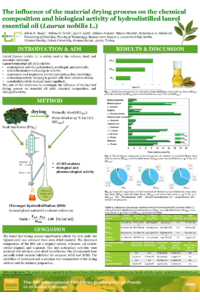
Laurel (Laurus nobilis L.) is a natural source of nutritionally and biologically valuable essential oils that are widely used in the culinary, food, and cosmetics industries. The plant material used to isolate the essential oil was fresh bay leaves, naturally dried leaves, and leaves oven dried at 45°C for 72 hours. The extraction of laurel essential oil was carried out using the Clevenger hydrodistillation (HD) method. The influence of the drying process on the essential oil yield, chemical composition, and biological activity was investigated. The biological and pharmacological potential was investigated using various in vitro antioxidation tests: ABTS (2,2'-azino-bis (3-ethylbenzothiazoline-6-sulfonic acid), DPPH (2,2-diphenyl-1-picrylhydrazyl), and CUPRAC (copper-reducing antioxidant capacity), FRAP (ferric-reducing antioxidant capacity), and metal chelating and total antioxidant capacity. The inhibitory effect of the enzyme was analysed against cholinesterases (AChE and BChE), tyrosinase, α-amylase, and α-glucosidase.
The yield of the essential oil obtained was significantly influenced by the drying process of the plant material, with the highest yield (2.33% (m/m)) being obtained when the material was dried at 45˚C for 72 hours. The dominant components of laurel essential oil are α-terpinyl acetate, sabinene, 1,8-cineole, methyl eugenol, and α-pinene. The composition is dominated by oxidized monoterpenes (56.5-62.51%), followed by monoterpenes (29.99-36.84%), while sesquiterpenes and oxidized sesquiterpenes are represented at a slightly smaller percentage (1.07-3.00% and 0.92-4.50%, respectively). The best antioxidant activities were achieved with oil extracted from oven-dried laurel leaves (DPPH, ABTS, CUPRAC, FRAP, and PBD, with 69.34±0.04 mg TE/g, 107.28±0.16 mg TE/g, 573.22±18.66 mg TE/g, 833.01±20.69 mg TE/g, and 69.08±1.03 mg EDTAE/g, respectively). The laurel essential oil extracted from naturally dried material showed inhibition of the enzymes AChE and BChE. The inhibition of tyrosinase and α-amylase was similar for all examined essential oils and independent of the drying material preparation process.
Keywords
laurel essential oil
hydrodistillation
chemical composition
antioxidant activity
Poster
J.Bajac_poster Foods2025.pdf
IMPACT OF THERMAL PROCESSING AND SIMULATED DIGESTION ON POLYPHENOL CONTENT, ANTIOXIDANT ACTIVITY, AND ENZYME INHIBITION OF FENUGREEK SEEDS
PLS-DA-Based Classification of Red Wine Vintages via Digital Imaging and Chemical Properties