Event submissions
Published
This submission belongs to the session E. Chemistry and Physicochemical Properties of the event The 6th International Electronic Conference on Foods
Published date
27 Oct, 2025
Academic Editor
'%3e%3cpath%20d='M12.6657%2010.9104C12.4185%2010.325%2012.0599%209.79327%2011.6097%209.34482C11.1609%208.89508%2010.6293%208.5365%2010.0442%208.28888C10.0389%208.28626%2010.0337%208.28495%2010.0285%208.28233C10.8446%207.69279%2011.3752%206.73249%2011.3752%205.64904C11.3752%203.8542%209.92103%202.39999%208.1262%202.39999C6.33136%202.39999%204.87715%203.8542%204.87715%205.64904C4.87715%206.73249%205.40774%207.69279%206.22393%208.28364C6.21869%208.28626%206.21345%208.28757%206.20821%208.29019C5.62129%208.5378%205.09463%208.89284%204.64265%209.34613C4.1929%209.79493%203.83432%2010.3266%203.58671%2010.9117C3.34345%2011.4845%203.21226%2012.0987%203.20023%2012.7209C3.19988%2012.7349%203.20233%2012.7488%203.20744%2012.7619C3.21255%2012.7749%203.22022%2012.7867%203.22998%2012.7968C3.23975%2012.8068%203.25142%2012.8147%203.26431%2012.8202C3.2772%2012.8256%203.29105%2012.8284%203.30504%2012.8284H4.09109C4.14874%2012.8284%204.19459%2012.7825%204.1959%2012.7262C4.2221%2011.7148%204.62823%2010.7676%205.34617%2010.0497C6.08899%209.30683%207.0755%208.89808%208.1262%208.89808C9.17689%208.89808%2010.1634%209.30683%2010.9062%2010.0497C11.6242%2010.7676%2012.0303%2011.7148%2012.0565%2012.7262C12.0578%2012.7838%2012.1037%2012.8284%2012.1613%2012.8284H12.9474C12.9613%2012.8284%2012.9752%2012.8256%2012.9881%2012.8202C13.001%2012.8147%2013.0126%2012.8068%2013.0224%2012.7968C13.0322%2012.7867%2013.0398%2012.7749%2013.0449%2012.7619C13.0501%2012.7488%2013.0525%2012.7349%2013.0522%2012.7209C13.0391%2012.0947%2012.9094%2011.4855%2012.6657%2010.9104ZM8.1262%207.9024C7.52486%207.9024%206.9589%207.6679%206.53312%207.24211C6.10733%206.81633%205.87283%206.25037%205.87283%205.64904C5.87283%205.0477%206.10733%204.48174%206.53312%204.05596C6.9589%203.63018%207.52486%203.39567%208.1262%203.39567C8.72753%203.39567%209.29349%203.63018%209.71927%204.05596C10.1451%204.48174%2010.3796%205.0477%2010.3796%205.64904C10.3796%206.25037%2010.1451%206.81633%209.71927%207.24211C9.29349%207.6679%208.72753%207.9024%208.1262%207.9024Z'%20fill='%235D1EE1'/%3e%3c/g%3e%3c/svg%3e) Víctor Manuel Pérez Puyana
Víctor Manuel Pérez PuyanaCitation
Shan Hong, Diane Rougeau, Yilin Li, Nirali Patel, Bipin Rajpurohit, Yonghui Li, Ron Haff, Yuzhu Zhang, Yixiang Xu, Physicochemical and functional properties of dietary fiber-rich by-products from different pulses: a comparative study, in Proceedings of The 6th International Electronic Conference on Foods, 28 October–30 October 2025, MDPI: Basel, Switzerland
Share
Email
Facebook
Twitter
LinkedIn
Physicochemical and functional properties of dietary fiber-rich by-products from different pulses: a comparative study
'%3e%3cpath%20d='M12.6647%2010.9104C12.4176%2010.325%2012.0589%209.7933%2011.6088%209.34485C11.16%208.89511%2010.6283%208.53653%2010.0432%208.28891C10.038%208.28629%2010.0327%208.28498%2010.0275%208.28236C10.8437%207.69282%2011.3743%206.73252%2011.3743%205.64907C11.3743%203.85423%209.92005%202.40002%208.12522%202.40002C6.33038%202.40002%204.87618%203.85423%204.87618%205.64907C4.87618%206.73252%205.40677%207.69282%206.22296%208.28367C6.21772%208.28629%206.21248%208.2876%206.20724%208.29022C5.62031%208.53783%205.09365%208.89287%204.64167%209.34616C4.19192%209.79496%203.83334%2010.3266%203.58573%2010.9117C3.34247%2011.4846%203.21128%2012.0987%203.19925%2012.721C3.1989%2012.735%203.20135%2012.7489%203.20646%2012.7619C3.21157%2012.7749%203.21924%2012.7868%203.22901%2012.7968C3.23877%2012.8068%203.25045%2012.8148%203.26334%2012.8202C3.27623%2012.8256%203.29007%2012.8284%203.30406%2012.8284H4.09012C4.14776%2012.8284%204.19362%2012.7825%204.19493%2012.7262C4.22113%2011.7148%204.62726%2010.7676%205.34519%2010.0497C6.08802%209.30686%207.07452%208.89811%208.12522%208.89811C9.17592%208.89811%2010.1624%209.30686%2010.9052%2010.0497C11.6232%2010.7676%2012.0293%2011.7148%2012.0555%2012.7262C12.0568%2012.7839%2012.1027%2012.8284%2012.1603%2012.8284H12.9464C12.9604%2012.8284%2012.9742%2012.8256%2012.9871%2012.8202C13%2012.8148%2013.0117%2012.8068%2013.0214%2012.7968C13.0312%2012.7868%2013.0389%2012.7749%2013.044%2012.7619C13.0491%2012.7489%2013.0515%2012.735%2013.0512%2012.721C13.0381%2012.0947%2012.9084%2011.4856%2012.6647%2010.9104ZM8.12522%207.90243C7.52388%207.90243%206.95792%207.66793%206.53214%207.24215C6.10636%206.81636%205.87185%206.2504%205.87185%205.64907C5.87185%205.04773%206.10636%204.48177%206.53214%204.05599C6.95792%203.63021%207.52388%203.3957%208.12522%203.3957C8.72655%203.3957%209.29252%203.63021%209.7183%204.05599C10.1441%204.48177%2010.3786%205.04773%2010.3786%205.64907C10.3786%206.2504%2010.1441%206.81636%209.7183%207.24215C9.29252%207.66793%208.72655%207.90243%208.12522%207.90243Z'%20fill='%235D1EE1'/%3e%3c/g%3e%3c/svg%3e)
Shan Hong 1
Diane Rougeau 2
Yilin Li 3
Nirali Patel 4
Bipin Rajpurohit 1

Yonghui Li 1
Ron Haff 4
Yuzhu Zhang 4
Yixiang Xu 4
1. Department of Grain Science and Industry, Kansas State University, 1301 Mid-Campus Dr, Manhattan, KS 66506, United States
2. Institut Agro Dijon, 26 bd Docteur Petitjean, BP 87999, Dijon Cedex, 21079, France
3. Department of Food Science and Technology, Virginia Tech, 1230 Washington St SW, Blacksburg, VA 24061, United States
4. Healthy Processed Foods Research Unit, Western Regional Research Center, USDA-ARS, 800 Buchanan Street, Albany, CA, 94710, United States
Abstract
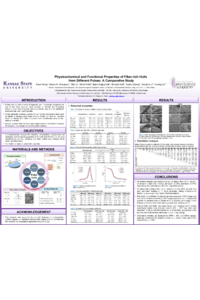
Pulse hulls, the primary by-product of pulse processing, are increasingly being recognized as promising sources of dietary fiber, yet their nutritional composition and functional properties remain underexplored. This study comparatively investigated the proximate composition, physicochemical and functional properties, and antioxidant activities of pulse hulls from six commonly consumed pulses: chickpea, red lentil, yellow pea, cowpea, black bean, and faba bean. All the studied samples were rich in dietary fiber (49.11 – 65.43%), while low in protein (3.94 – 13.91%), ash (2.23 – 5.03%), and fat (0 – 0.71%). Scanning electron microscopy revealed distinct surface morphologies across samples. Variations in compositional profiles and microstructures resulted in versatile functional properties. Chickpea hull displayed the highest water holding (5.91 g/g), oil holding (1.48 g/g), and swelling (4.17 mL/g) capacities; red lentil hull exhibited the highest glucose adsorption (308.01 mg/g) and exceptional cholesterol binding (135.19 mg/g) capacities, while cowpea hull exerted the greatest sodium cholate binding capacity (29.89 mg/g). Colored hulls (red lentil, faba bean, black bean, cowpea) demonstrated significantly higher total phenolic content (8.54 – 35.70 mg gallic acid equivalent (GAE)/g) compared to the light-colored chickpea and yellow pea hulls (< 1 mg GAE/g), with red lentil hull showing the highest value. Antioxidant activities assessed by DPPH, NO, and ORAC assays positively correlated with phenolic content (r = 0.992, 0.906, and 0.936, respectively, p < 0.05). These findings highlight the potential applicability of pulse hulls as antioxidant and fiber-rich ingredients for functional food applications.
Keywords
pulse hull
by-product
dietary fiber
proximate composition
functional property
antioxidant activity
Poster
sciforum-134099.pdf
Effects of Konjac Glucomannan on the Physicochemical and Structural Properties of Neghal Date Paste
Zinc enrichment of Triticum aestivum L. (cvs. Roxo and Paiva): nutritional characterization and influence of tecnifol zinc in flours and grains