Event submissions
Published
This submission belongs to the session B. Nutritional and Functional Foods of the event The 6th International Electronic Conference on Foods
Published date
27 Oct, 2025
Academic Editor
'%3e%3cpath%20d='M12.6657%2010.9104C12.4185%2010.325%2012.0599%209.79327%2011.6097%209.34482C11.1609%208.89508%2010.6293%208.5365%2010.0442%208.28888C10.0389%208.28626%2010.0337%208.28495%2010.0285%208.28233C10.8446%207.69279%2011.3752%206.73249%2011.3752%205.64904C11.3752%203.8542%209.92103%202.39999%208.1262%202.39999C6.33136%202.39999%204.87715%203.8542%204.87715%205.64904C4.87715%206.73249%205.40774%207.69279%206.22393%208.28364C6.21869%208.28626%206.21345%208.28757%206.20821%208.29019C5.62129%208.5378%205.09463%208.89284%204.64265%209.34613C4.1929%209.79493%203.83432%2010.3266%203.58671%2010.9117C3.34345%2011.4845%203.21226%2012.0987%203.20023%2012.7209C3.19988%2012.7349%203.20233%2012.7488%203.20744%2012.7619C3.21255%2012.7749%203.22022%2012.7867%203.22998%2012.7968C3.23975%2012.8068%203.25142%2012.8147%203.26431%2012.8202C3.2772%2012.8256%203.29105%2012.8284%203.30504%2012.8284H4.09109C4.14874%2012.8284%204.19459%2012.7825%204.1959%2012.7262C4.2221%2011.7148%204.62823%2010.7676%205.34617%2010.0497C6.08899%209.30683%207.0755%208.89808%208.1262%208.89808C9.17689%208.89808%2010.1634%209.30683%2010.9062%2010.0497C11.6242%2010.7676%2012.0303%2011.7148%2012.0565%2012.7262C12.0578%2012.7838%2012.1037%2012.8284%2012.1613%2012.8284H12.9474C12.9613%2012.8284%2012.9752%2012.8256%2012.9881%2012.8202C13.001%2012.8147%2013.0126%2012.8068%2013.0224%2012.7968C13.0322%2012.7867%2013.0398%2012.7749%2013.0449%2012.7619C13.0501%2012.7488%2013.0525%2012.7349%2013.0522%2012.7209C13.0391%2012.0947%2012.9094%2011.4855%2012.6657%2010.9104ZM8.1262%207.9024C7.52486%207.9024%206.9589%207.6679%206.53312%207.24211C6.10733%206.81633%205.87283%206.25037%205.87283%205.64904C5.87283%205.0477%206.10733%204.48174%206.53312%204.05596C6.9589%203.63018%207.52486%203.39567%208.1262%203.39567C8.72753%203.39567%209.29349%203.63018%209.71927%204.05596C10.1451%204.48174%2010.3796%205.0477%2010.3796%205.64904C10.3796%206.25037%2010.1451%206.81633%209.71927%207.24211C9.29349%207.6679%208.72753%207.9024%208.1262%207.9024Z'%20fill='%235D1EE1'/%3e%3c/g%3e%3c/svg%3e) Manuel Viuda-Martos
Manuel Viuda-MartosCitation
Karen Florencia Irigoytia, Carolina Elizabeth Genevois, Marina Francisca de Escalada Pla, Impact of millet and agro-industrial by-products on the technological quality and shelf life of gluten-free breads, in Proceedings of The 6th International Electronic Conference on Foods, 28 October–30 October 2025, MDPI: Basel, Switzerland
Share
Email
Facebook
Twitter
LinkedIn
Impact of millet and agro-industrial by-products on the technological quality and shelf life of gluten-free breads
'%3e%3cpath%20d='M12.6647%2010.9104C12.4176%2010.325%2012.0589%209.7933%2011.6088%209.34485C11.16%208.89511%2010.6283%208.53653%2010.0432%208.28891C10.038%208.28629%2010.0327%208.28498%2010.0275%208.28236C10.8437%207.69282%2011.3743%206.73252%2011.3743%205.64907C11.3743%203.85423%209.92005%202.40002%208.12522%202.40002C6.33038%202.40002%204.87618%203.85423%204.87618%205.64907C4.87618%206.73252%205.40677%207.69282%206.22296%208.28367C6.21772%208.28629%206.21248%208.2876%206.20724%208.29022C5.62031%208.53783%205.09365%208.89287%204.64167%209.34616C4.19192%209.79496%203.83334%2010.3266%203.58573%2010.9117C3.34247%2011.4846%203.21128%2012.0987%203.19925%2012.721C3.1989%2012.735%203.20135%2012.7489%203.20646%2012.7619C3.21157%2012.7749%203.21924%2012.7868%203.22901%2012.7968C3.23877%2012.8068%203.25045%2012.8148%203.26334%2012.8202C3.27623%2012.8256%203.29007%2012.8284%203.30406%2012.8284H4.09012C4.14776%2012.8284%204.19362%2012.7825%204.19493%2012.7262C4.22113%2011.7148%204.62726%2010.7676%205.34519%2010.0497C6.08802%209.30686%207.07452%208.89811%208.12522%208.89811C9.17592%208.89811%2010.1624%209.30686%2010.9052%2010.0497C11.6232%2010.7676%2012.0293%2011.7148%2012.0555%2012.7262C12.0568%2012.7839%2012.1027%2012.8284%2012.1603%2012.8284H12.9464C12.9604%2012.8284%2012.9742%2012.8256%2012.9871%2012.8202C13%2012.8148%2013.0117%2012.8068%2013.0214%2012.7968C13.0312%2012.7868%2013.0389%2012.7749%2013.044%2012.7619C13.0491%2012.7489%2013.0515%2012.735%2013.0512%2012.721C13.0381%2012.0947%2012.9084%2011.4856%2012.6647%2010.9104ZM8.12522%207.90243C7.52388%207.90243%206.95792%207.66793%206.53214%207.24215C6.10636%206.81636%205.87185%206.2504%205.87185%205.64907C5.87185%205.04773%206.10636%204.48177%206.53214%204.05599C6.95792%203.63021%207.52388%203.3957%208.12522%203.3957C8.72655%203.3957%209.29252%203.63021%209.7183%204.05599C10.1441%204.48177%2010.3786%205.04773%2010.3786%205.64907C10.3786%206.2504%2010.1441%206.81636%209.7183%207.24215C9.29252%207.66793%208.72655%207.90243%208.12522%207.90243Z'%20fill='%235D1EE1'/%3e%3c/g%3e%3c/svg%3e)
Karen Florencia Irigoytia 1,2
Carolina Elizabeth Genevois 1,2
Marina Francisca de Escalada Pla 2,3
1. Institute of Food Science and Technology of Entre Ríos (ICTAER, CONICET-UNER), Pte. Perón 1154, Gualeguaychú, E2820, Argentina.
2. National Scientific and Technical Research Council (CONICET), Godoy Cruz 2290, Autonomous City of Buenos Aires, C1425FQB, Argentina.
3. Institute of Food Technology and Chemical Processes (ITAPROQ, CONICET-UBA), Intendente Güiraldes 2160, Autonomous City of Buenos Aires, C1428EGA, Argentina.
Abstract
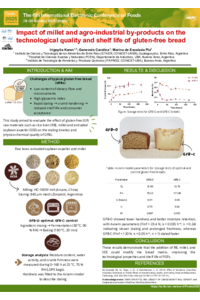
Gluten-free breads (GFBs) are usually formulated with refined flours, starches, or premixes that are low in fibre, micronutrients, and have a high glycaemic index. In addition, these formulations often stale rapidly, leading to crumb hardness, reducing shelf life, and decreasing consumer acceptance. This study aimed to evaluate the effect of gluten-free raw materials such as rice bran (RB), millet, and extruded soybean expeller (SEE) on the staling kinetics and physico-chemical quality of GFBs. Millet and SEE were milled using a HC-1000Y mill (Arcano, China) and then sieved together with RB through an 840 µm mesh (Zonytest, Argentina). Two GFB formulations were prepared: optimal (GFB-O) and control (GFB-C). Both contained xanthan gum (0.5%), sunflower oil (6%), salt (2%), sugar (5%), and dry yeast (3%). GFB-O included 15% each of RB, millet, and SEE and rice flour (22.5%), corn starch (32.5%), and water (115%), while GFB-C was made with 100% corn starch and 90% water. Moisture content (AACC, 2000), water activity, and crumb hardness (peak force during the first compression cycle of the texture profile analysis) were evaluated during storage (0–168 h, 25 °C, 70% RH, LDPE bags). Hardness data were fitted to the Avrami equation to model staling kinetics. ANOVA with Fisher’s LSD test (95% confidence) revealed significant effects of formulation and storage time on crumb water activity, moisture, and hardness (p<0.0001). GFB-O exhibited lower crumb hardness and improved moisture retention throughout the storage period. Avrami modelling supported this, showing that GFB-O had a lower final hardness (Finf = 23.4 N), lower rate constant (k = 0.035 h⁻ⁿ), and exponent (n = 0.24), indicating a slower staling process and prolonged freshness. In contrast, GFB-C showed Finf ≈ 120 N, k = 0.05 h⁻ⁿ, and n = 1, consistent with faster staling. These results demonstrate that the addition of RB, millet, and SEE could modify the bread matrix, improving the technological properties and shelf life of FGFs.
Keywords
Retrogradation
by-product valorization
staling kinetics
gluten-free breads
Poster
Póster e conference.pptx (1080 x 1536 px).pdf
Green extracts of Luzuriaga radicans berries Ruiz & Pav. with potential against chronic diseases
Sacha Inchi Leaf Extract Preserves Bioactive Lipids and Reduces Oxidation in Pan-Fried Beef Patties: A Lipidomics Approach