Event submissions
Published
This submission belongs to the session A. Food Technology and Engineering of the event The 6th International Electronic Conference on Foods
Published date
27 Oct, 2025
Academic Editor
'%3e%3cpath%20d='M12.6657%2010.9104C12.4185%2010.325%2012.0599%209.79327%2011.6097%209.34482C11.1609%208.89508%2010.6293%208.5365%2010.0442%208.28888C10.0389%208.28626%2010.0337%208.28495%2010.0285%208.28233C10.8446%207.69279%2011.3752%206.73249%2011.3752%205.64904C11.3752%203.8542%209.92103%202.39999%208.1262%202.39999C6.33136%202.39999%204.87715%203.8542%204.87715%205.64904C4.87715%206.73249%205.40774%207.69279%206.22393%208.28364C6.21869%208.28626%206.21345%208.28757%206.20821%208.29019C5.62129%208.5378%205.09463%208.89284%204.64265%209.34613C4.1929%209.79493%203.83432%2010.3266%203.58671%2010.9117C3.34345%2011.4845%203.21226%2012.0987%203.20023%2012.7209C3.19988%2012.7349%203.20233%2012.7488%203.20744%2012.7619C3.21255%2012.7749%203.22022%2012.7867%203.22998%2012.7968C3.23975%2012.8068%203.25142%2012.8147%203.26431%2012.8202C3.2772%2012.8256%203.29105%2012.8284%203.30504%2012.8284H4.09109C4.14874%2012.8284%204.19459%2012.7825%204.1959%2012.7262C4.2221%2011.7148%204.62823%2010.7676%205.34617%2010.0497C6.08899%209.30683%207.0755%208.89808%208.1262%208.89808C9.17689%208.89808%2010.1634%209.30683%2010.9062%2010.0497C11.6242%2010.7676%2012.0303%2011.7148%2012.0565%2012.7262C12.0578%2012.7838%2012.1037%2012.8284%2012.1613%2012.8284H12.9474C12.9613%2012.8284%2012.9752%2012.8256%2012.9881%2012.8202C13.001%2012.8147%2013.0126%2012.8068%2013.0224%2012.7968C13.0322%2012.7867%2013.0398%2012.7749%2013.0449%2012.7619C13.0501%2012.7488%2013.0525%2012.7349%2013.0522%2012.7209C13.0391%2012.0947%2012.9094%2011.4855%2012.6657%2010.9104ZM8.1262%207.9024C7.52486%207.9024%206.9589%207.6679%206.53312%207.24211C6.10733%206.81633%205.87283%206.25037%205.87283%205.64904C5.87283%205.0477%206.10733%204.48174%206.53312%204.05596C6.9589%203.63018%207.52486%203.39567%208.1262%203.39567C8.72753%203.39567%209.29349%203.63018%209.71927%204.05596C10.1451%204.48174%2010.3796%205.0477%2010.3796%205.64904C10.3796%206.25037%2010.1451%206.81633%209.71927%207.24211C9.29349%207.6679%208.72753%207.9024%208.1262%207.9024Z'%20fill='%235D1EE1'/%3e%3c/g%3e%3c/svg%3e) Mohsen Gavahian
Mohsen GavahianCitation
Nancy Noemí Esposito, Busch Verónica María, María del Pilar Buera, Carolina Elizabeth Genevois, Sensory profile of gluten-free breads formulated with Neltuma affinis powders, in Proceedings of The 6th International Electronic Conference on Foods, 28 October–30 October 2025, MDPI: Basel, Switzerland
Share
Email
Facebook
Twitter
LinkedIn
Sensory profile of gluten-free breads formulated with Neltuma affinis powders
'%3e%3cpath%20d='M12.6647%2010.9104C12.4176%2010.325%2012.0589%209.7933%2011.6088%209.34485C11.16%208.89511%2010.6283%208.53653%2010.0432%208.28891C10.038%208.28629%2010.0327%208.28498%2010.0275%208.28236C10.8437%207.69282%2011.3743%206.73252%2011.3743%205.64907C11.3743%203.85423%209.92005%202.40002%208.12522%202.40002C6.33038%202.40002%204.87618%203.85423%204.87618%205.64907C4.87618%206.73252%205.40677%207.69282%206.22296%208.28367C6.21772%208.28629%206.21248%208.2876%206.20724%208.29022C5.62031%208.53783%205.09365%208.89287%204.64167%209.34616C4.19192%209.79496%203.83334%2010.3266%203.58573%2010.9117C3.34247%2011.4846%203.21128%2012.0987%203.19925%2012.721C3.1989%2012.735%203.20135%2012.7489%203.20646%2012.7619C3.21157%2012.7749%203.21924%2012.7868%203.22901%2012.7968C3.23877%2012.8068%203.25045%2012.8148%203.26334%2012.8202C3.27623%2012.8256%203.29007%2012.8284%203.30406%2012.8284H4.09012C4.14776%2012.8284%204.19362%2012.7825%204.19493%2012.7262C4.22113%2011.7148%204.62726%2010.7676%205.34519%2010.0497C6.08802%209.30686%207.07452%208.89811%208.12522%208.89811C9.17592%208.89811%2010.1624%209.30686%2010.9052%2010.0497C11.6232%2010.7676%2012.0293%2011.7148%2012.0555%2012.7262C12.0568%2012.7839%2012.1027%2012.8284%2012.1603%2012.8284H12.9464C12.9604%2012.8284%2012.9742%2012.8256%2012.9871%2012.8202C13%2012.8148%2013.0117%2012.8068%2013.0214%2012.7968C13.0312%2012.7868%2013.0389%2012.7749%2013.044%2012.7619C13.0491%2012.7489%2013.0515%2012.735%2013.0512%2012.721C13.0381%2012.0947%2012.9084%2011.4856%2012.6647%2010.9104ZM8.12522%207.90243C7.52388%207.90243%206.95792%207.66793%206.53214%207.24215C6.10636%206.81636%205.87185%206.2504%205.87185%205.64907C5.87185%205.04773%206.10636%204.48177%206.53214%204.05599C6.95792%203.63021%207.52388%203.3957%208.12522%203.3957C8.72655%203.3957%209.29252%203.63021%209.7183%204.05599C10.1441%204.48177%2010.3786%205.04773%2010.3786%205.64907C10.3786%206.2504%2010.1441%206.81636%209.7183%207.24215C9.29252%207.66793%208.72655%207.90243%208.12522%207.90243Z'%20fill='%235D1EE1'/%3e%3c/g%3e%3c/svg%3e)
Nancy Noemí Esposito 1

Busch Verónica María 1,2
María del Pilar Buera 3
Carolina Elizabeth Genevois 1,2
1. Institute of Food Science and Technology of Entre Ríos (ICTAER UNER-CONICET), Gualeguaychú, 2820, Argentina.
2. National Council for Scientific and Technical Research (CONICET), Autonomous City of Buenos Aires, C1425FQD, Argentina.
3. Institute of Food Technology and Chemical Processes (ITAPROQ UBA-CONICET), Buenos Aires, C1428EGA, Argentina.
Abstract
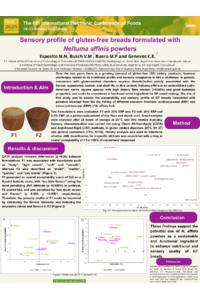
Although the demand for gluten-free (GF) bakery products has grown significantly over recent years, there are still challenges related to the sensory and nutritional acceptance of these products, with consumers expressing dissatisfaction with their flavour, texture and nutritional value. In this context, Neltuma affinis is an underutilised native legume species with a good nutritional profile, and could be a novel ingredient for GF bread making. The aim of this study was to assess the acceptability and sensory profile of GF breads formulated with powders obtained from the endocarp–seed (ESP) and exocarp–mesocarp (EMP) of N. affinis fruits. Two formulations were evaluated: F1 with 20% ESP, and F2 with 20% ESP and 2.4% EMP, as a partial replacement of rice flour and starch corn. Samples were analysed after 24 hours of storage at 25 °C and 70% relative humidity. Sensory characterisation was carried out using the Check All-That-Apply (CATA) and Just-About-Right (JAR) methods by individuals with gluten-related disorders and general consumers (N=105). CATA analysis revealed differences (p <0.05) between formulations. F1 was associated with descriptors such as “flavourful”, “light crumb”, “soft” and “smooth”, whereas F2 was described as “moist”, “elastic”, “gummy” and having a “highly aerated crumb". F1 presented an overall acceptability score of 7±2 on a 9-point hedonic scale, with “too little flavour” being the most penalising JAR attribute (1.579, p <0.0001); in contrast, F2 scored 6±2, and was penalised for having “too much colour and flavour” (1.246, p 0.003; 2.689, p <0.0001, respectively). Therefore, the sensory profile of F1 could be improved by enhancing its flavour intensity, and that of F2 could be improved by reducing its excessive colour and flavour. These findings support the potential use of N. affinis powders as a sustainable and functional ingredient to enhance the nutritional and sensory quality of GF breads.
Keywords
Sensory profile
Neltuma affinis
Gluten-free bread
Check All-That-Apply
Just-About-Right.
Poster
Sin título (59.999 x 80 cm).pdf
Color Stability and Bioactive Compound Retention in Patagonian Berry Pulps: Comparative Study of Pasteurization and Freezing Treatments
Gummy Innovation: Development and Characterization of Plant-Based Gummies as Healthier Alternatives