Event submissions
Published
This submission belongs to the session E. Chemistry and Physicochemical Properties of the event The 6th International Electronic Conference on Foods
Published date
27 Oct, 2025
Academic Editor
'%3e%3cpath%20d='M12.6657%2010.9104C12.4185%2010.325%2012.0599%209.79327%2011.6097%209.34482C11.1609%208.89508%2010.6293%208.5365%2010.0442%208.28888C10.0389%208.28626%2010.0337%208.28495%2010.0285%208.28233C10.8446%207.69279%2011.3752%206.73249%2011.3752%205.64904C11.3752%203.8542%209.92103%202.39999%208.1262%202.39999C6.33136%202.39999%204.87715%203.8542%204.87715%205.64904C4.87715%206.73249%205.40774%207.69279%206.22393%208.28364C6.21869%208.28626%206.21345%208.28757%206.20821%208.29019C5.62129%208.5378%205.09463%208.89284%204.64265%209.34613C4.1929%209.79493%203.83432%2010.3266%203.58671%2010.9117C3.34345%2011.4845%203.21226%2012.0987%203.20023%2012.7209C3.19988%2012.7349%203.20233%2012.7488%203.20744%2012.7619C3.21255%2012.7749%203.22022%2012.7867%203.22998%2012.7968C3.23975%2012.8068%203.25142%2012.8147%203.26431%2012.8202C3.2772%2012.8256%203.29105%2012.8284%203.30504%2012.8284H4.09109C4.14874%2012.8284%204.19459%2012.7825%204.1959%2012.7262C4.2221%2011.7148%204.62823%2010.7676%205.34617%2010.0497C6.08899%209.30683%207.0755%208.89808%208.1262%208.89808C9.17689%208.89808%2010.1634%209.30683%2010.9062%2010.0497C11.6242%2010.7676%2012.0303%2011.7148%2012.0565%2012.7262C12.0578%2012.7838%2012.1037%2012.8284%2012.1613%2012.8284H12.9474C12.9613%2012.8284%2012.9752%2012.8256%2012.9881%2012.8202C13.001%2012.8147%2013.0126%2012.8068%2013.0224%2012.7968C13.0322%2012.7867%2013.0398%2012.7749%2013.0449%2012.7619C13.0501%2012.7488%2013.0525%2012.7349%2013.0522%2012.7209C13.0391%2012.0947%2012.9094%2011.4855%2012.6657%2010.9104ZM8.1262%207.9024C7.52486%207.9024%206.9589%207.6679%206.53312%207.24211C6.10733%206.81633%205.87283%206.25037%205.87283%205.64904C5.87283%205.0477%206.10733%204.48174%206.53312%204.05596C6.9589%203.63018%207.52486%203.39567%208.1262%203.39567C8.72753%203.39567%209.29349%203.63018%209.71927%204.05596C10.1451%204.48174%2010.3796%205.0477%2010.3796%205.64904C10.3796%206.25037%2010.1451%206.81633%209.71927%207.24211C9.29349%207.6679%208.72753%207.9024%208.1262%207.9024Z'%20fill='%235D1EE1'/%3e%3c/g%3e%3c/svg%3e) Joana Amaral
Joana AmaralCitation
Cláudia Campos Pessoa, Elisandra Lopes, Diana Daccak, Inês Carmo Luís, Ana Coelho Marques, Ana Rita F. Coelho, Paulo Legoinha, Fernando H. Reboredo, Manuela Simões, Maria Manuela Silva, Fernando C. Lidon, Gummy Innovation: Development and Characterization of Plant-Based Gummies as Healthier Alternatives, in Proceedings of The 6th International Electronic Conference on Foods, 28 October–30 October 2025, MDPI: Basel, Switzerland
Share
Email
Facebook
Twitter
LinkedIn
Gummy Innovation: Development and Characterization of Plant-Based Gummies as Healthier Alternatives

Cláudia Campos Pessoa 1,2
'%3e%3cpath%20d='M12.6647%2010.9104C12.4176%2010.325%2012.0589%209.7933%2011.6088%209.34485C11.16%208.89511%2010.6283%208.53653%2010.0432%208.28891C10.038%208.28629%2010.0327%208.28498%2010.0275%208.28236C10.8437%207.69282%2011.3743%206.73252%2011.3743%205.64907C11.3743%203.85423%209.92005%202.40002%208.12522%202.40002C6.33038%202.40002%204.87618%203.85423%204.87618%205.64907C4.87618%206.73252%205.40677%207.69282%206.22296%208.28367C6.21772%208.28629%206.21248%208.2876%206.20724%208.29022C5.62031%208.53783%205.09365%208.89287%204.64167%209.34616C4.19192%209.79496%203.83334%2010.3266%203.58573%2010.9117C3.34247%2011.4846%203.21128%2012.0987%203.19925%2012.721C3.1989%2012.735%203.20135%2012.7489%203.20646%2012.7619C3.21157%2012.7749%203.21924%2012.7868%203.22901%2012.7968C3.23877%2012.8068%203.25045%2012.8148%203.26334%2012.8202C3.27623%2012.8256%203.29007%2012.8284%203.30406%2012.8284H4.09012C4.14776%2012.8284%204.19362%2012.7825%204.19493%2012.7262C4.22113%2011.7148%204.62726%2010.7676%205.34519%2010.0497C6.08802%209.30686%207.07452%208.89811%208.12522%208.89811C9.17592%208.89811%2010.1624%209.30686%2010.9052%2010.0497C11.6232%2010.7676%2012.0293%2011.7148%2012.0555%2012.7262C12.0568%2012.7839%2012.1027%2012.8284%2012.1603%2012.8284H12.9464C12.9604%2012.8284%2012.9742%2012.8256%2012.9871%2012.8202C13%2012.8148%2013.0117%2012.8068%2013.0214%2012.7968C13.0312%2012.7868%2013.0389%2012.7749%2013.044%2012.7619C13.0491%2012.7489%2013.0515%2012.735%2013.0512%2012.721C13.0381%2012.0947%2012.9084%2011.4856%2012.6647%2010.9104ZM8.12522%207.90243C7.52388%207.90243%206.95792%207.66793%206.53214%207.24215C6.10636%206.81636%205.87185%206.2504%205.87185%205.64907C5.87185%205.04773%206.10636%204.48177%206.53214%204.05599C6.95792%203.63021%207.52388%203.3957%208.12522%203.3957C8.72655%203.3957%209.29252%203.63021%209.7183%204.05599C10.1441%204.48177%2010.3786%205.04773%2010.3786%205.64907C10.3786%206.2504%2010.1441%206.81636%209.7183%207.24215C9.29252%207.66793%208.72655%207.90243%208.12522%207.90243Z'%20fill='%235D1EE1'/%3e%3c/g%3e%3c/svg%3e)
Elisandra Lopes 3

Diana Daccak 1,2
Inês Carmo Luís 1,2

Ana Coelho Marques 1,2

Ana Rita F. Coelho 1,2

Paulo Legoinha 1,2

Fernando H. Reboredo 1,2
Manuela Simões 1,2

Maria Manuela Silva 1,2

Fernando C. Lidon 1,2
1. Departamento de Ciências da Terra, Faculdade de Ciências e Tecnologia, Universidade Nova de Lisboa, 2829-516 Caparica, Portugal
2. Centro de Investigação de Geobiociências, Geoengenharias e Geotecnologias (GeoBioTec), Faculdade de Ciências e Tecnologia, Universidade Nova de Lisboa, 2829-516 Caparica, Portugal
3. FCT-NOVA, Faculdade de Ciências e Tecnologia, Universidade Nova de Lisboa, 2829-516 Caparica, Portugal
Abstract
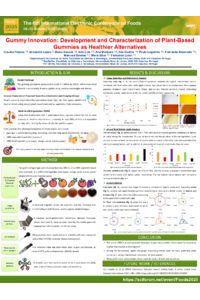
Faced with the global rise in sugar consumption linked to pathologies such as type 2 diabetes and obesity, there is an urgent need to develop healthier alternatives to standard sweets. This study aimed to develop plant-based gummies and evaluate their physical–chemical and sensory properties. A total of six gummy formulations were prepared using agar–agar (a gelling, thickening, and stabilizing agent of plant origin, derived from red algae), mixed with different beverage flavors: 100% vegetable-based beverage (coconut), or 100% fruit/vegetable juices (apple, grape, orange, tomato, carrot). The average transmittance in the visible spectra (450 - 650 nm) (assessed with a scanning spectrophotometric colorimeter in the visible region) demonstrated that coconut presented the highest values, which is a characteristic of its white color. A binocular magnifier was used to attain gummy images. The pH values (measured with a portable pH meter) varied between 3.42 and 7.09, with coconut flavored beverage presenting the highest value in comparison to the other formulations. The total soluble solids (assessed with a portable refractometer) show variations between 5 and 21 °Brix, with coconut and grape flavored beverages presenting the lowest and highest values, respectively. A sensory analysis with a hedonic scale was used to assess parameters such as color, aroma, firmness, texture, taste and sweetness. Color-wise, coconut and orange formulations presented the highest acceptance, and for aroma, coconut- and apple-flavored gummies received higher evaluations. On flavor and sweetness, grape and apple formulations were the most appreciated (to which total soluble solids may have contributed). Similar values in texture and firmness can be due to a homogeneous process in gummy formulations with agar. In conclusion, the use of 100% fruit and vegetable beverages in gummies provides a basis for innovation in plant-based product development.
Keywords
Agar
Gummies
Physicochemical properties
Plant based
Sensory analysis
Poster
Poster Pessoa 15-09-2025.pdf
Sensory profile of gluten-free breads formulated with Neltuma affinis powders
Effects of Physical and Drying Treatments on Near-Infrared Spectroscopic Characterization of Starch, Sucrose, and Protein Peaks in Ulva ohnoi with Respect to Model Spectra