Event submissions
Published
This submission belongs to the session E. Chemistry and Physicochemical Properties of the event The 6th International Electronic Conference on Foods
Published date
27 Oct, 2025
Academic Editor
'%3e%3cpath%20d='M12.6657%2010.9104C12.4185%2010.325%2012.0599%209.79327%2011.6097%209.34482C11.1609%208.89508%2010.6293%208.5365%2010.0442%208.28888C10.0389%208.28626%2010.0337%208.28495%2010.0285%208.28233C10.8446%207.69279%2011.3752%206.73249%2011.3752%205.64904C11.3752%203.8542%209.92103%202.39999%208.1262%202.39999C6.33136%202.39999%204.87715%203.8542%204.87715%205.64904C4.87715%206.73249%205.40774%207.69279%206.22393%208.28364C6.21869%208.28626%206.21345%208.28757%206.20821%208.29019C5.62129%208.5378%205.09463%208.89284%204.64265%209.34613C4.1929%209.79493%203.83432%2010.3266%203.58671%2010.9117C3.34345%2011.4845%203.21226%2012.0987%203.20023%2012.7209C3.19988%2012.7349%203.20233%2012.7488%203.20744%2012.7619C3.21255%2012.7749%203.22022%2012.7867%203.22998%2012.7968C3.23975%2012.8068%203.25142%2012.8147%203.26431%2012.8202C3.2772%2012.8256%203.29105%2012.8284%203.30504%2012.8284H4.09109C4.14874%2012.8284%204.19459%2012.7825%204.1959%2012.7262C4.2221%2011.7148%204.62823%2010.7676%205.34617%2010.0497C6.08899%209.30683%207.0755%208.89808%208.1262%208.89808C9.17689%208.89808%2010.1634%209.30683%2010.9062%2010.0497C11.6242%2010.7676%2012.0303%2011.7148%2012.0565%2012.7262C12.0578%2012.7838%2012.1037%2012.8284%2012.1613%2012.8284H12.9474C12.9613%2012.8284%2012.9752%2012.8256%2012.9881%2012.8202C13.001%2012.8147%2013.0126%2012.8068%2013.0224%2012.7968C13.0322%2012.7867%2013.0398%2012.7749%2013.0449%2012.7619C13.0501%2012.7488%2013.0525%2012.7349%2013.0522%2012.7209C13.0391%2012.0947%2012.9094%2011.4855%2012.6657%2010.9104ZM8.1262%207.9024C7.52486%207.9024%206.9589%207.6679%206.53312%207.24211C6.10733%206.81633%205.87283%206.25037%205.87283%205.64904C5.87283%205.0477%206.10733%204.48174%206.53312%204.05596C6.9589%203.63018%207.52486%203.39567%208.1262%203.39567C8.72753%203.39567%209.29349%203.63018%209.71927%204.05596C10.1451%204.48174%2010.3796%205.0477%2010.3796%205.64904C10.3796%206.25037%2010.1451%206.81633%209.71927%207.24211C9.29349%207.6679%208.72753%207.9024%208.1262%207.9024Z'%20fill='%235D1EE1'/%3e%3c/g%3e%3c/svg%3e) Joana Amaral
Joana AmaralCitation
Diana Daccak, Bárbara Barra, Cláudia Campos Pessoa, Inês Carmo Luís, Ana Coelho Marques, Ana Rita F. Coelho, Paulo Legoinha, Manuela Simões, Maria Manuela Silva, Fernando C. Lidon, Fernando H. Reboredo, Physicochemical Evaluation of Alternative and Conventional Flours: Toward Nutritional Diversification in the Flour-Based Industry, in Proceedings of The 6th International Electronic Conference on Foods, 28 October–30 October 2025, MDPI: Basel, Switzerland
Share
Email
Facebook
Twitter
LinkedIn
Physicochemical Evaluation of Alternative and Conventional Flours: Toward Nutritional Diversification in the Flour-Based Industry

Diana Daccak 1,2
'%3e%3cpath%20d='M12.6647%2010.9104C12.4176%2010.325%2012.0589%209.7933%2011.6088%209.34485C11.16%208.89511%2010.6283%208.53653%2010.0432%208.28891C10.038%208.28629%2010.0327%208.28498%2010.0275%208.28236C10.8437%207.69282%2011.3743%206.73252%2011.3743%205.64907C11.3743%203.85423%209.92005%202.40002%208.12522%202.40002C6.33038%202.40002%204.87618%203.85423%204.87618%205.64907C4.87618%206.73252%205.40677%207.69282%206.22296%208.28367C6.21772%208.28629%206.21248%208.2876%206.20724%208.29022C5.62031%208.53783%205.09365%208.89287%204.64167%209.34616C4.19192%209.79496%203.83334%2010.3266%203.58573%2010.9117C3.34247%2011.4846%203.21128%2012.0987%203.19925%2012.721C3.1989%2012.735%203.20135%2012.7489%203.20646%2012.7619C3.21157%2012.7749%203.21924%2012.7868%203.22901%2012.7968C3.23877%2012.8068%203.25045%2012.8148%203.26334%2012.8202C3.27623%2012.8256%203.29007%2012.8284%203.30406%2012.8284H4.09012C4.14776%2012.8284%204.19362%2012.7825%204.19493%2012.7262C4.22113%2011.7148%204.62726%2010.7676%205.34519%2010.0497C6.08802%209.30686%207.07452%208.89811%208.12522%208.89811C9.17592%208.89811%2010.1624%209.30686%2010.9052%2010.0497C11.6232%2010.7676%2012.0293%2011.7148%2012.0555%2012.7262C12.0568%2012.7839%2012.1027%2012.8284%2012.1603%2012.8284H12.9464C12.9604%2012.8284%2012.9742%2012.8256%2012.9871%2012.8202C13%2012.8148%2013.0117%2012.8068%2013.0214%2012.7968C13.0312%2012.7868%2013.0389%2012.7749%2013.044%2012.7619C13.0491%2012.7489%2013.0515%2012.735%2013.0512%2012.721C13.0381%2012.0947%2012.9084%2011.4856%2012.6647%2010.9104ZM8.12522%207.90243C7.52388%207.90243%206.95792%207.66793%206.53214%207.24215C6.10636%206.81636%205.87185%206.2504%205.87185%205.64907C5.87185%205.04773%206.10636%204.48177%206.53214%204.05599C6.95792%203.63021%207.52388%203.3957%208.12522%203.3957C8.72655%203.3957%209.29252%203.63021%209.7183%204.05599C10.1441%204.48177%2010.3786%205.04773%2010.3786%205.64907C10.3786%206.2504%2010.1441%206.81636%209.7183%207.24215C9.29252%207.66793%208.72655%207.90243%208.12522%207.90243Z'%20fill='%235D1EE1'/%3e%3c/g%3e%3c/svg%3e)
Bárbara Barra 3

Cláudia Campos Pessoa 1,2
Inês Carmo Luís 1,2

Ana Coelho Marques 1,2

Ana Rita F. Coelho 1,2

Paulo Legoinha 1,2
Manuela Simões 1,2

Maria Manuela Silva 1,2

Fernando C. Lidon 1,2

Fernando H. Reboredo 1,2
1. Departamento de Ciências da Terra, Faculdade de Ciências e Tecnologia, Universidade Nova de Lisboa, 2829-516 Caparica, Portugal
2. Centro de Investigação de Geobiociências, Geoengenharias e Geotecnologias (GeoBioTec), Faculdade de Ciências e Tecnologia, Universidade Nova de Lisboa, 2829-516 Caparica, Portugal
3. FCT-NOVA, Faculdade de Ciências e Tecnologia, Universidade Nova de Lisboa, 2829-516 Caparica, Portugal
Abstract
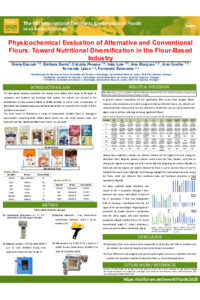
The flour-based industry constitutes the second most valued food sector in Portugal. As consumers seek healthier and functional food options, the industry has invested in the development of new products linked to health benefits. In recent years, the incorporation of alternative raw materials beyond conventional wheat flour has expanded the number of flours available to consumers.
This study aimed to characterize a range of commercially available flours in Portuguese hypermarkets, comprising seven refined flours (wheat, rice, oat, carob, almond, maize, and amaranth) and four wholemeal flours (oat, wheat, rye, and spelt). Each sample was analyzed for its colorimetric parameters (L*, a*, b*), moisture content, ash content, and concentrations of selected mineral elements (Ca, S, Fe, Mn, Mo, Zn, and Se). Mineral composition was assessed using X-ray fluorescence spectroscopy, with it being found that most of the mineral element concentrations did not significantly differ across flour samples. However, some exceptions were noted: manganese (Mn) was detected only in rice, almond, and wholewheat flour; selenium (Se) was only detected in wheat flour; and zinc (Zn) presented the highest value in oat flour (although this was not significant). Colorimetric values were obtained using visible-range scanning spectrophotometry. Carob flour showed distinct coloration, with the lowest L* value and the only positive a* value, indicating a darker reddish hue. Also, almond flour showed a particularly low moisture content and the highest ash level compared to that in the other alternative flours.
These differences highlight the potential of alternative flours to promote innovation in the food sector through healthy products based on their nutritional and physicochemical attributes.
Keywords
flours-based industry
mineral element
physicochemical properties
Poster
sciforum-131353.pdf
Effects of Physical and Drying Treatments on Near-Infrared Spectroscopic Characterization of Starch, Sucrose, and Protein Peaks in Ulva ohnoi with Respect to Model Spectra
Trypsin Inhibitory Activity and Protein Digestibility in Legume-Based Products Commercially Available in a Southern Brazilian City