Event submissions
Published
This submission belongs to the session B. Nutritional and Functional Foods of the event The 6th International Electronic Conference on Foods
Published date
27 Oct, 2025
Academic Editor
'%3e%3cpath%20d='M12.6657%2010.9104C12.4185%2010.325%2012.0599%209.79327%2011.6097%209.34482C11.1609%208.89508%2010.6293%208.5365%2010.0442%208.28888C10.0389%208.28626%2010.0337%208.28495%2010.0285%208.28233C10.8446%207.69279%2011.3752%206.73249%2011.3752%205.64904C11.3752%203.8542%209.92103%202.39999%208.1262%202.39999C6.33136%202.39999%204.87715%203.8542%204.87715%205.64904C4.87715%206.73249%205.40774%207.69279%206.22393%208.28364C6.21869%208.28626%206.21345%208.28757%206.20821%208.29019C5.62129%208.5378%205.09463%208.89284%204.64265%209.34613C4.1929%209.79493%203.83432%2010.3266%203.58671%2010.9117C3.34345%2011.4845%203.21226%2012.0987%203.20023%2012.7209C3.19988%2012.7349%203.20233%2012.7488%203.20744%2012.7619C3.21255%2012.7749%203.22022%2012.7867%203.22998%2012.7968C3.23975%2012.8068%203.25142%2012.8147%203.26431%2012.8202C3.2772%2012.8256%203.29105%2012.8284%203.30504%2012.8284H4.09109C4.14874%2012.8284%204.19459%2012.7825%204.1959%2012.7262C4.2221%2011.7148%204.62823%2010.7676%205.34617%2010.0497C6.08899%209.30683%207.0755%208.89808%208.1262%208.89808C9.17689%208.89808%2010.1634%209.30683%2010.9062%2010.0497C11.6242%2010.7676%2012.0303%2011.7148%2012.0565%2012.7262C12.0578%2012.7838%2012.1037%2012.8284%2012.1613%2012.8284H12.9474C12.9613%2012.8284%2012.9752%2012.8256%2012.9881%2012.8202C13.001%2012.8147%2013.0126%2012.8068%2013.0224%2012.7968C13.0322%2012.7867%2013.0398%2012.7749%2013.0449%2012.7619C13.0501%2012.7488%2013.0525%2012.7349%2013.0522%2012.7209C13.0391%2012.0947%2012.9094%2011.4855%2012.6657%2010.9104ZM8.1262%207.9024C7.52486%207.9024%206.9589%207.6679%206.53312%207.24211C6.10733%206.81633%205.87283%206.25037%205.87283%205.64904C5.87283%205.0477%206.10733%204.48174%206.53312%204.05596C6.9589%203.63018%207.52486%203.39567%208.1262%203.39567C8.72753%203.39567%209.29349%203.63018%209.71927%204.05596C10.1451%204.48174%2010.3796%205.0477%2010.3796%205.64904C10.3796%206.25037%2010.1451%206.81633%209.71927%207.24211C9.29349%207.6679%208.72753%207.9024%208.1262%207.9024Z'%20fill='%235D1EE1'/%3e%3c/g%3e%3c/svg%3e) Antonello Santini
Antonello SantiniCitation
Guilherme Soares Lapa Assis Assis, Olga Luisa Tavano, Raissa Leite Coelho, Arthur Amorim de Santana Marques, Lara Campos Borim, Trypsin Inhibitory Activity and Protein Digestibility in Legume-Based Products Commercially Available in a Southern Brazilian City, in Proceedings of The 6th International Electronic Conference on Foods, 28 October–30 October 2025, MDPI: Basel, Switzerland
Share
Email
Facebook
Twitter
LinkedIn
Trypsin Inhibitory Activity and Protein Digestibility in Legume-Based Products Commercially Available in a Southern Brazilian City
'%3e%3cpath%20d='M12.6647%2010.9104C12.4176%2010.325%2012.0589%209.7933%2011.6088%209.34485C11.16%208.89511%2010.6283%208.53653%2010.0432%208.28891C10.038%208.28629%2010.0327%208.28498%2010.0275%208.28236C10.8437%207.69282%2011.3743%206.73252%2011.3743%205.64907C11.3743%203.85423%209.92005%202.40002%208.12522%202.40002C6.33038%202.40002%204.87618%203.85423%204.87618%205.64907C4.87618%206.73252%205.40677%207.69282%206.22296%208.28367C6.21772%208.28629%206.21248%208.2876%206.20724%208.29022C5.62031%208.53783%205.09365%208.89287%204.64167%209.34616C4.19192%209.79496%203.83334%2010.3266%203.58573%2010.9117C3.34247%2011.4846%203.21128%2012.0987%203.19925%2012.721C3.1989%2012.735%203.20135%2012.7489%203.20646%2012.7619C3.21157%2012.7749%203.21924%2012.7868%203.22901%2012.7968C3.23877%2012.8068%203.25045%2012.8148%203.26334%2012.8202C3.27623%2012.8256%203.29007%2012.8284%203.30406%2012.8284H4.09012C4.14776%2012.8284%204.19362%2012.7825%204.19493%2012.7262C4.22113%2011.7148%204.62726%2010.7676%205.34519%2010.0497C6.08802%209.30686%207.07452%208.89811%208.12522%208.89811C9.17592%208.89811%2010.1624%209.30686%2010.9052%2010.0497C11.6232%2010.7676%2012.0293%2011.7148%2012.0555%2012.7262C12.0568%2012.7839%2012.1027%2012.8284%2012.1603%2012.8284H12.9464C12.9604%2012.8284%2012.9742%2012.8256%2012.9871%2012.8202C13%2012.8148%2013.0117%2012.8068%2013.0214%2012.7968C13.0312%2012.7868%2013.0389%2012.7749%2013.044%2012.7619C13.0491%2012.7489%2013.0515%2012.735%2013.0512%2012.721C13.0381%2012.0947%2012.9084%2011.4856%2012.6647%2010.9104ZM8.12522%207.90243C7.52388%207.90243%206.95792%207.66793%206.53214%207.24215C6.10636%206.81636%205.87185%206.2504%205.87185%205.64907C5.87185%205.04773%206.10636%204.48177%206.53214%204.05599C6.95792%203.63021%207.52388%203.3957%208.12522%203.3957C8.72655%203.3957%209.29252%203.63021%209.7183%204.05599C10.1441%204.48177%2010.3786%205.04773%2010.3786%205.64907C10.3786%206.2504%2010.1441%206.81636%209.7183%207.24215C9.29252%207.66793%208.72655%207.90243%208.12522%207.90243Z'%20fill='%235D1EE1'/%3e%3c/g%3e%3c/svg%3e)
Guilherme Soares Lapa Assis Assis 1

Olga Luisa Tavano 1
Raissa Leite Coelho 1
Arthur Amorim de Santana Marques 1

Lara Campos Borim 1
1. Faculty of Nutrition (FANUT), Federal University of Alfenas (UNIFAL-MG), Alfenas Campus, Alfenas, MG, 37130-001, Brazil
Abstract
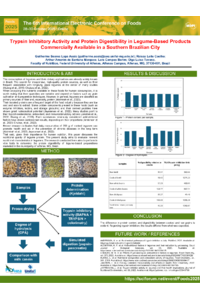
Plant-based protein diets have been increasingly promoted and adopted. Among the main sources of plant proteins are legumes, which are commonly consumed either as cooked grains or in processed forms. These legumes contain various proteins, including those known as protease inhibitors. Previously considered primarily as antinutritional factors, more recent studies have suggested that these compounds may offer health benefits, such as contributing to the prevention of colon cancer. Their presence at specific levels may, in fact, be desirable. Legume-based foods, even when subjected to thermal processing, retain some level of trypsin inhibitory activity. In this study, various legume-based foods available in markets or restaurants of a municipality in southeastern Brazil were analyzed. Samples were obtained either in ready-to-eat form or were prepared according to the instructions provided on their packaging. Following freeze-drying, protein content was determined, and in vitro protein digestibility was assessed using a sequential pepsin–pancreatin digestion method, followed by quantification of free alpha-amino groups. Trypsin inhibitory activity was evaluated using the BAPNA substrate. The analyzed samples included cooked beans (white, black, and brown varieties), chickpeas, and lentils, as well as aqueous extracts and preparations such as plant-based burgers. Raw seeds of the respective legumes were also analyzed for comparison. Trypsin inhibitory activity was detected in all samples, though with considerable variation (ranging from 447.09 to 15,000 TIU/g). Digestibility also varied substantially, ranging from 53.78% to 128.77% when expressed as a percentage relative to casein. No correlation was observed between trypsin inhibitory activity and digestibility values. The findings suggest that the inclusion of legume-based products in the diet provides a certain intake of protease inhibitors, which may confer health benefits. Furthermore, at the levels detected in this study, these inhibitors do not appear to negatively impact protein digestion in the analyzed samples.
Keywords
beans
lentils
chickpeas
protein digestibility
pulses.
Poster
poster.pdf
Physicochemical Evaluation of Alternative and Conventional Flours: Toward Nutritional Diversification in the Flour-Based Industry
Therapeutic Potential of Lemongrass Extract in Monosodium Glutamate-Induced Metabolic Disorders in Mice