Event submissions
Published
This submission belongs to the session A. Food Technology and Engineering of the event The 6th International Electronic Conference on Foods
Published date
27 Oct, 2025
Academic Editor
'%3e%3cpath%20d='M12.6657%2010.9104C12.4185%2010.325%2012.0599%209.79327%2011.6097%209.34482C11.1609%208.89508%2010.6293%208.5365%2010.0442%208.28888C10.0389%208.28626%2010.0337%208.28495%2010.0285%208.28233C10.8446%207.69279%2011.3752%206.73249%2011.3752%205.64904C11.3752%203.8542%209.92103%202.39999%208.1262%202.39999C6.33136%202.39999%204.87715%203.8542%204.87715%205.64904C4.87715%206.73249%205.40774%207.69279%206.22393%208.28364C6.21869%208.28626%206.21345%208.28757%206.20821%208.29019C5.62129%208.5378%205.09463%208.89284%204.64265%209.34613C4.1929%209.79493%203.83432%2010.3266%203.58671%2010.9117C3.34345%2011.4845%203.21226%2012.0987%203.20023%2012.7209C3.19988%2012.7349%203.20233%2012.7488%203.20744%2012.7619C3.21255%2012.7749%203.22022%2012.7867%203.22998%2012.7968C3.23975%2012.8068%203.25142%2012.8147%203.26431%2012.8202C3.2772%2012.8256%203.29105%2012.8284%203.30504%2012.8284H4.09109C4.14874%2012.8284%204.19459%2012.7825%204.1959%2012.7262C4.2221%2011.7148%204.62823%2010.7676%205.34617%2010.0497C6.08899%209.30683%207.0755%208.89808%208.1262%208.89808C9.17689%208.89808%2010.1634%209.30683%2010.9062%2010.0497C11.6242%2010.7676%2012.0303%2011.7148%2012.0565%2012.7262C12.0578%2012.7838%2012.1037%2012.8284%2012.1613%2012.8284H12.9474C12.9613%2012.8284%2012.9752%2012.8256%2012.9881%2012.8202C13.001%2012.8147%2013.0126%2012.8068%2013.0224%2012.7968C13.0322%2012.7867%2013.0398%2012.7749%2013.0449%2012.7619C13.0501%2012.7488%2013.0525%2012.7349%2013.0522%2012.7209C13.0391%2012.0947%2012.9094%2011.4855%2012.6657%2010.9104ZM8.1262%207.9024C7.52486%207.9024%206.9589%207.6679%206.53312%207.24211C6.10733%206.81633%205.87283%206.25037%205.87283%205.64904C5.87283%205.0477%206.10733%204.48174%206.53312%204.05596C6.9589%203.63018%207.52486%203.39567%208.1262%203.39567C8.72753%203.39567%209.29349%203.63018%209.71927%204.05596C10.1451%204.48174%2010.3796%205.0477%2010.3796%205.64904C10.3796%206.25037%2010.1451%206.81633%209.71927%207.24211C9.29349%207.6679%208.72753%207.9024%208.1262%207.9024Z'%20fill='%235D1EE1'/%3e%3c/g%3e%3c/svg%3e) Elsa Gonçalves
Elsa GonçalvesCitation
Dominika Opat, Krzysztof Dasiewicz, Iwona Szymańska, Effects of osmotic dehydration with ternary solutions on water loss and quality attributes of poultry meat, in Proceedings of The 6th International Electronic Conference on Foods, 28 October–30 October 2025, MDPI: Basel, Switzerland
Share
Email
Facebook
Twitter
LinkedIn
Effects of osmotic dehydration with ternary solutions on water loss and quality attributes of poultry meat

Dominika Opat 1

Krzysztof Dasiewicz 1

Iwona Szymańska 1
1. Department of Food Technology and Assessment, Institute of Food Science, Warsaw University of Life Sciences, Nowoursynowska St. 159c, 02-776 Warsaw, Poland
Abstract
Introduction
Osmotic dehydration is a mild, energy-efficient method for partial water removal, used to extend shelf life and preserve the quality of food. While traditionally performed with binary solutions (e.g., NaCl alone), recent studies suggest that ternary solutions—combining NaCl with maltose syrup—can improve mass transfer and product quality. However, this approach has not been extensively explored in poultry meat.
The aim of the study was to investigate the effect of osmotic dehydration using ternary solutions on selected quality attributes of poultry meat.
Methods
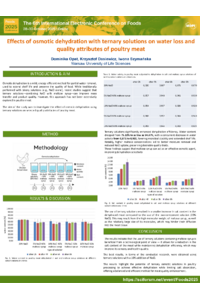
The research material consisted of chicken breast meat. Samples were subjected to osmotic dehydration using five different solutions: a binary solution of 20% NaCl and four ternary solutions combining 5% or 10% NaCl with either 40% or 60% maltose syrup. Beakers with the prepared solutions were placed in a refrigerated cabinet at 3 °C. Their contents were continuously mixed using magnetic stirrers, ensuring uniform distribution of both salt and maltose syrup throughout the solutions. Samples were collected before dehydration (0 h) and after 2, 4, 6, and 8 hours of immersion. At each time point, pH, moisture content, water activity (aw), and salt content were measured using standard physicochemical methods to evaluate mass transfer dynamics and quality changes.
Results and Conclusions
Ternary solutions significantly enhanced dehydration efficiency. Moisture content dropped from 75,22% to as low as 54,37%, with a concurrent decrease in water activity from 0,971 to 0,920, favoring microbial stability and extended shelf life. Notably, higher maltose concentrations led to better moisture removal and reduced NaCl uptake, preserving desirable quality traits.
The results highlight the potential of ternary osmotic solutions in poultry processing to achieve effective dehydration while limiting salt absorption, offering a balanced and efficient method for meat quality enhancement.
Keywords
osmotic dehydration
ternary solutions
poultry meat
Poster
D.Opat poster foods2025.pdf
IMPACT OF INNOVATIVE AGING TECHNIQUES ON THE PROFILE OF ROMANIAN PEAR BRANDY
Functional properties and antidiabetic effects of Moroccan bee pollen