Event submissions
Published
This submission belongs to the session B. Nutritional and Functional Foods of the event The 6th International Electronic Conference on Foods
Published date
27 Oct, 2025
Academic Editor
'%3e%3cpath%20d='M12.6657%2010.9104C12.4185%2010.325%2012.0599%209.79327%2011.6097%209.34482C11.1609%208.89508%2010.6293%208.5365%2010.0442%208.28888C10.0389%208.28626%2010.0337%208.28495%2010.0285%208.28233C10.8446%207.69279%2011.3752%206.73249%2011.3752%205.64904C11.3752%203.8542%209.92103%202.39999%208.1262%202.39999C6.33136%202.39999%204.87715%203.8542%204.87715%205.64904C4.87715%206.73249%205.40774%207.69279%206.22393%208.28364C6.21869%208.28626%206.21345%208.28757%206.20821%208.29019C5.62129%208.5378%205.09463%208.89284%204.64265%209.34613C4.1929%209.79493%203.83432%2010.3266%203.58671%2010.9117C3.34345%2011.4845%203.21226%2012.0987%203.20023%2012.7209C3.19988%2012.7349%203.20233%2012.7488%203.20744%2012.7619C3.21255%2012.7749%203.22022%2012.7867%203.22998%2012.7968C3.23975%2012.8068%203.25142%2012.8147%203.26431%2012.8202C3.2772%2012.8256%203.29105%2012.8284%203.30504%2012.8284H4.09109C4.14874%2012.8284%204.19459%2012.7825%204.1959%2012.7262C4.2221%2011.7148%204.62823%2010.7676%205.34617%2010.0497C6.08899%209.30683%207.0755%208.89808%208.1262%208.89808C9.17689%208.89808%2010.1634%209.30683%2010.9062%2010.0497C11.6242%2010.7676%2012.0303%2011.7148%2012.0565%2012.7262C12.0578%2012.7838%2012.1037%2012.8284%2012.1613%2012.8284H12.9474C12.9613%2012.8284%2012.9752%2012.8256%2012.9881%2012.8202C13.001%2012.8147%2013.0126%2012.8068%2013.0224%2012.7968C13.0322%2012.7867%2013.0398%2012.7749%2013.0449%2012.7619C13.0501%2012.7488%2013.0525%2012.7349%2013.0522%2012.7209C13.0391%2012.0947%2012.9094%2011.4855%2012.6657%2010.9104ZM8.1262%207.9024C7.52486%207.9024%206.9589%207.6679%206.53312%207.24211C6.10733%206.81633%205.87283%206.25037%205.87283%205.64904C5.87283%205.0477%206.10733%204.48174%206.53312%204.05596C6.9589%203.63018%207.52486%203.39567%208.1262%203.39567C8.72753%203.39567%209.29349%203.63018%209.71927%204.05596C10.1451%204.48174%2010.3796%205.0477%2010.3796%205.64904C10.3796%206.25037%2010.1451%206.81633%209.71927%207.24211C9.29349%207.6679%208.72753%207.9024%208.1262%207.9024Z'%20fill='%235D1EE1'/%3e%3c/g%3e%3c/svg%3e) Antonello Santini
Antonello SantiniCitation
Cristina Popovici, Xin Mei Teng, Ravi Jadeja, Moldavian consumer perceptions and preferences for plant-based food, in Proceedings of The 6th International Electronic Conference on Foods, 28 October–30 October 2025, MDPI: Basel, Switzerland
Share
Email
Facebook
Twitter
LinkedIn
Moldavian consumer perceptions and preferences for plant-based food

Cristina Popovici 1
'%3e%3cpath%20d='M12.6647%2010.9104C12.4176%2010.325%2012.0589%209.7933%2011.6088%209.34485C11.16%208.89511%2010.6283%208.53653%2010.0432%208.28891C10.038%208.28629%2010.0327%208.28498%2010.0275%208.28236C10.8437%207.69282%2011.3743%206.73252%2011.3743%205.64907C11.3743%203.85423%209.92005%202.40002%208.12522%202.40002C6.33038%202.40002%204.87618%203.85423%204.87618%205.64907C4.87618%206.73252%205.40677%207.69282%206.22296%208.28367C6.21772%208.28629%206.21248%208.2876%206.20724%208.29022C5.62031%208.53783%205.09365%208.89287%204.64167%209.34616C4.19192%209.79496%203.83334%2010.3266%203.58573%2010.9117C3.34247%2011.4846%203.21128%2012.0987%203.19925%2012.721C3.1989%2012.735%203.20135%2012.7489%203.20646%2012.7619C3.21157%2012.7749%203.21924%2012.7868%203.22901%2012.7968C3.23877%2012.8068%203.25045%2012.8148%203.26334%2012.8202C3.27623%2012.8256%203.29007%2012.8284%203.30406%2012.8284H4.09012C4.14776%2012.8284%204.19362%2012.7825%204.19493%2012.7262C4.22113%2011.7148%204.62726%2010.7676%205.34519%2010.0497C6.08802%209.30686%207.07452%208.89811%208.12522%208.89811C9.17592%208.89811%2010.1624%209.30686%2010.9052%2010.0497C11.6232%2010.7676%2012.0293%2011.7148%2012.0555%2012.7262C12.0568%2012.7839%2012.1027%2012.8284%2012.1603%2012.8284H12.9464C12.9604%2012.8284%2012.9742%2012.8256%2012.9871%2012.8202C13%2012.8148%2013.0117%2012.8068%2013.0214%2012.7968C13.0312%2012.7868%2013.0389%2012.7749%2013.044%2012.7619C13.0491%2012.7489%2013.0515%2012.735%2013.0512%2012.721C13.0381%2012.0947%2012.9084%2011.4856%2012.6647%2010.9104ZM8.12522%207.90243C7.52388%207.90243%206.95792%207.66793%206.53214%207.24215C6.10636%206.81636%205.87185%206.2504%205.87185%205.64907C5.87185%205.04773%206.10636%204.48177%206.53214%204.05599C6.95792%203.63021%207.52388%203.3957%208.12522%203.3957C8.72655%203.3957%209.29252%203.63021%209.7183%204.05599C10.1441%204.48177%2010.3786%205.04773%2010.3786%205.64907C10.3786%206.2504%2010.1441%206.81636%209.7183%207.24215C9.29252%207.66793%208.72655%207.90243%208.12522%207.90243Z'%20fill='%235D1EE1'/%3e%3c/g%3e%3c/svg%3e)
Xin Mei Teng 2,3
Ravi Jadeja 2,3
1. Department of Food and Nutrition, Faculty of Food Technology, Technical University of Moldova, 168 Stefan cel Mare si Sfant blvd., Chisinau, MD 2004, Republic of Moldova
2. Robert M. Kerr Food & Agricultural Products Center, Oklahoma State University, Stillwater, OK 74078, USA
3. Department of Animal & Food Sciences, Oklahoma State University, Stillwater, OK 74078, USA
Abstract
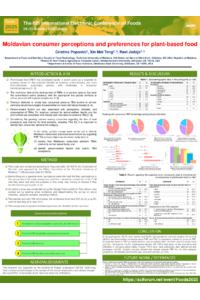
Plant-based food (PBF) has developed rapidly in recent years as a response to growing interest in sustainable options, with challenges in consumer beliefs/perceptions. In this study, opinion surveys were carried out to identify Moldavian consumers' perceived benefits/barriers regarding PBF. This study was conducted according to Regulation(EU) 2016/679, the Declaration of Helsinki, and approved by the Ethics Committee of the Technical University of Moldova (TUM) (protocol code 011/2024). Before filling out a questionnaire, participants were informed that their participation in the survey would be made anonymous and that it would be carried out at the TUM and they were told what the purpose of this study was, having to choose if they would voluntary participate or not. An online survey was conducted using the Google Forms platform. Recruitment was carried out by sending email invitations and disseminating the survey on social networks, using the snowball sampling method. The sample size was 186 valid cases, the confidence level was 95% (k=2), p=q=50, and the sampling error was 4.9%. The survey was composed of closed questions and divided into four sections: (1) participants' sociodemographic, economic, and diet factors; (2) perceived PBF knowledge and purchase intention; (3) perceived PBF barriers; and (4) perceived PBF benefits and market extension. Data were analysed with SAS 9.4 software (SAS Institute, USA). Of the participants, 69.7% were women and 63.5% had completed university studies. Consumers (88,9%) had intermediate knowledge about PBF and 79.6 % expressed a desire to consume PBF. An important factor in PBF purchase decision was its positive effect on health and the environment (p˂0.05). Participants (45,3%) experienced barriers with PBF's high price, its low availability and difficulties in changing eating habits. Popular PBFs were meat substitutes, dairy alternatives and beverages (p≤0.05). Conjoint analysis showed that interest towards PBF did not differ between genders but did between participants' age, education and diet (p˂0.05). Future studies for specific PBF groups may offer new outcomes in consumer perception studies.
Acknowledgments: This research was supported by the Institutional Project, subprogram 020405 “Optimizing food processing technologies in the context of the circular bioeconomy and climate change”, Bio-OpTehPAS, implemented at the Technical University of Moldova.
Keywords
Consumer perception
plant-based food
survey
Poster
Poster_ID_sciforum-134639_Consumer_Perceptions.pdf
Sequential Microwave-Ultrasound-Assisted Extraction and Optimization of Phenolic Compounds from Black Tea Waste
Use of Annurca Apple Peel Flour (Malus domestica) and Cherry Seed Oil in the Formulation of Enriched Crackers