Event submissions
Published
This submission belongs to the session A. Food Technology and Engineering of the event The 6th International Electronic Conference on Foods
Published date
27 Oct, 2025
Academic Editor
'%3e%3cpath%20d='M12.6657%2010.9104C12.4185%2010.325%2012.0599%209.79327%2011.6097%209.34482C11.1609%208.89508%2010.6293%208.5365%2010.0442%208.28888C10.0389%208.28626%2010.0337%208.28495%2010.0285%208.28233C10.8446%207.69279%2011.3752%206.73249%2011.3752%205.64904C11.3752%203.8542%209.92103%202.39999%208.1262%202.39999C6.33136%202.39999%204.87715%203.8542%204.87715%205.64904C4.87715%206.73249%205.40774%207.69279%206.22393%208.28364C6.21869%208.28626%206.21345%208.28757%206.20821%208.29019C5.62129%208.5378%205.09463%208.89284%204.64265%209.34613C4.1929%209.79493%203.83432%2010.3266%203.58671%2010.9117C3.34345%2011.4845%203.21226%2012.0987%203.20023%2012.7209C3.19988%2012.7349%203.20233%2012.7488%203.20744%2012.7619C3.21255%2012.7749%203.22022%2012.7867%203.22998%2012.7968C3.23975%2012.8068%203.25142%2012.8147%203.26431%2012.8202C3.2772%2012.8256%203.29105%2012.8284%203.30504%2012.8284H4.09109C4.14874%2012.8284%204.19459%2012.7825%204.1959%2012.7262C4.2221%2011.7148%204.62823%2010.7676%205.34617%2010.0497C6.08899%209.30683%207.0755%208.89808%208.1262%208.89808C9.17689%208.89808%2010.1634%209.30683%2010.9062%2010.0497C11.6242%2010.7676%2012.0303%2011.7148%2012.0565%2012.7262C12.0578%2012.7838%2012.1037%2012.8284%2012.1613%2012.8284H12.9474C12.9613%2012.8284%2012.9752%2012.8256%2012.9881%2012.8202C13.001%2012.8147%2013.0126%2012.8068%2013.0224%2012.7968C13.0322%2012.7867%2013.0398%2012.7749%2013.0449%2012.7619C13.0501%2012.7488%2013.0525%2012.7349%2013.0522%2012.7209C13.0391%2012.0947%2012.9094%2011.4855%2012.6657%2010.9104ZM8.1262%207.9024C7.52486%207.9024%206.9589%207.6679%206.53312%207.24211C6.10733%206.81633%205.87283%206.25037%205.87283%205.64904C5.87283%205.0477%206.10733%204.48174%206.53312%204.05596C6.9589%203.63018%207.52486%203.39567%208.1262%203.39567C8.72753%203.39567%209.29349%203.63018%209.71927%204.05596C10.1451%204.48174%2010.3796%205.0477%2010.3796%205.64904C10.3796%206.25037%2010.1451%206.81633%209.71927%207.24211C9.29349%207.6679%208.72753%207.9024%208.1262%207.9024Z'%20fill='%235D1EE1'/%3e%3c/g%3e%3c/svg%3e) Mohsen Gavahian
Mohsen GavahianCitation
Tania Doménech Valiente, Diana Vicente-Jurado, Purificación García-Segovia, Marta Igual, Jose-Manuel Catalá-Civera, Javier Martínez-Monzó, Microwave Drying of 3D-Printed Carrot Purée Using an Evanescent Wave Antenna, in Proceedings of The 6th International Electronic Conference on Foods, 28 October–30 October 2025, MDPI: Basel, Switzerland
Share
Email
Facebook
Twitter
LinkedIn
Microwave Drying of 3D-Printed Carrot Purée Using an Evanescent Wave Antenna
'%3e%3cpath%20d='M12.6647%2010.9104C12.4176%2010.325%2012.0589%209.7933%2011.6088%209.34485C11.16%208.89511%2010.6283%208.53653%2010.0432%208.28891C10.038%208.28629%2010.0327%208.28498%2010.0275%208.28236C10.8437%207.69282%2011.3743%206.73252%2011.3743%205.64907C11.3743%203.85423%209.92005%202.40002%208.12522%202.40002C6.33038%202.40002%204.87618%203.85423%204.87618%205.64907C4.87618%206.73252%205.40677%207.69282%206.22296%208.28367C6.21772%208.28629%206.21248%208.2876%206.20724%208.29022C5.62031%208.53783%205.09365%208.89287%204.64167%209.34616C4.19192%209.79496%203.83334%2010.3266%203.58573%2010.9117C3.34247%2011.4846%203.21128%2012.0987%203.19925%2012.721C3.1989%2012.735%203.20135%2012.7489%203.20646%2012.7619C3.21157%2012.7749%203.21924%2012.7868%203.22901%2012.7968C3.23877%2012.8068%203.25045%2012.8148%203.26334%2012.8202C3.27623%2012.8256%203.29007%2012.8284%203.30406%2012.8284H4.09012C4.14776%2012.8284%204.19362%2012.7825%204.19493%2012.7262C4.22113%2011.7148%204.62726%2010.7676%205.34519%2010.0497C6.08802%209.30686%207.07452%208.89811%208.12522%208.89811C9.17592%208.89811%2010.1624%209.30686%2010.9052%2010.0497C11.6232%2010.7676%2012.0293%2011.7148%2012.0555%2012.7262C12.0568%2012.7839%2012.1027%2012.8284%2012.1603%2012.8284H12.9464C12.9604%2012.8284%2012.9742%2012.8256%2012.9871%2012.8202C13%2012.8148%2013.0117%2012.8068%2013.0214%2012.7968C13.0312%2012.7868%2013.0389%2012.7749%2013.044%2012.7619C13.0491%2012.7489%2013.0515%2012.735%2013.0512%2012.721C13.0381%2012.0947%2012.9084%2011.4856%2012.6647%2010.9104ZM8.12522%207.90243C7.52388%207.90243%206.95792%207.66793%206.53214%207.24215C6.10636%206.81636%205.87185%206.2504%205.87185%205.64907C5.87185%205.04773%206.10636%204.48177%206.53214%204.05599C6.95792%203.63021%207.52388%203.3957%208.12522%203.3957C8.72655%203.3957%209.29252%203.63021%209.7183%204.05599C10.1441%204.48177%2010.3786%205.04773%2010.3786%205.64907C10.3786%206.2504%2010.1441%206.81636%209.7183%207.24215C9.29252%207.66793%208.72655%207.90243%208.12522%207.90243Z'%20fill='%235D1EE1'/%3e%3c/g%3e%3c/svg%3e)
Tania Doménech Valiente 1
Diana Vicente-Jurado 1,2
Purificación García-Segovia 1

Marta Igual 1
Jose-Manuel Catalá-Civera 2
Javier Martínez-Monzó 1
1. i-Food Group, Instituto Universitario de Ingeniería de Alimentos-FoodUPV, Universitat Politècnica de València, Valencia, 46022, Spain
2. Institute of Information and Communication Technologies (ITACA), Universitat Politècnica de València, Camino de Vera, 46022 Valencia, Spain
Abstract
INTRODUCTION
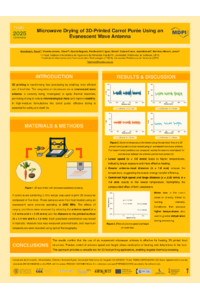
Three-dimensional printing is revolutionising food processing by enabling more efficient work with various food inks compared to other techniques. The integration of microwaves by means of an evanescent wave antenna is currently being investigated with the aim of applying a thermal treatment to food inks, favouring their drying to eliminate microbiological risks and ensure their stability. In formulations such as carrot purée, a high-water content necessitates efficient drying to ensure product stability and reduce the risk of contamination.
METHODS
A carrot purée formulated with 3.13% konjac was utilised to print three-dimensional structures consisting of five lines. Subsequently, the samples were subjected to heat treatment using an evanescent wave antenna operating at a centre frequency of 2490 MHz. The impact of varying experimental conditions was evaluated through the modulation of antenna speed (1.5 mm/s and 2.25 mm/s) and the distance between the antenna and the printed surface (1.0 mm and 1.2 mm). Each combination of parameters was tested in triplicate. The loss of moisture was determined by gravimetry, and the maximum temperature reached at each point of the sample was recorded by means of optical thermography.
RESULTS
The most favourable conditions were observed at the lowest antenna speed (1.5 mm/s) and shortest distance to the sample (1 mm), yielding the highest moisture loss (up to 35%) and a stable maximum temperature with minimal thermal fluctuations. In contrast, higher speeds resulted in greater temperature oscillations, leading to less uniform drying. Similarly, increasing the distance between the antenna and the carrot purée led to a reduction in maximum temperature during treatment, which in turn decreased moisture loss.
CONCLUSIONS
Evanescent microwave heating proved effective for the localised drying of carrot purée, with antenna speed and distance being critical to maximise moisture loss and ensure thermal uniformity.
Keywords
Carrot
3D food printing
moisture loss
drying.
Poster
Poster_Microwave Drying of 3D-Printed Carrot Purée Using an Evanescent Wave Antenna_TDV.pdf
A Biochar-Integrated Hydroponic Platform for Enhanced Microgreen Food Cultivation under Water-Limited Conditions
Bioinformatics-assisted peptidomic profiling of microalgal protein hydrolysates reveals novel multifunctional peptides for nutraceutical use