Event submissions
Published
This submission belongs to the session A. Food Technology and Engineering of the event The 6th International Electronic Conference on Foods
Published date
27 Oct, 2025
Academic Editor
'%3e%3cpath%20d='M12.6657%2010.9104C12.4185%2010.325%2012.0599%209.79327%2011.6097%209.34482C11.1609%208.89508%2010.6293%208.5365%2010.0442%208.28888C10.0389%208.28626%2010.0337%208.28495%2010.0285%208.28233C10.8446%207.69279%2011.3752%206.73249%2011.3752%205.64904C11.3752%203.8542%209.92103%202.39999%208.1262%202.39999C6.33136%202.39999%204.87715%203.8542%204.87715%205.64904C4.87715%206.73249%205.40774%207.69279%206.22393%208.28364C6.21869%208.28626%206.21345%208.28757%206.20821%208.29019C5.62129%208.5378%205.09463%208.89284%204.64265%209.34613C4.1929%209.79493%203.83432%2010.3266%203.58671%2010.9117C3.34345%2011.4845%203.21226%2012.0987%203.20023%2012.7209C3.19988%2012.7349%203.20233%2012.7488%203.20744%2012.7619C3.21255%2012.7749%203.22022%2012.7867%203.22998%2012.7968C3.23975%2012.8068%203.25142%2012.8147%203.26431%2012.8202C3.2772%2012.8256%203.29105%2012.8284%203.30504%2012.8284H4.09109C4.14874%2012.8284%204.19459%2012.7825%204.1959%2012.7262C4.2221%2011.7148%204.62823%2010.7676%205.34617%2010.0497C6.08899%209.30683%207.0755%208.89808%208.1262%208.89808C9.17689%208.89808%2010.1634%209.30683%2010.9062%2010.0497C11.6242%2010.7676%2012.0303%2011.7148%2012.0565%2012.7262C12.0578%2012.7838%2012.1037%2012.8284%2012.1613%2012.8284H12.9474C12.9613%2012.8284%2012.9752%2012.8256%2012.9881%2012.8202C13.001%2012.8147%2013.0126%2012.8068%2013.0224%2012.7968C13.0322%2012.7867%2013.0398%2012.7749%2013.0449%2012.7619C13.0501%2012.7488%2013.0525%2012.7349%2013.0522%2012.7209C13.0391%2012.0947%2012.9094%2011.4855%2012.6657%2010.9104ZM8.1262%207.9024C7.52486%207.9024%206.9589%207.6679%206.53312%207.24211C6.10733%206.81633%205.87283%206.25037%205.87283%205.64904C5.87283%205.0477%206.10733%204.48174%206.53312%204.05596C6.9589%203.63018%207.52486%203.39567%208.1262%203.39567C8.72753%203.39567%209.29349%203.63018%209.71927%204.05596C10.1451%204.48174%2010.3796%205.0477%2010.3796%205.64904C10.3796%206.25037%2010.1451%206.81633%209.71927%207.24211C9.29349%207.6679%208.72753%207.9024%208.1262%207.9024Z'%20fill='%235D1EE1'/%3e%3c/g%3e%3c/svg%3e) Elsa Gonçalves
Elsa GonçalvesCitation
Antonella Estefania Bergesse, Alexis Damián Barbero, Maria Elizabeth Oroná, Leonardo Gabriel Vera, Nelson Rubén Grosso, Valeria Nepote, Microencapsulation of peanut skin polyphenols: application of peanut protein isolate as encapsulating agent, in Proceedings of The 6th International Electronic Conference on Foods, 28 October–30 October 2025, MDPI: Basel, Switzerland
Share
Email
Facebook
Twitter
LinkedIn
Microencapsulation of peanut skin polyphenols: application of peanut protein isolate as encapsulating agent
'%3e%3cpath%20d='M12.6647%2010.9104C12.4176%2010.325%2012.0589%209.7933%2011.6088%209.34485C11.16%208.89511%2010.6283%208.53653%2010.0432%208.28891C10.038%208.28629%2010.0327%208.28498%2010.0275%208.28236C10.8437%207.69282%2011.3743%206.73252%2011.3743%205.64907C11.3743%203.85423%209.92005%202.40002%208.12522%202.40002C6.33038%202.40002%204.87618%203.85423%204.87618%205.64907C4.87618%206.73252%205.40677%207.69282%206.22296%208.28367C6.21772%208.28629%206.21248%208.2876%206.20724%208.29022C5.62031%208.53783%205.09365%208.89287%204.64167%209.34616C4.19192%209.79496%203.83334%2010.3266%203.58573%2010.9117C3.34247%2011.4846%203.21128%2012.0987%203.19925%2012.721C3.1989%2012.735%203.20135%2012.7489%203.20646%2012.7619C3.21157%2012.7749%203.21924%2012.7868%203.22901%2012.7968C3.23877%2012.8068%203.25045%2012.8148%203.26334%2012.8202C3.27623%2012.8256%203.29007%2012.8284%203.30406%2012.8284H4.09012C4.14776%2012.8284%204.19362%2012.7825%204.19493%2012.7262C4.22113%2011.7148%204.62726%2010.7676%205.34519%2010.0497C6.08802%209.30686%207.07452%208.89811%208.12522%208.89811C9.17592%208.89811%2010.1624%209.30686%2010.9052%2010.0497C11.6232%2010.7676%2012.0293%2011.7148%2012.0555%2012.7262C12.0568%2012.7839%2012.1027%2012.8284%2012.1603%2012.8284H12.9464C12.9604%2012.8284%2012.9742%2012.8256%2012.9871%2012.8202C13%2012.8148%2013.0117%2012.8068%2013.0214%2012.7968C13.0312%2012.7868%2013.0389%2012.7749%2013.044%2012.7619C13.0491%2012.7489%2013.0515%2012.735%2013.0512%2012.721C13.0381%2012.0947%2012.9084%2011.4856%2012.6647%2010.9104ZM8.12522%207.90243C7.52388%207.90243%206.95792%207.66793%206.53214%207.24215C6.10636%206.81636%205.87185%206.2504%205.87185%205.64907C5.87185%205.04773%206.10636%204.48177%206.53214%204.05599C6.95792%203.63021%207.52388%203.3957%208.12522%203.3957C8.72655%203.3957%209.29252%203.63021%209.7183%204.05599C10.1441%204.48177%2010.3786%205.04773%2010.3786%205.64907C10.3786%206.2504%2010.1441%206.81636%209.7183%207.24215C9.29252%207.66793%208.72655%207.90243%208.12522%207.90243Z'%20fill='%235D1EE1'/%3e%3c/g%3e%3c/svg%3e)
Antonella Estefania Bergesse 1,2
Alexis Damián Barbero 1,3
Maria Elizabeth Oroná 1,4
Leonardo Gabriel Vera 1,3
Nelson Rubén Grosso 1,4
Valeria Nepote 1,3
1. Instituto Multidisciplinario de Biología Vegetal - Consejo Nacional de Investigaciones Científicas y Técnicas (IMBIV-CONICET), 5000, Córdoba Argentina
2. Departamento de Agroalimentos, Facultad de Ciencias Agropecuarias, Universidad Nacional de Córdoba (FCA-UNC), 5000, Córdoba, Argentina
3. Facultad de Ciencias Exactas, Físicas y Naturales - Universidad Nacional de Córdoba (FCEFyN-UNC), 5000, Córdoba, Argentina
4. Facultad de Ciencias Agropecuarias - Universidad Nacional de Córdoba (FCA-UNC), 5000, Córdoba, Argentina
Abstract
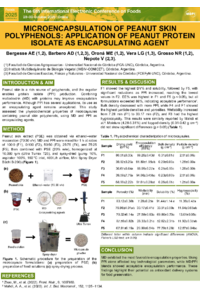
Peanut skin is a rich source of polyphenols, and an expeller enables protein isolate (PPI) production. Combining maltodextrin (MD) with proteins may improve encapsulation performance. Although PPI has several applications, its use as an encapsulating agent remains unexplored. This study assessed the physicochemical properties of microcapsules containing peanut skin polyphenols, using MD and PPI as encapsulating agents. The polyphenol extract (PSE) was obtained via ethanol–water maceration (70:30 v/v). MD and PPI were mixed for 1 h at ratios of 100:0 (F1), 0:100 (F2), 50:50 (F3), 25:75 (F4), and 75:25 (F5), then combined with PSE (20% w/w), homogenized at 10,000 rpm (Ultra Turrax T25), and spray-dried (pump 10%, aspirator 100%, 160 °C inlet, 400 L/h airflow, Mini Spray Dryer Büchi B-290). Drying yield, encapsulation efficiency, moisture content, bulk, particle, and tapped densities, porosity, wettability, solubility, and hygroscopicity were analyzed. Statistical analysis: ANOVA and Fisher’s LSD test (α = 0.05). F1 showed the highest drying yield (80.52%) and solubility (91.45%), followed by F5 (69% and 77.8%), with significant reductions as PPI increased, reaching the lowest values in F2 (38.92% and 33.51%). Encapsulation efficiency was highest in F1 (99.26%) and F5 (97.61%) (p < 0.05), but all formulations exceeded 88%, indicating acceptable performance. Bulk density decreased with more PPI, while F4 (75% PPI) and F1 (100% MD) showed the highest particle densities and porosities. Wettability increased from 7.28 min (F1) to 33.17 min (F2), and F3 had the highest hygroscopicity (13%). Moisture and tapped density showed no significant differences. MD exhibited the most favorable encapsulation properties. Using PPI alone affected key technological parameters, while MD:PPI blends showed acceptable encapsulation performance. These findings highlight their potential as antioxidant delivery systems for food preservation.
Keywords
microcapsules
peanut skin
antioxidant
protein isolate
maltodextrin
Poster
Póster Foods BERGESSE 2025.pdf
Influence of the combined application of lemon essential oil and UV-C radiation on the sensory quality of minimally processed rocket
Exploiting green lentil processing by-products as a novel source of nourishment through ultrafiltration